Get Full Government Meeting Transcripts, Videos, & Alerts Forever!
Get email alerts on the Mega Tax Credits topic
No spam. Unsubscribe anytime.
Subcommittee hears overview of Michigan MEGA tax credits; members press for transparency on liabilities and verification
Summary
House Oversight Subcommittee received a briefing from the House Fiscal Agency on the Michigan Economic Growth Authority (MEGA) refundable tax-credit program, its remaining liability, and verification controls. Members urged more disclosure and questioned how the state verifies company claims used to certify credits.
The House Oversight Subcommittee on Corporate Subsidies and State Investments heard a briefing March 12, 2025, about the Michigan Economic Growth Authority refundable tax-credit program and its remaining fiscal liability.
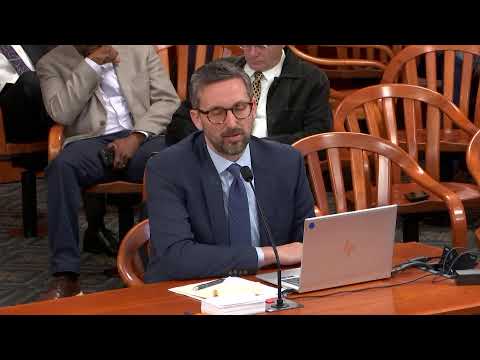
Ben Gilchick, Associate Director with the House Fiscal Agency, told the panel the MEGA program was established in 1995 to attract and retain jobs and capital investment. He said MEGA credits are refundable, performance-based awards that in some cases were awarded for up to 20 years and that refunds reduce net business-tax revenues when credits exceed tax liability.
"Our overarching mission is to provide objective, nonpartisan expertise to the House of Representatives on legislative fiscal matters," Gilchick said in opening remarks, describing the House Fiscal Agency’s role in analyzing the program and its revenue impacts.
Gilchick summarized key facts: retention credits account for about two-thirds of MEGA’s total award value; roughly two-thirds of the program’s value was awarded between February 2008 and 2011; MEGA agreements were discontinued in 2011 when the Michigan Business Tax (MBT) was replaced for many taxpayers by the corporate income tax (CIT); and existing MEGA credits can still be claimed by businesses filing under the legacy MBT through the credits’ expiration. He provided recent estimates from the Annual MEGA and Other Certificated Credits report: a total lifetime MEGA award estimate of about $9.4 billion and roughly $3.0 billion in outstanding certificated-credit value expected to be claimed through the end of the program, with redemptions affecting state revenues through fiscal year 2032.
Committee members focused on verification, public access to underlying data and revenue forecasting. Vice Chair Green asked whether 2011 marked the transition from the old system to the current tax structure; Gilchick confirmed 2011 marked replacement of the MBT and that previously awarded credits continued to be claimable under the MBT filing mechanics.
Minority Vice Chair Wigela pressed about which entities negotiate agreements and whether the statute or practice allowed delayed redemption. Gilchick said the agreements operate within the statutory framework, that the Michigan Strategic Fund (previously the MEGA board) approved awards, and that procedures for certification, verification by MEDC staff, and Treasury refunds are part of the process. He noted that earlier forecasting underestimated credit values by not accounting for wage, health-care and investment growth and that changes in the late 2000s and 2010s sought to improve estimating and limit amendments that increased credit liability.
Members asked whether House Fiscal or the committee could review company-level filings to compare taxes paid under MBT versus what companies ultimately receive from credits. Gilchick said individual taxpayer filings are private; House Fiscal does not receive company-level tax returns and would need to coordinate with the Department of Treasury and the Michigan Economic Development Corporation (MEDC) for whatever information they can provide.
Wigela cited a 2017 Auditor General finding that, in some audits, MEGA recipients had created or retained fewer jobs than agreed (48% of standard new jobs, 39% of high-tech jobs; 83% of retained jobs in the 2017 sample). She also referenced external studies that estimated high per-job subsidy costs. Committee members requested follow-up on what publicly available information exists and whether redacted data could be provided to improve legislative oversight.
The committee recorded one formal action at the start of the meeting: Representative Bierlein moved to approve the minutes of the March 5 meeting; hearing no objection, the minutes were approved. The committee heard no other formal motions during the MEGA briefing and adjourned after questions and next-step discussion.