Get Full Government Meeting Transcripts, Videos, & Alerts Forever!
Get email alerts on the Economic Development topic
No spam. Unsubscribe anytime.
MEDC urges sustained funding for Make It in Michigan strategy; requests talent teams, site readiness and Pure Michigan support
Summary
Quentin Messer, MEDC chief executive and economic competitiveness officer, presented the agency’s FY26 priorities to the House appropriations subcommittee, emphasizing the Make It in Michigan strategy (people, places, projects), one-time talent action teams, ongoing business attraction and community revitalization funding, and Pure Michigan.
Quentin Messer, chief executive and economic competitiveness officer for the Michigan Economic Development Corporation, told the House appropriations subcommittee the MEDC’s FY26 priorities center on a three-part Make It in Michigan strategy focused on people, places and projects.
Messer said MEDC’s regional support teams work across 10 prosperity regions to connect districts with business development, community revitalization, small business supports and manufacturing assistance. “Economic development matters because people matter,” Messer said, summarizing the agency’s approach.
He presented FY24 accomplishments and the administration’s FY26 requests. Messer described one-time and ongoing funding priorities the agency recommends to the legislature: - One-time requests: $10 million for Talent Action Teams (industry-led teams to identify workforce needs and training pipelines), $10 million for small business support hubs/co-ops, and other targeted one-time investments to catalyze local projects. - Ongoing requests: continuation of a $100 million business attraction and community revitalization line (described as a workhorse program for attracting and retaining companies and revitalizing sites), support for the Pure Michigan marketing program at $16 million with up to $10 million in matching funds, and near-$10 million for the Michigan Arts and Culture Council; $15.65 million for entrepreneurship and innovation programs; and $5.5 million for the Michigan Office of Defense and Aerospace Innovation.
Messer highlighted results MEDC attributes to previous funding: support for almost 14,000 small businesses, leveraged private investment the presentation cited as about $11.1 billion in FY24, nearly 1,100 interns placed and over 3,000 people trained and hired through MEDC programs. He said MEDC-supported placemaking and site readiness work produced significant local leverage and that the agency partners with MSHDA and other state agencies to complete capital stacks for development projects.
Members asked about outcomes from recent trade and outreach trips. Representative Van Werkom asked what direct investments had resulted from the governor’s recent overseas travel; Messer said MEDC is in active follow-up with overseas delegations and cited specific announced investments tied to past outreach efforts (Nel Hydrogen after a trip to Norway/Switzerland and a project tied to the Paris Air Show).
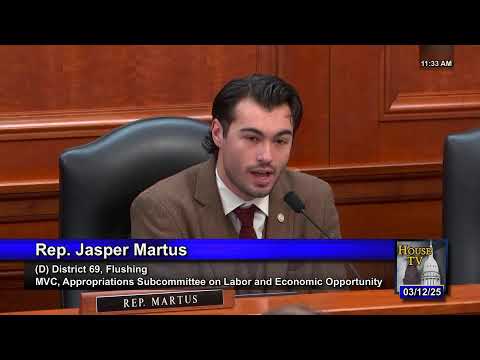
Representative Martis asked about the status of a large potential investment in Genesee County and whether recent federal actions could affect that project; Messer said the state continues to consider the Flint/Genesee site among the strongest in North America, that federal deliberations are ongoing, and that MEDC remains engaged with the region and prospective investors.
Messer closed by reiterating the Make It in Michigan priorities and noted MEDC staff will continue engagement with committee members and districts on those initiatives.