Get Full Government Meeting Transcripts, Videos, & Alerts Forever!
Get email alerts on the Employee Wellness topic
No spam. Unsubscribe anytime.
Escambia County employee relations trainer leads ‘Working With Yourself’ wellness session for staff
Summary
Lincoln McDonald, an employee relations trainer for Escambia County, led an internal staff training titled “Working With Yourself” that covered self-image, physical health, emotional regulation, finances, time management and self-control.
Lincoln McDonald, an employee relations trainer for Escambia County, led an internal staff training titled “Working With Yourself” that covered self-image, body care, emotional regulation, finances, time management and self-control.
McDonald opened by saying, “The purpose of this training is to teach you how to swim in the currents of life,” and structured the roughly 50-minute presentation around actions attendees can take on hydration, exercise, sleep and habits to support workplace performance and personal well-being.
The session’s central argument was practical: aligning mind, body and habits supports professional functioning. McDonald described self-image as “the core of who we believe we are,” and presented it as a cycle in which identity shapes behavior, which in turn shapes experience and then reinforces identity. He urged staff to change behavior to change self-image rather than expect quick, instant personality shifts.
On bodily health, McDonald gave concrete recommendations: drink about "6 to 8 glasses of water per day," aim for about 150 minutes of moderate physical activity per week (roughly 30 minutes most days), and target seven to eight hours of sleep nightly. He cited broad population-level concerns — noting that more than 40 percent of adults 20 and older are classified as obese and that many adults are physically inactive — to underline the health risks tied to inactivity, poor sleep and diet.
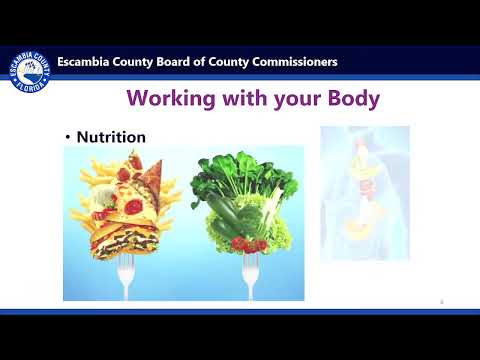
McDonald summarized simple nutrition guidance (more fruits and vegetables, less saturated fat and added sugars) and described calories as energy that must be balanced with physical activity. On sleep he quoted Mayo Clinic recommendations such as maintaining a regular sleep schedule, avoiding late caffeine or alcohol and creating a quiet, cool, dark sleeping environment.
Turning to the mind, McDonald discussed mindset effects (placebo/nocebo), meditation, hypnotism and the role of beliefs and self-talk in shaping behavior. He described emotional intelligence components — self-awareness, self-regulation, motivation, social awareness and social skills — and tied them to workplace outcomes such as engagement and productivity.
The training addressed common barriers to action: procrastination (which he said affects 20 to 25 percent of adults worldwide), cravings rooted in evolutionary biology (fat, salt, sugar), and modern convenience and marketing pressures that exploit those cravings. He recommended concrete time-management strategies: estimate task time, round up estimates, create plans and eliminate distractions; he warned that multitasking dilutes attention.
McDonald emphasized self-control strategies including adopting an internal locus of control where appropriate, building habits deliberately ("habit is what keeps you going"), and using self-talk and self-suggestion to reinforce desired behavior. He also encouraged staff to think of past selves as teachers and to use the concept of future self to motivate responsible choices.
He closed by reminding attendees that county employees and their dependents have access to the employee assistance program and that "you and your dependents get 3 free sessions per year." A handout referenced during the session included a worksheet with exercises on self-image, body care, cravings, finances, time management and self-control and attendees were told a follow-up survey would be distributed.
The presentation was informational and prescriptive in tone; no formal county actions, votes or policy changes were proposed or taken during the session.