Get Full Government Meeting Transcripts, Videos, & Alerts Forever!
Get email alerts on the Regulation Insurance topic
No spam. Unsubscribe anytime.
DIFS budget overview highlights fee-funded structure; committee flagged large licensed-agent roll
Summary
The subcommittee received a high-level presentation of the Department of Insurance and Financial Services (DIFS) fiscal 2025 budget, including one-time studies and the observation that the state's licensed-agent registry contains many long-standing licenses that inflate apparent counts.
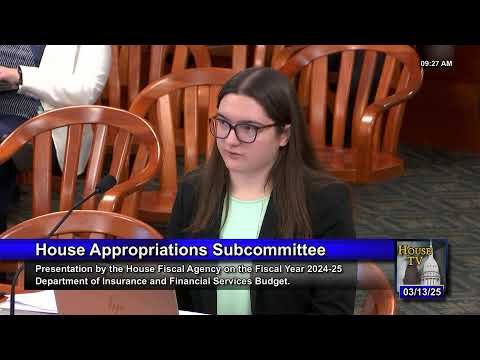
Una Yakupovich, the House fiscal analyst for Insurance and Financial Services, presented the fiscal 2025 budget for the Department of Insurance and Financial Services (DIFS) and explained the department's funding structure and recent one-time appropriations.
Yakupovich said DIFS has about $78.6 million in gross appropriations for the fiscal year, of which roughly $77.2 million is state-restricted revenue derived primarily from license and regulatory fees. She said DIFS receives virtually no general-fund support in 2025 and that roughly 87% of the department's budget supports the Insurance Financial Services Regulation unit, which handles regulatory and consumer-service activities.
Yakupovich highlighted two one-time appropriations in DIFS's budget: $250,000 for an automobile-insurance study examining the effects of 2019 no-fault reform with a report due Sept. 30, 2025, and $250,000 for a consumer outreach campaign to inform residents how to file complaints and pursue health insurance appeals.
Committee members discussed the number of licensed insurance agents and the cost of maintaining registrations. Yakupovich noted that the number of licensed agents and agencies increased, while mortgage licensees declined. During later clarification, the chair of the subcommittee said that many licenses remain active indefinitely: once a license is purchased it remains on the state's register unless administratively removed, inflating the count of active licenses relative to the number of practitioners. Yakupovich and the chair suggested the department needs to evaluate registry maintenance costs and the accuracy of the license counts.
Yakupovich also reviewed historical budget drivers for DIFS, including earlier funding changes related to no-fault reforms and the elimination of the autism coverage fund. She said FTE authorizations have risen about 7% over five years with similar increases in gross appropriations. Yakupovich reiterated that about 98% of DIFS's budget is state restricted and identified five primary restricted fund sources that supply about 90% of the department's restricted revenue, largely from the insurance sector.
Yakupovich closed by offering to take questions and reminding members that department leaders would appear in forthcoming hearings to provide more granular detail.