Get Full Government Meeting Transcripts, Videos, & Alerts Forever!
Get email alerts on the State Budget topic
No spam. Unsubscribe anytime.
House subcommittee hears LARA budget; MIDC grants drive recent increases
Summary
House Appropriations Subcommittee members heard a high-level presentation of the Licensing and Regulatory Affairs (LARA) fiscal 2025 budget, including a large increase in Michigan Indigent Defense Commission (MIDC) grants and discussions about nursing home oversight and program transfers.
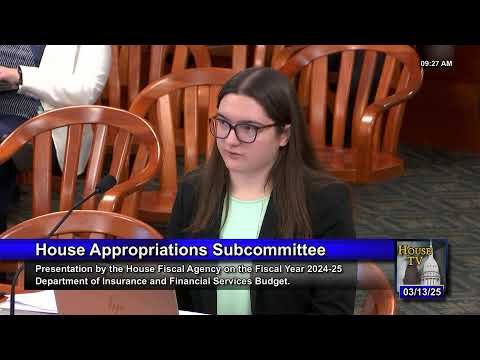
Una Yakupovich, the House fiscal analyst for Licensing and Regulatory Affairs and Insurance and Financial Services, told the House Appropriations Subcommittee on License and Regulatory Affairs and Insurance and Financial Services on the department's fiscal 2025 budget and long-term funding trends.
Yakupovich said the department's enacted appropriations for 2025 total about $648.7 million, roughly 48% of which comes from the general fund and about 43% from state-restricted sources such as license fees and fines. She said roughly $308.6 million is general fund and about $282 million is state restricted. Yakupovich identified a large driver of recent general-fund growth as increased grants distributed by the Michigan Indigent Defense Commission (MIDC).
The MIDC, Yakupovich said, received about $3.1 million for commission operations and approximately $258.3 million for local indigent defense grants in the current fiscal year. Yakupovich described the MIDC grants as intended to help local systems meet newly approved minimum standards for indigent defense, including attorney assignment and client access to private meeting space.
Committee members asked how statutory requirements shape grant distribution. Representative Donnie Steele asked whether the grants shown on the department's slide (firefighter training, liquor law enforcement, remonumentation, and utility consumer representation) are statutorily mandated. Yakupovich answered that the firefighter training, liquor law enforcement reimbursements, remonumentation, and utility consumer representation grants are statutorily required and have at least some required funding levels; other grants may be discretionary.
Representative Donovan McKinney asked what state oversight exists for nursing homes. Yakupovich identified the Bureau of Community and Health Systems within LARA as the bureau that oversees related facilities but said she did not have detailed operational answers and offered to follow up with the department. McKinney also asked whether funding for inspections and oversight of nursing homes was included in a Republican-passed House budget the prior week; Yakupovich said she did not have that information on hand and noted the budget process includes placeholder language before details are finalized.
Yakupovich also reviewed LARA's program structure and highlighted key units: occupational regulation (about half of authorized FTEs), the Michigan Public Service Commission, the Liquor Control Commission (MLCC), the Cannabis Regulatory Agency (CRA), the Office of Administrative Hearings and Rules, and several grant programs. She said about 84% of LARA general-fund appropriations support MIDC grants and that the department's FTE changes between 2022 and 2024 were driven largely by additions for nursing-home surveyors and cannabis regulatory staff. Yakupovich noted childcare licensing was moved out of LARA into MiLEAP in 2025, contributing to a year-to-year FTE decline.
Yakupovich listed several recurring grant programs funded in the current year, including $2.3 million for firefighter training grants, $9.9 million for liquor law enforcement reimbursements, $3 million for marijuana operation oversight grants, $6.8 million for remonumentation of public land survey corners, $1 million for urban search and rescue, and $2.1 million for utility consumer representation grants administered by the Utility Consumer Participation Board within the Public Service Commission. She said the public-safety and regulatory workload supported by federal funds is concentrated in the Bureau of Survey and Certification, which performs federal survey duties on behalf of the Centers for Medicare and Medicaid Services.
Yakupovich closed by noting several one-time appropriations in the 2025 budget, including a five-year energy waste reduction study required of the Public Service Commission and one-time funding for smoke detector distribution, renewable energy grants, and juvenile indigent defense grants. She invited committee members to ask follow-up questions during forthcoming department-level presentations.
Yakupovich's slides and comments provided the presentation-level overview; she repeatedly offered to provide more detailed departmental answers during subsequent department appearances before the subcommittee.