Get Full Government Meeting Transcripts, Videos, & Alerts Forever!
Get email alerts on the Land Division Housing topic
No spam. Unsubscribe anytime.
Committee hears bill to allow up to 10 land divisions to increase buildable lots
Summary
A House committee heard testimony on House Bill 4081, which would raise the number of land divisions allowed under the Land Division Act from four to 10 and let local jurisdictions allow more, a change proponents say will free up lots for housing and opponents warn could create survey, infrastructure and environmental problems.
Representative DeBoer presented House Bill 4081 on the Michigan House Committee on Regulatory Reform, saying the bill would amend the Land Division Act to increase the number of allowable parcel splits from four to 10 and permit local governments by ordinance to allow even more.
DeBoer said the change is "the first small step" to address Michigan's housing shortage by freeing up parcels that currently lie unused because they cannot be split under the existing statute. He told the committee the bill preserves local control over lot size, frontage and depth-to-width ratios and includes a delayed effective date "July 1, 2026" to give jurisdictions time to adopt ordinances.
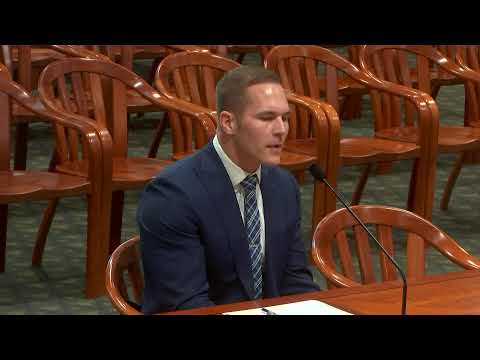
Supporters at the hearing argued the bill would add flexibility for local officials and developers. Sean Cecil of Michigan Realtors said the proposal "create[s] flexibility in property division and put[s] another tool in the toolbox of local government to work with developers on cost savings for new housing," and stressed that zoning rules — lot sizes, setbacks and use restrictions — would still apply. Erica Farley, executive director of the Rental Property Owners Association of Michigan, and Andrew Kuhn of the Apartment Association of Michigan testified that Michigan faces a housing shortfall and rising costs for construction, labor and insurance that hamper new building and renovation.
Opponents urged caution and changes. Brett Hollandsworth of the Michigan Society of Professional Surveyors (MSPS) testified that, while MSPS shares the goal of more efficient land division, the bill as written could cause "significant unintended consequences," including gaps and overlaps in parcel boundaries, strain on infrastructure, shifting development costs to taxpayers and environmental risks. Hollandsworth noted the Land Division Act currently allows only tentative parcel maps with approximate dimensions and does not always require surveys, and warned the risk of boundary errors grows as the number of splits increases.
Committee members pressed both sides on technical details. Members asked whether the subdivision act differs from the land division rules, how local minimum parcel-size ordinances would interact with a mandate to allow more splits, and whether surveys should be required as a precondition for approvals. Hollandsworth said the land division application "does not specifically require" a survey and that inconsistent local requirements have led to ambiguous legal descriptions and, ultimately, to gaps and overlaps in property lines.
No vote on House Bill 4081 was recorded in the transcript. The committee heard testimony from proponents and opponents and questioned witnesses on implementation details, legal descriptions, infrastructure impacts and consumer protections.
The hearing included multiple stakeholders — state associations of surveyors, realtors, rental-property owners and apartment operators — who framed the bill as balancing faster creation of buildable lots against the need for accurate surveys, infrastructure planning and local review.
The committee recessed without a recorded decision on HB 4081; further consideration or amendments may be scheduled at a later meeting.