Get Full Government Meeting Transcripts, Videos, & Alerts Forever!
Get email alerts on the Treasury Boilerplate topic
No spam. Unsubscribe anytime.
Treasury boilerplate review: deletions of reports, changes to gaming earmarks and new one‑time items including $25M for Detroit arc‑wire removal
Summary
Milo Knausson of the Department of Treasury briefed the House Appropriations Committee on recommended FY26 Treasury boilerplate changes, report deletions, and several one‑time appropriations.
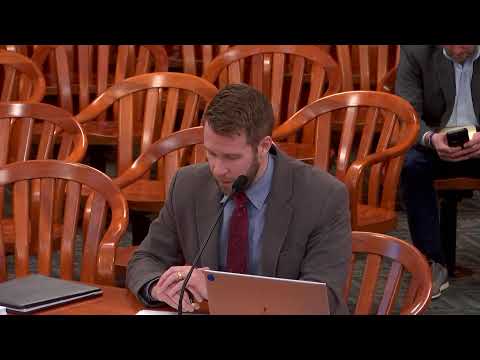
Milo Knausson of the Department of Treasury reviewed proposed FY26 boilerplate changes and one‑time appropriations during the House Appropriations Committee on General Government meeting.
Knausson told the committee the governor’s recommended budget would delete several reporting and boilerplate requirements in Treasury’s section, update receive‑and‑expend language tied to bonding programs moved to line items, and remove a number of specific reporting requirements that had been added in recent budget cycles. "This first change is between the current year and fiscal year 26 recommended budget," he said, describing deletions of reports that had tracked refinancing of bonds and annual debt‑service changes, and the removal of an RFP requirement for secondary placement collection services added in a prior budget.
Knausson also described program‑level changes inserted or revised since FY23. Notable items he identified were the separation of the $34.4 million CVT allocation (the FY25 three‑factor allocation) into its own line item, updated distributions for Internet sports betting and Internet gaming funds with higher earmarks to the compulsive gaming prevention fund, and deletion of some election reserve language that had appeared in earlier House bills. He summarized several report deletions tied to new statutory or line‑item arrangements (for example, receive‑and‑expend authority moved with bonding-related line items) and the recommended deletion of boilerplate deemed unenforceable, such as a nonbinding intent language about financial independence teams coordinating school fiscal distress responses.
Knausson also noted several one‑time appropriations in the governor’s proposal. He cited a proposed $3,000,000 Michigan Financial Empowerment program and a proposed $25,000,000 appropriation for arc‑wire removal in Detroit with specific stipulations attached to that appropriation. He described changes at the Michigan Gaming Control Board section to codify how Internet sports betting and Internet gaming revenues are split and to increase earmarks to the compulsive gaming prevention fund (Knausson said prior $500,000 earmarks would be increased to $1,000,000 and $3,000,000 respectively).
Committee members asked for context on some deletions; Knausson said he did not have reasons for every recommended deletion and suggested the committee follow up with Treasury staff as boilerplate decisions are finalized. The presentation concluded without formal votes; the committee moved on to other business and adjourned.