Get Full Government Meeting Transcripts, Videos, & Alerts Forever!
Get email alerts on the Revenue Sharing topic
No spam. Unsubscribe anytime.
House panel hears overview of state revenue sharing, history and recent formula changes
Summary
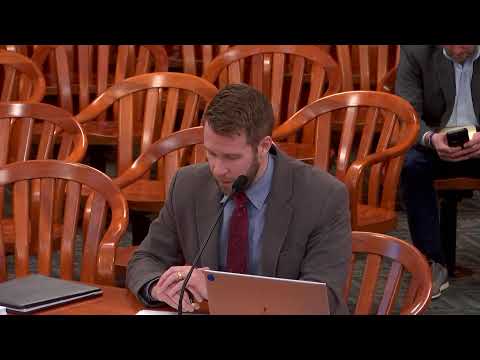
Ben Gilchick, a House Fiscal Agency analyst, told the House Appropriations Committee on General Government that state revenue sharing consists of constitutional and statutory payments that together provide direct, largely unrestricted funding to Michigan local governments.
Ben Gilchick, a House Fiscal Agency analyst, told the House Appropriations Committee on General Government that state revenue sharing consists of constitutional and statutory payments that together provide direct, largely unrestricted funding to Michigan local governments. "Revenue sharing includes payments to 280 cities, 253 villages, 1,240 townships, and 83 counties," Gilchick said, and he noted that the state constitution requires that 48.97% of state spending from state sources be paid to local units of government.
The briefing focused on how constitutional revenue sharing — a per‑capita share derived from 15% of sales tax collections at the 4% base rate — differs from statutory revenue sharing, which has changed forms over time (including EVIP and the later CVT revenue sharing). Gilchick summarized decades of changes, the mid‑2000s reductions that removed statutory payments for many local units, and the FY25 appropriations that restored broader CVT payments and introduced a three‑factor formula to distribute a $34.4 million increase.
Why it matters: combined constitutional and statutory revenue sharing is a major source of flexible local funding that supports police, fire, public works, and other municipal services across roughly 1,856 local units (cities, villages, townships and counties combined). Changes to formulas and one‑time supplements alter how much money individual municipalities receive, affecting budgets and service decisions at the local level.
Gilchick walked committee members through the history and recent numbers. He said constitutional revenue sharing payments—based on actual sales tax collections and distributed bimonthly—were roughly $1.1 billion in FY24 and were forecast to decline about 2.5% in FY25 before a modest rebound in FY26. On statutory revenue sharing, he traced the shift from a full‑funding earmark (described as 74.94% of 21.3% of the sales tax at the 4% rate in historical materials) through the EVIP (Economic Vitality Incentive Program) changes in FY12 and the later CVT revenue sharing structure adopted in FY15.
Gilchick provided fiscal details from the briefing: EVIP reduced funding from about $315 million (FY11 statutory level) to roughly $210 million in FY12 and imposed compliance conditions; CVT revenue sharing later returned some payments to more units and in FY25 totaled approximately $333.5 million (an 11.5% increase). Under FY25 provisions, roughly $299.1 million was distributed based on prior eligibility and shares, while $34.4 million was allocated using the three‑factor formula (inverse taxable value per capita, weighted population by unit type, and a yield equalization factor designed to help low‑tax‑capacity/high‑tax‑effort jurisdictions).
Gilchick also summarized county revenue sharing history: counties do not receive constitutional payments; they received statutory payments and, after a 2005 policy change, many created reserve funds and withdrew annual amounts in lieu of statutory payments until those reserves were exhausted. CARES Act funds were used in 2020 to backfill COVID‑era reductions (Gilchick cited examples such as a $43.5 million midyear cut that was backfilled with roughly $67.6 million of CARES support on a 1.5x basis). For FY25, counties received a $30 million increase distributed using only the inverse taxable value factor. The county incentive program (with its accountability and transparency conditions) was eliminated in FY25, though the requirement that some increases be deposited into pension systems for units with unfunded pension liabilities remained.
Committee members pressed for additional detail on specific local impacts and implementation questions. Representative Matic said he had examined FY25 per‑capita distributions in a cluster of municipalities and cited figures including "Addison Township, $103 per person; Bloomfield, $109; Commerce, $96; Groveland Township, $109; Highland, $110; Springfield Township, $109;" and noted Milford at about $67 per person — roughly 40% less than adjacent townships. Gilchick responded that those differences stem from how constitutional and statutory components combine and from how the FY25 three‑factor formula allocated the $34.4 million, and he said he would review and compare the specific local numbers for the representative.
Representatives also asked about two implementation topics Gilchick did not fully answer from the briefing: whether the Department of Treasury would have sufficient staff funding and capacity to process payments if a budget omitted Treasury staffing, and a request for historical data on the pension deposit requirement's effect on unfunded liabilities. Gilchick said he would look into the pension‑deposit history and produce comparative data; he did not provide a definitive answer on Treasury staffing and processing capacity.
The presentation closed with members requesting follow‑up detail. Gilchick agreed to provide comparisons for the per‑capita examples raised by Representative Matic and to gather context on the pension deposit amounts and timing. The committee then moved to the next agenda item.