Get Full Government Meeting Transcripts, Videos, & Alerts Forever!
Get email alerts on the Economic Development topic
No spam. Unsubscribe anytime.
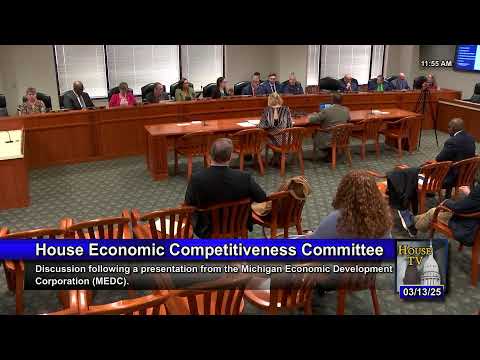
MEDC presents 'Make It in Michigan' strategy emphasizing people, places and projects
Summary
Director Quentin Messer and MEDC chief growth officer Hillary Doe told the House Committee on Economic Competiveness that the 'Make It in Michigan' strategy focuses on talent, placemaking and project readiness and highlighted program results and metrics including job gains, leveraged private investment and talent-campaign interest.
Director Quentin Messer, director of the Michigan Economic Development Corporation, told the House Committee on Economic Competitiveness that MEDC’s Make It in Michigan economic development strategy centers on three pillars: people, places and projects.
The nut graf: Messer and Hillary Doe, the agency’s chief growth officer and chief marketing officer, told legislators that the integrated approach aims to align workforce development, community revitalization and business attraction tools so companies can both recruit and retain talent and scale production in Michigan.
Messer said MEDC organizes work across 10 prosperity regions and partners with local economic development organizations, small business development centers, the Michigan Manufacturing Technology Center and 20 entrepreneurial “smart zones” to tailor assistance by region. “We are not trying to dictate from Lansing,” Messer said, describing regional teams that support local partners.
On the people pillar, Hillary Doe described talent programs including the Michigan Talent Solutions Division, an AI-driven career portal tied to a talent-attraction campaign and the Michiganders Scholars Program for top engineering and tech students linked to mobility, semiconductor and aerospace employers. Doe said the campaign produced 27,000 people who “got all the way down the funnel” and expressed interest in living and working in Michigan in about 18 months of operation.
On places, MEDC highlighted Michigan Main Streets and other placemaking programs. Messer and Doe said Michigan Main Streets placemaking projects in fiscal 2024 are projected to leverage roughly $3.9 billion in private investment and reactivate about 6.4 million square feet of public space. They said community revitalization awards and brownfield tax-increment financing have been combined to support mixed‑use projects, citing a redevelopment in Marquette anchored by a brewery and four new housing units.
On projects, MEDC described the Michigan Business Development Program, a recurring business attraction and community revitalization (BACR) budget line the presenters said is $100 million annually, strategic site‑readiness work, small business lending and targeted supports for manufacturing and technology. Messer said Michigan added about 46,000 jobs in MEDC’s focus industries between 2021 and 2024 and that, in absolute numbers, that gain ranked fifth nationally and first in the Midwest for those industries.
Messer also outlined MEDC’s role in aligning state tools with anticipated federal industrial policy, including potential CHIPS-related opportunities. He described the agency as a recommending body: MEDC evaluates and recommends projects while the Michigan Strategic Fund and other public processes provide final approvals. “MEDC only recommends projects. The Michigan Strategic Fund Board approves,” Messer said.
Committee members asked about practical navigation of MEDC programs. Messer invited legislators to bring MEDC to local town halls and company visits, and said the agency’s external affairs staff can serve as a concierge for legislators to connect constituents with appropriate programs. Doe and Messer offered to run follow‑up briefings, including a walkthrough of the MEDC website’s program pages.
Ending: Messer and Doe left legislators with further materials and contact information and offered to return for follow-ups. Committee members thanked the presenters and moved to adjourn, with the committee approving prior minutes by unanimous consent earlier in the session.