Get Full Government Meeting Transcripts, Videos, & Alerts Forever!
Get email alerts on the Nonprofit Voter Registration Industry topic
No spam. Unsubscribe anytime.
Researcher tells committee nonprofit voter-registration network funneled large sums to partisan consultants, raised concerns about foreign funding and IRS rules
Summary
Parker Thayer of the Capital Research Center testified that a nationwide nonprofit voter-registration ecosystem channels large dollars to partisan consulting firms and said groups including Everybody Votes, the Voter Participation Center and the Voter Registration Project have paid millions to Democratic consulting firms.
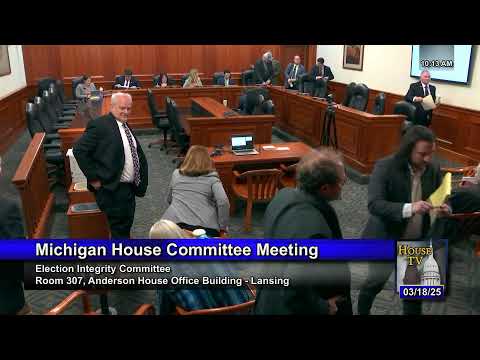
Parker Thayer, a researcher with the Capital Research Center, told a Michigan House committee that the nonprofit voter-registration industry is large and in many cases financially tied to partisan consulting firms. Thayer described organizational networks, funding flows and examples his research flagged as inconsistent with 501(c)(3) restrictions on partisan activity.
Thayer said national estimates of the "voter-registration ecosystem" range from roughly $760 million to about $1 billion in annual revenue. He said the Voter Registration Project (VRP) reported on its IRS Form 990 paying GBI Strategies more than $2.5 million in 2020 for "voter registration consulting," and he argued that the VRP and its public-facing Everybody Votes campaign were created with partisan aims despite presenting as nonpartisan charities.
Thayer detailed additional examples: that the Everybody Votes network reported roughly $47 million in 2023; that the Everybody Votes campaign claims to have registered about 7,000,000 voters over its lifetime; and that the Voter Participation Center (VPC) has used demographic "include" and "exclude" filters in social-media ads, which the witness argued targeted likely Democratic audiences while excluding others. He cited other contested payments and fines noted in public records and reporting: a $12 million grant from the Center for Election Innovation and Research to the Michigan Center for Election Law and Administration in 2020 (the witness said most of that money went to Democratic consulting firms, with about $9.7 million to Waterfront Strategies and about $2 million to Alper Strategies); the VPC's reported payments of $17.8 million to Michigan Control and $40 million to the Pivot Group; and a $300,000 fine against the New Georgia Project for partisan activity.
Thayer described historical context (the Tax Reform Act of 1969 tightened charitable-sector electioneering rules) and warned of a foreign-interference vector he said exists because 501(c)(3) groups can accept foreign funding while PACs cannot. "If a foreign government wanted to interfere," he said, "they could write a large check to a nonprofit that promises to do nonpartisan registration in targeted areas." He recommended closing perceived loopholes, increasing transparency of grantees and examining payments from nonprofits to for-profit consulting firms.
Committee members asked questions. Representative Song pressed Thayer on alternatives to nonprofits conducting registration work; Thayer suggested that PACs, political parties or private citizens could run registration drives without 501(c)(3) tax subsidies. Representative Fox asked about the scale of registration counts and whether Thayer could verify headline numbers; Thayer replied he had not independently verified every registration-count claim but said the fundraising and payment flows to partisan vendors were documented in tax filings and other records.
Thayer offered to provide additional documentation and to answer written questions for the record.