Get Full Government Meeting Transcripts, Videos, & Alerts Forever!
Get email alerts on the Geologic Resources Management topic
No spam. Unsubscribe anytime.
EGLE division outlines orphan‑well work, groundwater database and push for Class VI primacy
Summary
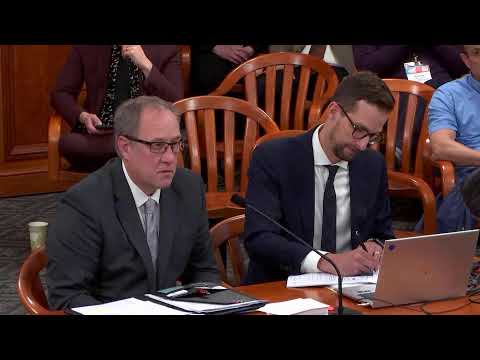
Adam Weigant, director of EGLE's Geologic Resources Management Division, told a House appropriations subcommittee the division is using federal grants and state funding to plug orphan oil and gas wells, build a statewide groundwater data system and pursue state primacy for Class VI underground injection wells for carbon sequestration.
Chair Cabot convened the House Appropriations Subcommittee on Environment, Great Lakes, and Energy and approved minutes for March 4 before hearing a presentation from Adam Weigant, director of the Geologic Resources Management Division at the Michigan Department of Environment, Great Lakes, and Energy (EGLE).
Weigant told the committee the division manages roughly 15 regulatory programs covering oil and gas, gas storage, disposal wells, mining and large water withdrawals and that the work increasingly relies on one-time federal grants. “We regulate things cradle to grave with respect to the oil and gas industry,” he said, describing the division's long record of oversight and program changes to address legacy wells.
The division highlighted three near-term priorities: completing orphan‑well work funded by federal grants and state appropriations; building a Groundwater Data Management System and monitoring network to support water‑withdrawal assessments; and pursuing state primacy for EPA's Class VI underground injection control program for carbon capture and sequestration projects.
Orphan wells and federal funding Weigant said Michigan's orphan‑well program, funded in part by an oil and gas severance tax and recent federal grants, plugs wells when no responsible operator exists. He said the state's long-standing orphan program has plugged roughly 396 wells with state severance revenue before recent federal support and that the Infrastructure Investment and Jobs Act provided multiple federal tranches that expanded work to about 240 sites in the first year of a large federal grant. A later tranche slowed after the Department of the Interior added requirements tied to the Endangered Species Act and the National Historic Preservation Act, he said, limiting last year's work to roughly 25 sites while the department awaits further guidance.
Weigant described typical and extreme plugging costs: recently active conventional Antrim wells can be plugged for about $20,000, while complex, hard‑to‑access or older orphan wells can cost from roughly $100,000 to $1,000,000 per well depending on access and site complexity. He said many wells currently cost in the tens or hundreds of thousands of dollars to remediate and that the division is prioritizing sites under available federal formula and matching grants.
Groundwater data and water‑withdrawal assessments Weigant described a new Groundwater Data Unit and a Water Assessment Unit moved under the division to improve modeling and data access. He said EGLE is building a Michigan hydrogeologic framework with updated geologic mapping, new monitoring networks and a public Groundwater Data Management System to feed modelers and support the Water Withdrawal Assessment Tool and permitting decisions.
He summarized the water‑withdrawal process: registrations through the assessment tool for lower‑risk withdrawals, site‑specific reviews when a potential adverse resource impact appears, and Part 327 permits for very large withdrawals (for example, withdrawals above statutory thresholds). The division has elevated modeling staff and aims for more science‑based, transparent reviews.
Mining, storage and other emerging uses Weigant reviewed Michigan's mining footprint, including two active iron mines, the Eagle Mine and other nonferrous activity, and sand dune mining sites regulated since the 1970s. He described an Upper Peninsula Geologic Repository located at the former K.I. Sawyer site in Gwinn that houses drill core and now co‑locates Michigan Geologic Survey staff.
He also flagged emerging technologies that may not fit existing regulatory boxes: carbon capture, compressed air energy storage, pumped hydro in mine workings, geothermal and hydrogen projects. For underground natural gas storage, EGLE co‑regulates intrastate facilities with the Public Service Commission and works with PHMSA for interstate facilities.
Pursuit of Class VI primacy and next steps EGLE has a $1.9 million EPA grant to pursue Class VI primacy for carbon sequestration wells and said it will use the funds to draft administrative rules and prepare a primacy application requiring governor and attorney general letters. Weigant said adopting the federal Class VI framework in state law would streamline EPA's review and that, if the state has "all our ducks in a row," approval could take roughly six months to a year after formal submission. He noted West Virginia was recently awarded primacy and that the department is coordinating with stakeholders on authorizing legislation.
Questions from committee members Representatives asked about EGLE's interactions with the Department of Natural Resources on wells on state land; Weigant said staff meet regularly with DNR's Forest Resources and Mineral Management sections to align operations and expectations. Rep. Price asked what would happen if EGLE lacked funding; Deputy Director Travis Boscol responded that the division's work is funded by a combination of federal grants, industry fees and some general fund support, and that those fees and statutes continue to provide some program funding while appropriations determine the department's spending authority. Committee members also asked about the repository location (Gwinn), the Gay Stamp Sands abandoned mine issue in the Upper Peninsula, and estimates for plugging costs and timelines.
Votes at a glance Representative Rob Markkanen moved to approve the March 4 minutes; there were no objections and the minutes were approved by unanimous consent.
Ending Weigant said the division will continue to press on orphan‑well work, finalize water‑management improvements and pursue Class VI primacy while adapting to emerging technologies and funding opportunities. The subcommittee adjourned after questions.