Get Full Government Meeting Transcripts, Videos, & Alerts Forever!
Get email alerts on the Foster Care And Kinship Care topic
No spam. Unsubscribe anytime.
Michigan officials outline kinship expansion, proposed FY2026 foster-care investments
Summary
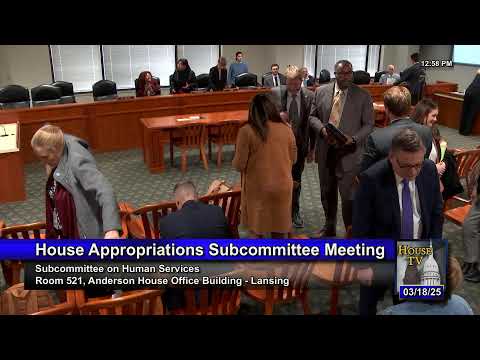
Michigan Department of Health and Human Services (MDHHS) officials told the House Appropriations Subcommittee on Human Services that the department is prioritizing kinship care and proposed a $24 million increase in the Fiscal Year 2026 executive budget to expand kinship supports, professional foster placements and other foster-care services.
Michigan Department of Health and Human Services (MDHHS) officials told the House Appropriations Subcommittee on Human Services that the department is prioritizing kinship care and proposed a $24 million increase in the Fiscal Year 2026 executive budget to expand kinship supports, professional foster placements and other foster-care services.
Demetrius Starling, senior deputy director for the Children’s Services Administration, told the committee the department receives roughly 175,000 child protective services complaints a year and currently has about 10,000 children in foster care, with roughly half placed in kinship settings. “We have around 175,000 CPS complaints on a yearly basis,” Starling said, adding that kinship placements now account for about 50% of foster placements in Michigan.
The proposed FY2026 investments described by Amy Eppke, senior deputy director over financial operations, include a $24 million increase for kinship-focused work; a pilot for 30 paid professional foster parents to serve children with complex needs; expanded behavioral and physical health services for adopted children and families; a proposal to redirect Social Security benefits for children in foster care into the child’s account while replacing those services with general fund dollars; and statewide expansion of Family Impact Teams from 23 counties to all 83 counties, a shift MDHHS says will be cost-neutral by moving staff currently on the Pathways to Potential program.
Why it matters: state officials, private providers and kinship caregivers all told the committee that keeping children with relatives or trusted “fictive kin” when safe is linked to greater placement stability, fewer missing-child incidents and faster permanency. Private providers warned, however, that higher clinical acuity among the children who remain in foster care strains workforce capacity and agency budgets.
Most important facts and context
- MDHHS officials said about 10,000 children are currently in foster care in Michigan and that roughly 50% of those children are placed with kin. Starling noted that in fiscal year 2019 there were about 17,000 children in foster care.
- MDHHS cited several programmatic accomplishments: licensing more than 800 new foster homes in fiscal year 2024; raising the percentage of youth matched with an adoptive family to about 90%; using HopSkipDrive to remove transportation barriers so children can remain in their schools; and strengthening information sharing with the Michigan State Police to reduce missing-youth rates to under 1% (the national average is about 4%), Starling said.
- Kinship policy and pilots: Michigan was described by MDHHS staff as among the first states to implement separate licensing standards for kinship providers and to adopt a “kin-first” approach. MDHHS said it has a kinship advisory council, regional kinship support workers in pilot counties, a kinship navigation process using the MSU Kinship Care Resource Center, and a Kin Care pilot funded by a Children’s Bureau grant and other partners.
- Outcomes from a private agency pilot: Nicole Lawson of Orchards Children’s Services and Kelsey Wistowski described the Kinship Connections pilot, which began June 2022. Orchards reported the pilot served 608 children for family finding, averaging more than 32 connections identified per child, with 77 children placed with relatives or fictive kin. Of 62 families supported by the pilot, Orchards said only four children had to be removed from those placements.
- Provider and caregiver perspectives: Deb Frisbie, a kinship caregiver and steering member of the Michigan Kinship Care Coalition (MKCC), told the committee that an estimated 50,000 Michigan children live with kinship caregivers outside the formal child-welfare system and that many of those families face barriers accessing supports such as the TANF child-only grant, mental-health services and other concrete assistance. Samaritas executives warned that although overall numbers of children in care fell during rapid reunification in the pandemic, the children who remain in care are showing higher levels of trauma and clinical need, increasing demands on foster caregivers and provider staff.
Questions and areas of uncertainty
- Funding totals: Representative Roth and other members asked about a $30 million federal figure referenced during the meeting; MDHHS staff said they would double-check that figure. Amy Eppke described the executive budget proposal as including a $24 million increase for kinship work in FY2026.
- Professional foster-parent criteria: Representative Beeson asked why the proposed pilot’s paid foster parents would be required to be licensed, trained and hold a bachelor’s degree. MDHHS officials said the requirement was designed specifically for a small cohort of paid, professional caregivers who would serve children with “extreme and adverse” behavioral and medical needs; MDHHS emphasized that the bachelor’s-degree requirement is tied to that specialized pilot rather than to traditional foster-parent licensure.
- Child Caring Institutions (CCIs): Representative Edwards asked whether children would lack placements because CCIs were not funded in the proposed budget. MDHHS replied that CCI funding continues into 2026, that contracts were restructured and that MDHHS has CCI contracts for about 560 beds (described in the meeting as “560 kids”), and that the funding to maintain those placements is included in 2026.
What providers and caregivers asked the committee to do
- Improve outreach and identification of kinship families outside the formal system so those caregivers can access existing programs (TANF child-only grants, child care, mental-health and substance-use services, housing supports).
- Preserve funding for foster-care services and for the workforce that supports high-acuity children; several private providers said current funding has not kept pace with inflation and rising care needs.
- Continue and scale programs that prioritize family-based placements and family-finding work, including the Kinship Connections pilot, kinship support workers, kinship navigation and family resource centers.
Quotes
- “We have around 175,000 CPS complaints on a yearly basis,” Demetrius Starling, senior deputy director for MDHHS Children’s Services Administration, told the committee.
- “Keeping kids safe is absolutely a top priority for the department,” Amy Eppke, senior deputy director over financial operations, said when summarizing the proposed budget initiatives.
- “It’s much easier for [children] to be able to go into someone’s home that they’ve already been in before,” Kelsey Wistowski, program officer for placement services at Orchards Children’s Services, said when describing kinship placements.
- “It would just take…training and support,” Deb Frisbie told the committee about the help kinship caregivers need to navigate benefits and services; she urged the state to assign knowledgeable points of contact for families who do not enter formal child-welfare pathways.
Next steps and committee follow-up
Committee members asked MDHHS to confirm the $30 million federal figure referenced in public testimony and to provide current counts for children in CCI placements. MDHHS and private providers emphasized ongoing collaboration to scale kinship supports while maintaining capacity to care for children with the highest clinical needs.
Ending
Committee members concluded the hearing after a Q&A session and invited continued follow-up from MDHHS and provider partners; MDHHS staff agreed to return with clarifications on the federal funding question and placement counts.