Get Full Government Meeting Transcripts, Videos, & Alerts Forever!
Get email alerts on the Qvf Transparency topic
No spam. Unsubscribe anytime.
Witness tells House committee MichiganQVF shows registration anomalies, urges transaction logs and transparency
Summary
A presenter cited large registration surges, duplicate ballots and third-party access to MichiganQualified Voter File (QVF) during testimony to a House committee, and called for transaction logs, user audit files and improved HAVA-compliant controls.
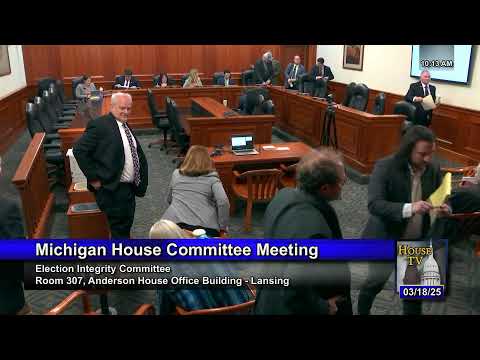
At a Michigan House committee hearing, a testifier identified in the record as Mr. Kayala told committee members that the stateQualified Voter File (QVF) and county registration records show irregularities including large unanticipated registration increases in Muskegon County, duplicate absentee ballots, and third-party write access to the QVF.
Mr. Kayala said the Muskegon County clerk reported 148,000 voters on one snapshot while internal analysis showed 17,000 registrations added in 2020 and that outside canvassers from GBI Strategies were active in September and October 2020. He said the stateQVF appears to have subsequent quarters with missing or changed counts after a quarter when the QVF was inaccessible, and that the Secretary of State has not released enough information about the status of roughly 12,000 registrations that he described as suspicious.
The testimony emphasized several specific data concerns: that a single registration record had been associated with 29 different addresses and received multiple absentee ballots, that about 8,000 registrations in one election cycle received at least one extra ballot at a different address, and that across the dataset there are roughly 2.5 million registrations flagged with one or more data problems. "I don't think that's real," Mr. Kayala said of the scale of some registration increases in Muskegon. He called for access to QVF transaction logs (LDF files) so officials can see which user accounts made which changes.
Committee members asked for clarification. Representative Colazar asked whether the witness accepted the result of the 2020 election; the witness replied, "I accept the results of it," and said his concern is that audits and reviews did not examine the specific data issues he identified. Representative Song questioned whether the witness's remarks implied 2024 election outcomes were incorrect; the chair redirected members to keep questions to the presentation.
The presenter also raised technical and security concerns, citing a 2012 HAVA rule and EAC certification expectations, and saying Michigan's systems are not FISMA-compliant and that user access and logging are not sufficiently traceable. He recommended the state provide the QVF transaction logs, electronic poll book data (the SD card lists sent to local clerks), and documentation of absentee ballots that were sent, rejected, or spoiled so counties can reconcile ballots against the registration file.
The testimony described local clerks as underfunded and reliant on the Secretary of State for the QVF, and said some third-party organizations (ERIC, Rock the Vote and others) have read/write access that local clerks may not fully monitor. The witness said he had reported concerns to county investigators and the Michigan State Police and that some matters were referred to the FBI.
The committee did not take formal action during the hearing. Members thanked the witness and moved to the next presenter.