Get Full Government Meeting Transcripts, Videos, & Alerts Forever!
Get email alerts on the Education Budget topic
No spam. Unsubscribe anytime.
Wappingers superintendent outlines proposed 2025-26 budget, tax-cap calculations and public schedule
Summary
Superintendent Dwight Bank presented the Wappingers Central School District's proposed 2025-26 budget, explaining the district's tax-levy figures, the state's tax-cap formula and the schedule of upcoming public presentations and the May 20 budget vote.
Superintendent Dwight Bank outlined the Wappingers Central School District's proposed 2025-26 budget and the district's public engagement schedule in a recorded presentation, and explained how the state tax-cap calculation and state aid timing affect the final levy the board can propose.
Bank said the district's preliminary 2025-26 tax levy proposal is higher than the 2024-25 levy and described it as a 1.50 percent increase compared with the prior year. He said the district's proposed levy would rise from "$190,231,957" in 2024-25 to "$193,094,943" in 2025-26 (figures given by Bank). Bank also said the proposed 2025-26 budget total is $305,851,033.
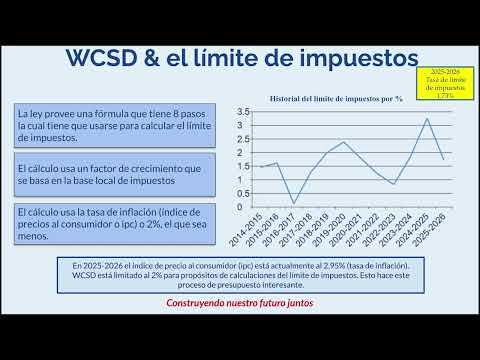
The superintendent explained the state's tax-cap (tax levy limit) process, saying the state formula uses eight calculation steps that start with the prior year's levy and then apply growth factors and inflation measures. Bank said the state's tax-cap calculation for 2025-26 results in a 1.73 percent limit for the district; he noted the consumer price index (CPI) in 2025 is about 2.95 percent and that the tax-cap formula uses the lower of CPI or 2 percent in parts of the calculation. Bank added that districts may propose a levy higher than the calculated limit but doing so requires 60 percent voter approval.
Bank reviewed revenue sources for district operations, saying New York State aid is a key variable that cannot be finalized until the state's budget numbers are issued. He described state education aid as determined annually by a law enacted by the state Legislature and said the district's aid historically comes from two main pools: general funds (about 88 percent of state aid) and lottery funds (about 12 percent). He also listed other revenue sources the district uses: payments in lieu of taxes, interest earnings, continuing education and tuition, billing for health services, insurance recoveries, gifts and donations, and miscellaneous items.
Bank outlined the district's public schedule and outreach for the budget: a superintendent video explaining the process (posted Nov. 4 and again Feb. 24 in English and Spanish), a preliminary budget presentation on Feb. 10, the superintendent's first recommended budget presentation on March 10, a second recommended budget presentation and an update on state aid on April 7, an anticipated board adoption of the budget on April 22, a community presentation May 5 at John J (school name as given), a public hearing/forum May 12 at Ketchum (location as given), and the budget vote scheduled for May 20, 2025. Bank encouraged residents to review materials on the district website and to use the district's budget email for questions (given in the presentation as Budget@WCCDNY.org).
Bank said the district maintains a glossary of common budget terms on its website to help residents interpret financial documents and acronyms used during the budget process. He emphasized that the tax-levy limit calculation and final proposed budget both depend on the state's aid numbers and on exclusions such as capital expenditures and pension adjustments.
The presentation was a recorded message by the superintendent to the community; no formal vote occurred during the presentation itself. Bank closed by urging community members to participate in the scheduled forums and to vote on May 20.