Get Full Government Meeting Transcripts, Videos, & Alerts Forever!
Get email alerts on the Pending Loads Distribution Planning topic
No spam. Unsubscribe anytime.
CPUC workshop explores "pending loads" proposals as utilities, CEC, advocates debate how to plan for fast-changing electrification demand
Summary
The California Public Utilities Commission convened a stakeholder workshop on Oct. 12 to develop a new "pending loads" planning category meant to help utilities anticipate midterm demand from transportation electrification, data centers and other rapidly emerging load types.
The California Public Utilities Commission convened a stakeholder workshop on Oct. 12 to develop a new "pending loads" planning category meant to help utilities anticipate midterm demand from transportation electrification, data centers and other rapidly emerging load types.
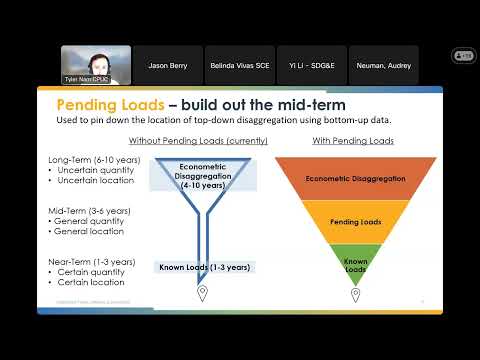
The workshop, hosted by CPUC staff and led in opening remarks by Commissioner Darcy Hoch, focused on how pending loads — estimates that sit between formal customer applications and top‑down forecasts — should be defined, evidenced, reconciled with the California Energy Commission's Integrated Energy Policy Report (IEPR) and used in distribution planning and General Rate Case (GRC) funding requests. "The goal of developing the pending loads category is to better enable planning for these types of loads to increase utility awareness of where loads will likely appear and to allow customers and utilities to better plan for these loads in advance to timely meet customer needs," Commissioner Darcy Hoch said.
Why it matters: Utilities say faster, concentrated growth from EV charging depots, freight electrification and large tech loads is stressing a process designed for slower, more diffuse growth. Without intermediate signals, planners jump from a system wide IEPR allocation to discrete customer applications, a gap utilities say causes long energization lead times and late upgrades. Advocates and staff pushed for guardrails so pending loads do not drive unnecessary, rate‑funded upgrades if projects do not materialize.
CEC context and data: Quentin Gee, manager of advanced electrification analysis at the California Energy Commission, described the IEPR process and how the CEC treats transportation electrification as a load modifier rather than a simple, direct addition. He said the CEC and utilities coordinate in working groups and that the next IEPR adoption is expected in January 2026. On data centers, Gee said joint work with utilities identified roughly 4 gigawatts of potential near‑term demand concentrated in several service territories, and that the IEPR process and local reliability scenarios are intended to capture geographically concentrated risk.
Transportation electrification: Emily Clayton, an analyst in CPUC Energy Division's Transportation Electrification team, outlined how federal and state rulemakings and local air district rules will continue to shape near‑term adoption patterns but can create uncertainty (for example, recent changes to Advanced Clean Fleets implementation and pending waivers). She said CEC charger estimates (AB 2127) are county‑ and traffic‑analysis‑zone level and do not currently provide the site‑level capacity detail utilities need to assign pending loads at circuit scale.
Utility proposals and framework: The major investor‑owned utilities presented converging approaches. PG&E, Southern California Edison and San Diego Gas & Electric proposed a three‑tier structure: - High‑confidence bottom‑up ("Category A"): customer projects with specific location/date/capacity or utility studies tied to regulatory mandates. Utilities said Category A should be treated as reliable bottom‑up data and may be allowed to exceed IEPR in the near term. - Medium‑confidence bottom‑up ("Category B"): projects or trends with less specificity that may warrant partial inclusion in the base forecast (by applying discount factors) or placement in scenario runs rather than immediate capital plans. - Top‑down allocation: the traditional IEPR disaggregation used when no bottom‑up data exists.
SDG&E described a concrete first implementation: the utility used a medium/heavy‑duty bottom‑up forecast for its 2024–25 distribution planning cycle and reported that the SDG&E bottom‑up projection exceeded the IEPR's medium/heavy‑duty component; SDG&E therefore treated the difference as pending loads for distribution planning and said it will reconcile those pending loads annually against known loads and IEPR vintages. SDG&E staff noted a procedural limit: because IEPR is a system‑level forecast, utilities cannot, in many cases, map a system‑level IEPR bucket to specific distribution circuits; that complicates efforts to produce a per‑project list of upgrades "driven exclusively" by pending loads.
SCE laid out detailed proposed intake and scoring rules and said it will run both a base scenario (used to generate needs and mitigations and a proposed investment plan) and a separate "augmented pending loads" study scenario (a systems study to show the impacts of adding broader categories). SCE emphasized the need for intake fields that capture location, capacity and expected in‑service date and said it will move projects from lower to higher confidence categories as permitting approvals and other milestones occur.
PG&E described a technical workflow to ingest pending‑load inputs into a centralized pending‑loads database, assign each input to a distribution circuit, validate data and convert qualifying Category A loads into the CYME load‑flow model (so they are handled the same as known loads), while Category B items would enter the feeder‑level forecasting tool (LoadsSEER) and be handled via spatial allocation runs. PG&E also emphasized the need for automated ingestion, assignment logic and confidence rubrics (examples: permit stage, funding status, property ownership).
Key disagreements and open questions: Participants debated whether pending loads should be permitted to exceed the IEPR forecast. Utilities argued certain kinds of bottom‑up information (customer plans, regulatory obligations such as port or local mandates, or consistent utility studies) are reliable and should be allowed to exceed IEPR, subject to reporting and guardrails. Consumer advocates flagged the need for transparent public reporting and for the Commission to scrutinize whether utility bottom‑up forecasts are demonstrably better than the CEC's statewide IEPR. Utilities and CEC staff agreed more routine, documented coordination is needed so IEPR and utility bottom‑up work inform each other.
Reporting and funding: Utilities noted timing mismatches between distribution planning cycles and GRC filing schedules; several IOUs said projects identified now may not be funded until a future GRC and that capital requests are submitted only for assets that are or will soon be "used and useful." The CPUC's decision directing pending‑loads work (D.24‑10‑030) includes an evaluation/advice‑letter requirement: utilities must compare pending loads to known loads and report outcomes (ordered reporting items were discussed by utilities, which said item 6 — identifying specific in‑service dates for projects attributable solely to pending loads — may not be practically separable because multiple forecast components together trigger identified upgrades).
What's next: Workshop participants asked utilities to file advice letters or testimony with specified intake formats and scoring rubrics; Energy Division staff said stakeholder comments from the workshop will inform how utilities craft formal proposals later this year. CPUC staff signaled upcoming scenario‑planning workshops where pending loads will be one of the variables studied.
The workshop closed with requests for greater public documentation of bottom‑up methodologies and for the utilities to provide accessible intake channels for community, tribal and local‑government submissions; utilities said they will file community engagement plans and publish reporting on system‑level pending‑load megawatts in future DPP/GNA or GRC filings.