Get Full Government Meeting Transcripts, Videos, & Alerts Forever!
Get email alerts on the Shoreland Permit Review topic
No spam. Unsubscribe anytime.
Wolfeboro planners flag mismatches between shoreland ordinance and permit application; staff to draft updates
Summary
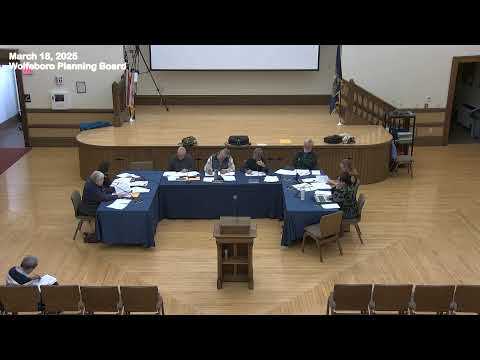
At a March 18 work session the Wolfeboro Planning Board reviewed the town's Shoreland permit application and identified gaps between the 2024 shoreland ordinance and the existing permit form; staff will prepare draft application revisions and suggested ordinance clarifications for the board to review April 15.
The Wolfeboro Planning Board reviewed the town’s Shoreland permit application at a March 18 work session and agreed staff should draft updates to the permit form and propose clarifying ordinance language for the board to consider at its April 15 meeting.
Shanna Saunders, the town’s interim planner, opened the discussion by noting a discrepancy between wording in the newly adopted town Shoreland ordinance and fields on the current permit application. “What I am seeing…is that the wording of the ordinance and the wording in the applications do not match,” Saunders said, adding the application on file is dated February 2012.
The board’s review focused on three linked parts of the ordinance used to assess development in shoreland areas: impervious coverage across the 250-foot shoreland zone, the natural woodlands buffer in the 50-to-150-foot band from the reference line, and the 0-to-50-foot waterfront buffer with its 25-point tree-score grid segments. Saunders and members traced how the application currently calculates the woodland-buffer percentages but omits the information the ordinance requires when a lot does not meet the buffer standards and must meet the ordinance’s renewal standards.
Key ordinance provisions discussed (as read aloud by staff and consultants): - Impervious coverage thresholds for the full 250-foot shoreland zone: more than 30% impervious area prohibits additional development; the ordinance treats the 15–20% band differently from the 20–30% band, with the latter generally requiring a professional-engineer-prepared stormwater management plan. - For projects that will result in greater than 20% impervious coverage, a stormwater-management plan prepared by a professional engineer is required and the waterfront-grid segments must meet a 25-tree score. - The natural woodlands buffer standard (the 50-to-150-foot band) differs by lot size: lots greater than one-half acre must retain at least 50% of that middle section in an “unaltered state” exclusive of impervious area; smaller lots must retain at least 25% (the smaller-lot calculation is not exclusive of impervious area). Where a lot fails to meet those thresholds the ordinance requires applicants to use the renewal standards (subsections a–f) to bring the lot up to the required percentage.
Saunders emphasized that the ordinance’s “lot redevelopment” section (section d on page 6) requires a narrative and several technical submittals but does not itself explain how the shoreland dimensional standards (impervious coverage, natural-woodlands buffer, waterfront grid) apply to redevelopment projects. She told the board the application currently allows applicants to carry forward a smaller of existing or required buffer percentages onto a line in the form rather than documenting how the property will meet the ordinance’s renewal standards.
Consultant Randy Castro, who addressed the board as someone who has worked on shoreland applications for many years in Wolfeboro, told members the local practice since the ordinance changes has been to treat “redevelopment” and “new construction” differently. He said redevelopment review historically focused on getting projects to be “more nearly conforming” without forcing full compliance in every case, and that practice informed how past staff and reviewers handled approvals. “The general thought is, we just want people to make it a little bit better,” Castro said.
Board members and attendees agreed that at a minimum the permit application needs to be updated (the copy in use is dated 02/2012) so that it collects the information the current ordinance requires. Several board members said the ordinance language itself is ambiguous in places and could be clarified so future planners and applicants apply consistent standards; others urged caution about changing the ordinance because the current language was the product of a prior multi-stakeholder committee.
Outcome and next steps: Though the board did not take a formal legislative vote on ordinance language, the board asked staff to draft revisions to the Shoreland permit application and to prepare proposed ordinance clarifications (notably language that explains how sections a, b and c of the ordinance apply when a project is designated a lot redevelopment under section d). Shanna Saunders said she would bring draft application and ordinance language for the board to review at the April 15 meeting.
Why it matters: The town’s shoreland rules govern development near lakes and affect septic replacement, docks, driveways and small-lot reconstruction across Wolfeboro’s waterfront neighborhoods. The board’s work to align its application with the ordinance will affect what information applicants must submit and could change how redevelopment projects are reviewed by the planning office and by future boards.
For now: No changes to the ordinance were adopted at the March 18 meeting. Staff will return with draft application changes and recommended clarifications for board review on April 15.