Get Full Government Meeting Transcripts, Videos, & Alerts Forever!
Get email alerts on the Educator Allocations topic
No spam. Unsubscribe anytime.
Parents, teachers and students urge MMSD board to reverse proposed educator allocation cuts
Summary
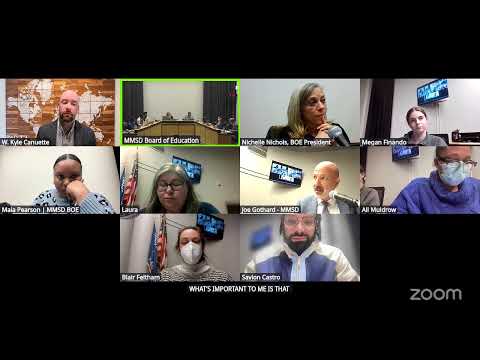
More than a dozen parents, teachers and students told the Madison Metropolitan School District Board of Education on March 17 that proposed educator allocation changes will push class sizes to the district maximum and damage supports for students with disabilities.
More than a dozen parents, teachers and students told the Madison Metropolitan School District Board of Education on March 17 that proposed educator allocation changes will push class sizes to the district maximum and damage supports for students with disabilities.
Speakers at the district’s public-input period singled out Lapham, Marquette, O’Keeffe and East elementary schools and West and East high schools as facing cuts that would reduce classroom and special-education staff. Catherine Howley, a Lapham parent and Latham Marquette PTG board member, said the school will lose “a second grade teacher” and “two special education assistants,” a change she said would leave two second-grade classrooms of 27 students each in a building that routinely overheats.
“The plan is teeing us up for two classrooms of 27 second graders each,” Howley said during public comment. “We are setting our teachers up for failure, and that will absolutely fall down on our kids.”
Teachers and staff echoed concerns about both class size and the district’s transparency about how allocations were calculated. Leland Pan, a school social worker and MTI building representative, said the lack of building-level data and clear enrollment-projection methodology fuels “misinformation” and staff distrust when cuts are announced without clear local figures.
Multiple speakers described cohorts that entered pre-K or kindergarten during the pandemic and said those groups need smaller classes to recover lost early childhood contact time. A common figure cited by speakers was a cohort of 54 students whose second-grade classes could become two sections of 27 under the proposed staffing model; a number of speakers noted the board’s current maximum for second- and third-grade classes is 27, a limit established by prior board policy.
Teachers also warned that cutting classroom staff while expanding some central-office positions would harm student-facing work. One East High teacher said cuts at her school could remove nearly seven full-time teachers, increasing class sizes and reducing elective and specialized offerings. Dominic Johan Burkle, a physics teacher at Madison West High School, read from an email a former student had sent praising the impact of small-class teaching and urged the board to “look elsewhere for cost saving measures” rather than reduce teachers.
Special-education staff and parents stressed that students with disabilities would be disproportionately affected. Several speakers said enrollment projections available to the district show increases in students qualifying for special-education services while proposed allocations would reduce school-based special-education assistants and teachers.
Speakers asked the board to direct staff to adopt conservative allocations — for example, using 90% of a building’s maximum allowable class-size threshold when planning next year — and to publish building-level enrollment projections, the calculation methods used, and historical accuracy of prior projections so the community can evaluate whether proposed reductions are justified.
A handful of speakers raised program-specific concerns. Alana Torres Bruin, a West High teacher in the district’s Spanish dual-language immersion (DLI) program, said DLI has no dedicated budget at the secondary level and warned that rising enrollment and staffing cuts would push some sections to about 30 students and increase pressure to hire bilingual staff the district currently lacks.
Several teachers and staff also criticized the pace and number of district initiatives, saying frequent new programs and policy changes without meaningful teacher input are increasing workload and harming retention. Jessica Hotz, a Madison East history teacher of 25 years, said the district has introduced multiple districtwide changes since the pandemic and that they’ve increased teachers’ workload without the time to implement them well.
Board members acknowledged the concerns and said staff will continue to refine projections and allocations. Superintendent Christopher Gothard told the board he remains engaged with enrollment and allocations work and noted districtwide elementary sections increased by 47 last year to reduce class size; he said projected enrollment changes for 2025–26 show some schools down and some up and that staff will continue to monitor changes through counts later in the year.
Ending
Speakers asked the board to reconsider allocation reductions, restore eliminated teachers and special-education assistants at affected schools, and publish the data and methods the district used to reach allocation decisions. The board did not take a vote on allocation policy at the March 17 meeting; the public comment period concluded and the board proceeded to routine agenda items and the consent agenda.