Get Full Government Meeting Transcripts, Videos, & Alerts Forever!
Get email alerts on the Party Leadership topic
No spam. Unsubscribe anytime.
Candidates for Washington County GOP chair debate turnout, SB 54, fundraising and transparency
Summary
At a forum hosted by the Washington County Republican Women, county party chair candidates outlined competing plans to boost caucus turnout, reduce reliance on SB 54 signature gathering, increase fundraising and expand transparency; no formal party votes were taken.
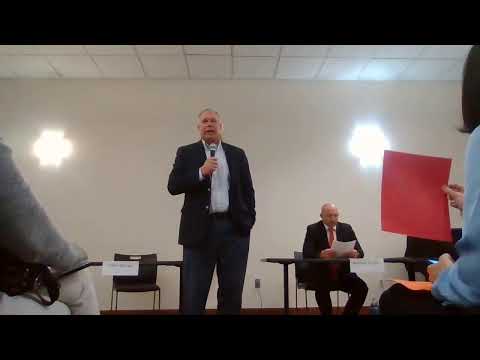
WASHINGTON COUNTY — Candidates for chair of the Washington County Republican Party spoke at a candidate forum hosted by the Washington County Republican Women at the county library, laying out competing plans to grow caucus participation, counter the effects of SB 54, expand fundraising and increase transparency in party operations.
The forum brought multiple declared chair candidates before delegates who asked questions on strategy, bylaw changes, signature-gathering fraud and internal party unity. No formal motions or votes on party leadership were recorded during the meeting; the evening consisted of opening statements, candidate answers, and closing remarks.
The most contested subject was SB 54, the state-level law that allows candidates to reach the primary ballot by collecting signatures. One candidate, identified in the forum as Willie (candidate for Washington County Republican Party chair), said the county should blunt SB 54’s influence by educating and engaging voters directly: “judge me on my fruits and qualifications and accomplishments,” he told delegates as he outlined a plan of neighborhood meetings, social-media outreach and short informational videos intended to reduce the appeal of signature-gathering. Willie said in the forum that “SB 54 is something that...we need to do away with,” and emphasized that the county party should support legislative efforts while also mounting grassroots outreach to change voter behavior.
Another candidate, identified as Brandon (candidate for Washington County Republican Party chair), framed the problem as lack of outreach: “the real issue is this 90% of the Republicans in Washington County know nothing about our party,” he said, arguing for a mass-engagement campaign to teach voters how caucus and convention processes work so they will be less likely to sign petitions for candidates who bypass the convention route.
Candidates from both wings described multi-pronged outreach: repeated small neighborhood meetings, college and high-school engagement through Teenage/College Republican efforts, and short social-media videos. Several speakers described past and planned “boot camp” training events for students and first-time caucus-goers.
Fundraising and use of party reserves drew detailed discussion. Candidates said the county party’s reserves have grown in recent years; speakers gave figures used in campaign remarks: a reserve of about $20,000 four years ago that is now above $80,000, with one candidate recounting a past goal to raise $100,000 to invest directly in candidates and caucus promotion. Panelists noted a bylaw change passed last year that allows the county party to donate to candidates who win the convention threshold, and said the party has in the past reallocated funds to state candidates.
Delegates also pressed candidates on signature-gathering fraud. One candidate noted that Washington County officials — including county clerk Ryan Sullivan and county attorney Eric Clark — helped identify suspicious activity by a paid signature-gathering firm, and said the county party should publish a statement when facts are verified. “If the facts are there ... releasing a statement of sorts that backs up all the facts without emotion is something that we should do,” the candidate said.
Candidates debated internal party transparency and vote secrecy. One speaker urged moving away from publishing individual convention votes, arguing that publicized voting records can produce retribution and division; another candidate said executive-committee minutes and agendas should be public and that the party should generally operate “out on the table.” Several candidates said bylaws govern how and where those decisions are made and that the county central committee (the body of precinct chairs and vice chairs) is the appropriate forum for changing bylaws.
Other topics included relations with local elected officials, the role of precinct officers, and party unity. Candidates repeatedly emphasized outreach at the precinct level as the primary way to boost caucus turnout. Candidates who described past party roles said precinct leaders set the tone for neighborhood turnout and that the party should recruit and train precinct leaders to invite younger voters to caucus.
Candidates gave specific baseline figures for caucus participation and targets: candidates cited 2022 figures of about 54,146 registered Republicans in Washington County with roughly 3,432 attending caucus (about 6.5%), and more recent figures of 67,904 registered Republicans with about 6,600 caucus attendees (about 10%). One candidate set a goal of lifting caucus participation toward 25% of registered Republicans over multiple cycles, while acknowledging different estimates and the difficulty of achieving rapid growth without broad precinct-level effort.
The forum closed with brief final remarks from candidates. Delegates were told there would be additional candidate events through the week and reminded of scheduling constraints at the library. No formal actions, motions or votes on chair selection were reported during the event.