Get Full Government Meeting Transcripts, Videos, & Alerts Forever!
Get email alerts on the Utilities Bwl topic
No spam. Unsubscribe anytime.
Residents, labor and business leaders urge keeping Lansing Board of Water and Light’s current governance
Summary
Dozens of speakers at the Lansing Charter Commission meeting on March 4, 2005, urged the commission to preserve the existing charter language that keeps the Lansing Board of Water and Light (BWL) as an independent, publicly run utility; speakers cited service reliability, employee protection and economic development.
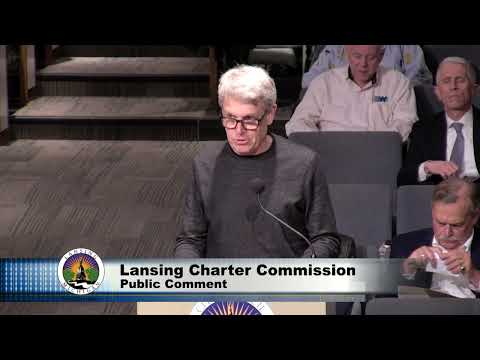
Dozens of residents, retirees, union leaders and business representatives told the Lansing Charter Commission on March 4 that the Lansing Board of Water and Light should remain a publicly run, independently governed utility.
Curtis Hertel, a former state senator and BWL ratepayer, told commissioners the city should “keep a strong, public utility here,” saying independent governance has helped protect employees, ratepayers and service. “A good publicly run utility has become rare in the state, and we are lucky to have them,” Hertel said.
Several other speakers echoed that point. Tim Damon, president and CEO of the Lansing Regional Chamber of Commerce, said the BWL is a “city asset” that supports economic development and that the current appointment-and-confirmation structure—mayoral appointment with council confirmation—provides checks and transparency while insulating the utility from short-term political pressures. “We strongly support the BWL remaining an independent entity and maintaining its current governance structure,” Damon said.
Angela Whitwer, identified as a state representative from Delta Township, told commissioners the utility’s governance “has worked seamlessly for the last 50 plus years,” and noted new state energy laws require BWL transparency and compliance while underscoring the utility’s regional role.
Speakers also included BWL employees and union members who attended in support, and the BWL’s general manager (identified in the record as **** Peffley) said the current charter language gives the mayor and city council authority to hold BWL commissioners accountable and urged the commission to keep the charter largely intact.
Not all comments focused only on governance structure. Mike McDaniel, who chaired a community review team that evaluated BWL’s response to a 2013 ice storm, described BWL’s strategic moves to diversify power sources, noting the utility’s efforts to add generation capacity (including cogeneration and plans for solar, wind, battery storage and reciprocating engines). “These are great innovations that we do not see from other public utilities,” McDaniel said, and he attributed some of that progress to the utility’s independence.
Why it matters: Commissioners are considering charter changes that affect how city-owned services are governed. Speakers said preserving an independent BWL board protects ratepayers and supports long-term planning and economic development, while some public commenters urged greater transparency in the appointment process and term limits for board members.
The commission scheduled a dedicated meeting on March 18 to discuss Article V, Chapter 2, the section of the charter that addresses the Board of Water and Light.
Sources and context: The testimony collected at the public-comment portion of the March 4 meeting included current and former elected officials, business leaders, BWL staff and neighborhood residents. Several speakers referenced past state involvement and audits; details about specific state actions were not provided in the March 4 record.