Get Full Government Meeting Transcripts, Videos, & Alerts Forever!
Get email alerts on the Definition Of Family Zoning topic
No spam. Unsubscribe anytime.
Planning commission recommends Ordinance 15-45 to expand zoning definition of “family,” forwards measure to council
Summary
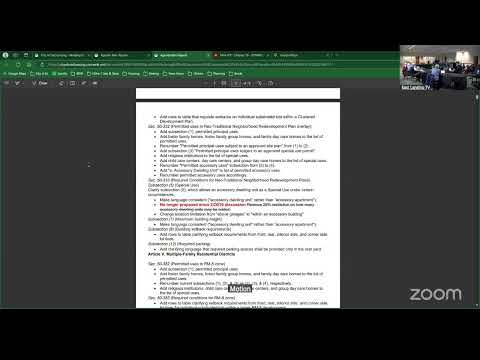
The East Lansing Planning Commission voted 6-0 on March 12, 2025, to recommend City Council approve Ordinance 15-45, expanding the zoning code’s definition of “family” to explicitly include nieces, nephews, cousins, foster children, wards under guardianship and similar relations.
The East Lansing Planning Commission voted 6-0 on March 12, 2025, to recommend that City Council approve Ordinance 15-45, which amends the zoning code’s definition of “family” to add nieces, nephews, cousins, foster children, persons living with the dwelling-unit owner under guardianship and legally adopted children.
The change is intended to align the zoning code’s family definition with a recent charter amendment known as Proposal 1 and to reduce ambiguity in administration. Supporters said the amendment clarifies who may occupy a household without triggering rental-licensing requirements; critics and several public commenters warned that local zoning definitions of “family” have been the subject of constitutional and state-court rulings.
City staff described the amendment as a targeted clarification rather than a policy shift. Landon Bartley, a city planner, told commissioners the proposal “adds just a few words essentially to include cousins, foster children, persons living with dwelling unit owner, under guardianship,” and noted that nieces and nephews had already been added in a prior change.
Councilmember Meadows, who introduced the change at council, told the commission it was motivated by Proposal 1. “It seemed clear from the passage of Proposal 1 that, we needed to make a change to this particular provision,” Meadows said, urging the commission to recommend approval.
Public commenters sharply disputed that the amendment was required. Mark Grebner, speaking as a long-time resident and attorney, warned that municipalities lack authority to define family in zoning and cited United States Supreme Court precedent: “you cannot define family for the purpose of zoning. You do not have that legal power,” he said, citing Moore v. East Cleveland and later Michigan case law. Patrick Rose, another resident, urged the commission to place the family definition in the rental-code section rather than the zoning chapter and said the amendment “doesn’t fix the problem” critics describe.
City staff and the city attorney responded that the proposed language was not intended to conflict with Proposal 1 or state law and that the ordinance includes a broader “domestic unit” provision that allows administrative review of household arrangements if they do not meet the enumerated categories. The city attorney noted the code already requires a demonstrable relationship when a person’s family status is contested.
Commission members discussed whether to define “cousin” more narrowly, and several said they preferred an inclusive approach. Commissioners also reiterated that, if the commission recommended approval, Council would review the ordinance and could consider further refinements. Commissioner Chapin moved to approve the amendment; Commissioner Overby seconded. The motion passed on a roll call vote: Chapin — yes; Hendrix — yes; Levine — yes; Overby — yes; Putz — yes; Chair Sullivan — yes. The commission’s recommendation will be transmitted to City Council for final action on a date to be determined.
The commission’s packet and staff reports list the change as ordinance 15-45 and describe it as a definitional amendment to Chapter 50 (zoning). Commissioners and speakers flagged potential legal risk and differing interpretations of how the amendment interacts with Proposal 1 and with the city’s rental-license rules. Staff said the city has not faced a legal challenge to the existing definition during the roughly 18 years it has been in the zoning code.
A staff note on implementation: the code also retains a “domestic unit” provision that staff said offers a catch-all administrative path for groups to demonstrate family status if they do not strictly meet the enumerated categories in the amended definition. Several commissioners said they expect Council and staff to consider whether additional definitional detail (for example, a legal limiting definition of “cousin”) is necessary.
The commission’s recommendation will move to City Council for further consideration and possible adoption; a council hearing date had not been set at the close of the meeting.