Get Full Government Meeting Transcripts, Videos, & Alerts Forever!
Get email alerts on the Business Regulation topic
No spam. Unsubscribe anytime.
Council adopts policy resolution to amend entertainment and related business license fees; DDA to offset first $200,000 in downtown overtime
Summary
After extensive debate on fairness and enforcement, the council approved a policy resolution that sets new baseline fees and a chargeback system for dedicated police overtime in the downtown entertainment district; the DDA will preliminarily appropriate $200,000 in FY26 to offset overtime, with excess costs billed to businesses.
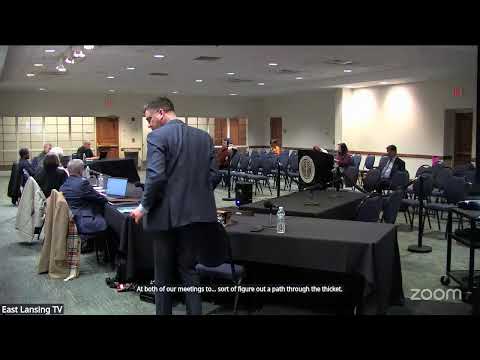
The East Lansing City Council on March 4 approved a policy resolution that updates recommended business license fees for several categories and establishes a chargeback framework for dedicated police overtime in the downtown entertainment district. The motion passed 4–1.
What the resolution says: Under the recommendation presented to council, beginning in fiscal year 2026 the city would include the following fees in the annual budget tax rate and fee schedule: amusement/video arcade — $50; dance halls, restaurants and takeout stores — $200. Entertainment licenses (events requiring a dedicated police overtime response) would not have a flat fee but would be billed for the actual cost of police overtime when dedicated staffing for downtown events exceeds an initial $200,000 that the Downtown Development Authority (DDA) is preliminarily expected to appropriate for FY26.
City Manager Bellman told council the DDA at its meeting preliminarily agreed to include $200,000 in its FY26 budget to offset downtown overtime; he said the policy resolution provides guidance for how staff will structure the fee schedule and how cost recovery would work. City Attorney Chubb said the resolution memorializes procedures for calculating actual costs associated with dedicated police overtime and explains which call types would be eligible for chargebacks.
Chargeback scope: The resolution limits chargeable incidents to a specified list of call types connected to policing downtown crowd control and disorder: assaults, fights, unwanted subject (report), suspicious persons, unknown trouble, obscene complaints, disorderly conduct and noise complaints. The resolution clarifies that medical responses are not eligible for chargebacks.
Debate: Council discussion included concern from members who said they did not want enforcement to be used as a revenue stream and objections to a system that might bill businesses for calls initiated by patrons rather than by staff. Councilmembers also said the resolution and the proposed fee schedule will be rolled into the regular budget and fee schedule process for final adoption; the council will have another opportunity to change rates during the budget process.
Outcome and next steps: The council approved the policy resolution that staff will use to place proposed fees into the upcoming budget tax rate and fee schedule; final adoption of fees will occur as part of the normal annual budget process. The motion carried 4–1 (yes:4; no:1). The record does not specify the name of the dissenting member in the vote tally provided in the agenda packet.