Get Full Government Meeting Transcripts, Videos, & Alerts Forever!
Get email alerts on the Public Art topic
No spam. Unsubscribe anytime.
East Lansing council asks city attorney to draft updates to public art 'percent for art' ordinance
Summary
After presentations from the Arts Commission, the council voted unanimously to ask the city attorney to draft changes to Ordinance 13-39 that would broaden eligible art types, remove internal contradictions, and clarify allowable uses and coding alignment.
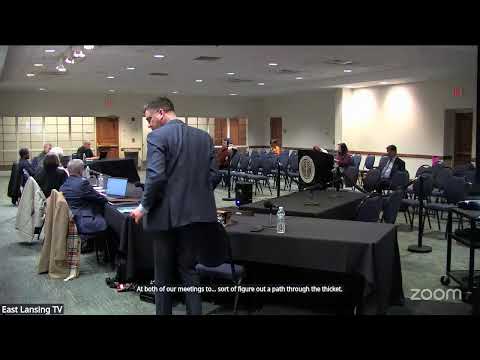
The East Lansing City Council on March 4 voted unanimously to ask the city attorney to draft proposed amendments to Ordinance 13-39, the city's public art “percent for art” rule, after members of the Arts Commission described proposed changes intended to broaden the ordinance's definitions and remove internal contradictions.
Arts commissioners told the council the current ordinance restricts the city to funding certain permanent visual works and contains lines that contradict one another. “Right now, there is a whole definition of how the artwork that we fund can be on public property under certain circumstances. And then it has a line that says you can't have it on private property. So we've just taken that out to make that more clear,” said Ali Sciardo, vice chair of the Arts Commission.
Why it matters: The commission and staff said the changes would allow the city to support a wider range of art — including performance, musical, written and digital work — and better align the ordinance with the commission's five‑year cultural arts plan and the zoning code.
In prepared remarks and at the council meeting, commission chair Barbara Warges said the commission reviewed national models and research from Americans for the Arts as it developed options. Heather Mahano, the city's arts and stewardship coordinator and the commission's staff liaison, told the council the ordinance currently requires developers to allocate 1% of a project budget (up to $25,000) to public art or to pay into a public art fund; the proposed drafting effort will clarify language about eligible expenses and bring the ordinance into alignment with the zoning code.
Councilmembers praised the commission's work and asked that the city attorney prepare a redline for future public review. The motion to authorize the city attorney to draft the changes was moved and seconded at the meeting and carried unanimously; councilmembers will receive the attorney's draft and will consider it in future public hearings before any final ordinance vote.
The council emphasised this action directs staff and the city attorney to prepare ordinance language for future consideration; it does not itself amend the ordinance.
A follow-up: The city attorney's redlined draft will return to the council for at least two readings and additional public comment before any change is adopted.