Get Full Government Meeting Transcripts, Videos, & Alerts Forever!
Get email alerts on the Wastewater Biosolids Management topic
No spam. Unsubscribe anytime.
Kalamazoo staff outline $194 million plan to stop hauling biosolids to landfill, citing PFAS, odors and rising costs
Summary
City staff presented a plan to replace landfill disposal of wastewater biosolids with a dryer plus ERS system, estimating a $194 million project, reduced truck traffic and PFAS destruction; public hearing set for March 25 and a resolution expected April 21.
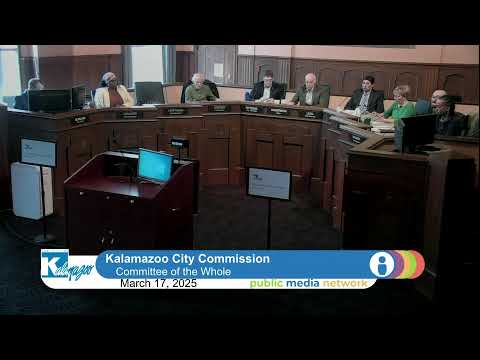
Kalamazoo City officials on March 17 heard a staff presentation on a proposed $194 million project to change how the Kalamazoo Water Reclamation Plant handles biosolids, reduce truck traffic and destroy PFAS and microplastics from the wastewater stream.
Director of Public Services James Baker told the commission the plant treats about 26 million gallons of wastewater a day and that the city currently sends its biosolids to landfills. "Of the dollars that we collect every year from your water bill, 13 and a half million goes to take sludge to the landfill," Baker said, noting landfill disposal costs were about $4.5 million in February 2019 and have risen to roughly $13.5 million today.
The project plan published with the Clean Water State Revolving Loan Fund application proposes using a dryer combined with an oxygen‑rich, high‑temperature oxidation process (ERS) to produce an oxidized mineral ash that staff say is largely odorless and destroys PFAS and microplastics. Baker said the dryer + ERS option scored well in lifecycle cost, greenhouse gas footprint and odor potential in the city's evaluation of more than 30 technology responses to an earlier RFI.
Why it matters: staff project long‑term operational savings and neighborhood improvements if the city reduces the current daily truckloads of dewatered, wet solids. Baker said current hauling is roughly 200 tons per day of dewatered solids at about 23% solids — roughly "20 full size... trucks a day." After drying, the city would expect "less than 2 trucks a day," he said, and substantially lower annual disposal costs by 2030 under the proposed process.
Key details and timeline - Estimated project cost: approximately $194,000,000 (all‑in), up from earlier estimates near $150 million; staff said higher capital estimates and rising input costs have pushed the figure up. - Household impact: the project plan includes a standardized cost estimate used in the funding application that equates to about $12 per month per typical household for a $194 million project; Baker emphasized that figure is required for the funding application and is not a formal rate recommendation. - Public process: a public hearing on the project plan is scheduled for March 25 at 6 p.m. at Mount Zion. Staff expect to return to the full commission April 21 seeking adoption of a project plan resolution and to submit the funding application to the state (referred to in the briefing as EAGLE) on April 30. State/federal funding decisions are expected in September. - Construction and operation: staff outlined a planning and construction window from 2026 through 2030, with operations anticipated around 2030 if permits and funding proceed. - Sites under consideration: 1415 Harrison and 600 East Mazel, with the latter located north of existing salt barns and farther from the North Side neighborhood.
Alternatives, permits and reliability Baker said the city evaluated multiple technologies including fluidized‑bed incineration and supercritical water oxidation. He described the dryer + ERS path as a mature dryer technology with an ERS process used in Europe since the mid‑1990s and in limited U.S. installations; staff noted supercritical water oxidation is not yet proven at municipal scale in the U.S. The ERS process differs from conventional incineration, Baker said, running at higher temperatures and using carbon in the feedstock to sustain combustion.
Before construction the city must pursue wastewater construction permits (part 41) and an "air permit to install," which will include its own public review. Baker said the design phase will define the air pollution controls needed to meet or exceed local standards and to ensure emissions do not harm nearby neighborhoods.
Redundancy and operations Staff described redundancy plans to limit reliance on trucks if equipment is offline. The conceptual design includes multiple dryer units, dry bulk storage silos and a plan to size equipment to match historical daily solids patterns. Baker said the initial plan centers on multiple dryers and a single large ERS based on current manufacturer input; dried material would be crushed, stored in silos and loaded out as needed to allow time for ERS maintenance without resuming large‑scale hauling of wet cake.
Funding and reuse City staff are pursuing multiple funding sources: the Clean Water State Revolving Loan Fund (CWSRF), a WIFIA letter of intent and congressional directed funding requests to federal representatives (staff specifically mentioned a request to Senator Gary Peters). Baker said a low‑interest 40‑year loan would significantly reduce ratepayer impacts compared with shorter amortization.
On beneficial reuse, staff said prior local land application ended years ago and that potential beneficial uses for the oxidized ash — such as use in concrete or fill — are being explored but are not yet certified or guaranteed.
Other points raised in discussion Commissioners asked about technology maturity, payback and lifecycle. Baker said earlier payback estimates of about 10 years (when project costs were lower) have moved to roughly an 18–20 year horizon under the current $194 million estimate and noted that future landfill disposal cost increases are a major variable.
Baker also said about 60–70% of the plant's loading is from industrial sources; the plant serves roughly 200,000 people and about 65 industrial customers, and two large industrial customers together account for nearly 25% of revenue and loading.
Decision status and next steps No formal decision or vote on the biosolids project occurred at the March 17 work session. The commission was notified of the public hearing date, the April 21 anticipated resolution request and the April 30 funding submission date. Staff will return with further details on design, permit parameters, air pollution controls and refined cost estimates as the project moves through public review and funding consideration.
Ending Baker closed by urging continued community engagement and said the goal is a durable, low‑odor, lower‑emissions solution for biosolids management. The city will hold the public hearing on March 25 and discuss the plan at the April 21 commission meeting.