Get Full Government Meeting Transcripts, Videos, & Alerts Forever!
Get email alerts on the Building Electrification topic
No spam. Unsubscribe anytime.
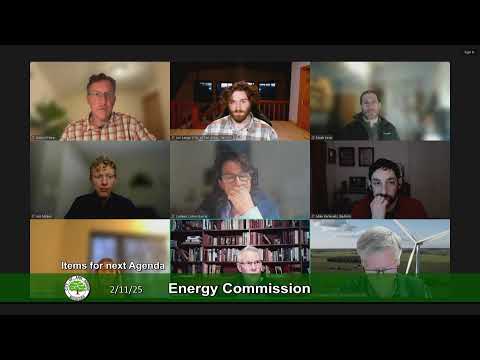
Ann Arbor Energy Commission pauses carbon pollution impact fee resolution, refers measure to working group
Summary
The Energy Commission postponed a resolution proposing a $190-per-ton carbon pollution impact fee for large new buildings and referred it to a working group to refine the proposal with city staff and community stakeholders.
The Ann Arbor Energy Commission on March 11 postponed consideration of a proposed ordinance that would establish a carbon pollution impact fee on certain new construction and major renovations and referred the proposal to a working group to work with city staff and community stakeholders.
The resolution, presented as a revised version of a measure first discussed in September 2023, would have applied reporting requirements to buildings of about 20,000 square feet and priced carbon at $190 per metric ton of CO2 equivalent, using both on-site and upstream emissions conversion factors. The commission voted to delay and request further work rather than advance the proposal to a formal recommendation to city council.
Why it matters: Commissioners and public speakers said buildings are a major source of local emissions and argued the city must move faster to meet its A2ZERO carbon neutrality goals. Supporters said pricing carbon into new construction could shift developer choices toward electrification; opponents and some commissioners raised legal concerns about whether a locally imposed fee would survive challenges under Michigan law.
Public commenters and commissioners framed the debate broadly. Ken Garber, a caller who flagged himself as living at 28 Haverhill Court, told the commission, “Thank you for bringing back the carbon pollution impact fee.” He urged the panel to discuss the ordinance’s aims and legal footing and noted prior outreach on the topic. Another caller, Larry Junks, described health risks associated with fossil fuels and urged the commission to pursue measures “in accord with the provisions of the city's carbon neutrality pledge passed by the city council in November 2019.”
Commissioner John Mirsky, who led drafting and presentation of the revised resolution, reviewed technical context during the discussion, saying Ann Arbor’s expanded greenhouse-gas inventory showed the city’s existing decarbonization rate must accelerate manyfold to reach net-zero on the current timetable. Mirsky also noted the draft cites 32 approved developments that connected to natural gas since the A2ZERO plan took effect and estimated emissions from those projects consume roughly two-thirds of a year’s worth of local decarbonization progress.
Several commissioners and the council liaisons urged a mixed approach of incentives and disincentives. Council Member Briggs said the council could consider symbolic actions to press the state for legal changes and encouraged continued dialogue. Council Member Malek said he supported the goal but flagged the risk that a legal challenge could divert city resources and suggested pursuing less legally uncertain incentives and collaborations, including models from the University of Michigan’s new-construction practices.
City staff and commissioners also confirmed that multiple legal memoranda had been circulated internally; one was distributed to commissioners as a privileged, confidential memo and could not be discussed in detail in the public meeting. Staff suggested that involving city legal and operations staff in the working group would help the commission test options that are both effective and administratively feasible.
Outcome and next steps: The motion to postpone the resolution and refer it to a working group to collaborate with city staff and outside stakeholders passed by voice vote; individual roll-call tallies were not recorded in the meeting minutes. The commission asked the working group to return with revised language and additional incentive options; no definite return date was set at the meeting, though some commissioners suggested aiming to reconvene the item later in the spring if feasible.
Votes at a glance: Motion to postpone the carbon pollution impact fee resolution and refer it to the working group — approved (voice vote). No formal numeric tally or recorded nay/aye list was entered on the record.
Context and clarifying details: The draft resolution would have applied to new construction and major renovations over a threshold (reported in the meeting as 20,000 square feet) and included a proposed fee rate of $190 per metric ton of CO2 equivalent; the conversion factor in the draft includes upstream emissions. Commissioners cited the city’s A2ZERO plan and a city council carbon-neutrality pledge adopted in 2019 as policy context. Legal uncertainty about the interaction of the proposal with Michigan’s State Construction Code Act and case law (participants cited a precedent as “Bolts v Lansing” in public comment) was a persistent concern raised at multiple points in the discussion.
What was not decided: The commission did not adopt the resolution or recommend the ordinance to council. Commissioners did not vote on any ordinance text, nor did the commission set a formal deadline for the working group to report back.