Get Full Government Meeting Transcripts, Videos, & Alerts Forever!
Get email alerts on the Cdl Work Authorization topic
No spam. Unsubscribe anytime.
Committee advances bill requiring certain foreign CDLs to be accompanied by U.S. work authorization
Summary
House Bill 1745, which requires some commercial drivers holding Mexican or Canadian non‑domiciled CDLs to carry U.S. employment authorization when operating in Arkansas and creates associated offenses, advanced from committee after extended testimony and an amendment removing learner's‑permit language.
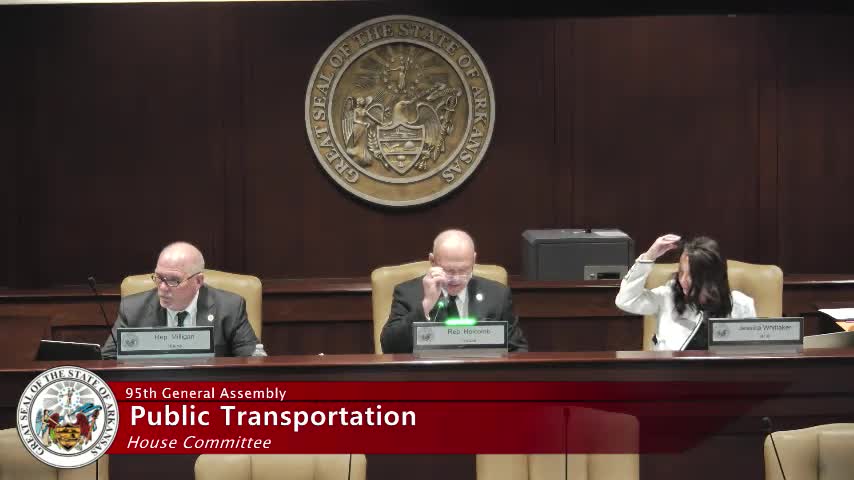
After extended public testimony that included victims' family members, carriers, truckers and law‑enforcement officials, the House Transportation Committee voted to advance House Bill 1745 as amended. The bill requires certain holders of non‑domiciled commercial driver licenses (CDLs) to possess U.S. employment authorization documentation while operating a commercial motor vehicle in Arkansas and establishes criminal penalties for violations as described in the bill.
Representative RJ Hawk, the bill sponsor, told the committee the measure is intended to reduce fraudulent foreign CDLs used to operate on U.S. roads. He said the bill does not create new licensing requirements but requires drivers who rely on foreign CDLs to carry federal work‑authorization documentation in addition to their foreign CDL. Hawk said the bill was drafted with input from the highway police, state police and the attorney general to conform with federal and state law. The sponsor also noted an amendment struck language about commercial learner's permits.
Opponents and witnesses raised safety and enforcement concerns. Several family members of people killed in crashes testified that non‑domiciled drivers who lacked English proficiency and adequate vetting presented a safety risk. Deann Miller, who said her husband was killed by a truck driver, testified the bill “does not do enough” to ensure that foreign drivers are skilled and properly vetted. Industry witnesses, including Shannon Newton of the Arkansas Trucking Association, said many of the issues described—credential validity, insurance, employment standards—are best addressed at the federal level but that HB 1745 provides an additional verification filter at roadside.
Law‑enforcement witnesses said the requirement for a U.S. government document would help officers verify identity at roadside. Chief Jeff Holmes of the Department of Transportation Highway Police said the U.S. document “will help tremendously at roadside” to confirm who an officer has stopped. Witnesses also pointed to a Federal Motor Carrier Safety Administration regulation (49 C.F.R. §391.11) that requires English language proficiency for certain driver tasks; panelists said a 2016 memorandum reduced the use of that standard as an out‑of‑service criterion.
Committee members adopted a time limit for public testimony and heard more than a dozen people on both sides; Representative Whitaker moved to limit debate to three minutes per speaker. Representative Hawk moved to advance the bill as amended; the motion passed on a voice vote with no recorded roll‑call tally in the transcript.
The bill as described in committee would make possession of the federal employment authorization document a required condition for some non‑domiciled CDLs operating in Arkansas and establishes penalties described in the bill text. Sponsors and witnesses repeatedly urged that complementary federal action is needed to address the larger set of credentialing and safety concerns raised during testimony.