Get Full Government Meeting Transcripts, Videos, & Alerts Forever!
Get email alerts on the Budget Process topic
No spam. Unsubscribe anytime.
Newberg SD 29J holds budget committee orientation, outlines process and timeline
Summary
District finance staff led a budget committee training covering the nine-step budget process, appropriation levels, revenue drivers including the State School Fund, and meeting dates for proposed budget review and hearings.
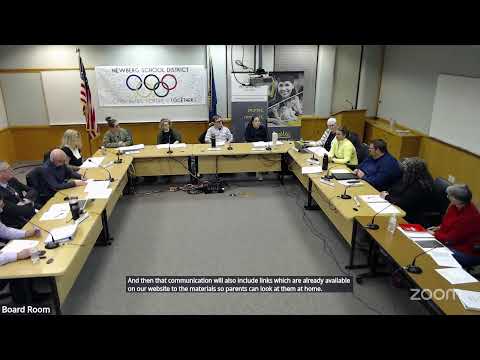
Nate Bridal, director of finance for Yamhill County School District 29J (Newberg SD 29J), led a budget committee orientation and training for board and budget committee members, explaining the statutory process and the district’s timeline for the coming months. Bridal said the session was “the budget committee orientation or training” and told members the meeting was intended to explain “what it is we're gonna do, what we have to do, what we should do, and what we can do.”
The training framed the work of the committee as a public, statutory process overseen by the Oregon Department of Revenue and governed by Oregon Revised Statutes (ORS). Bridal walked members through what he described as a nine-step process that begins with appointing a budget officer (the district’s finance director), preparing a proposed budget and publishing notice, then conducting public budget committee meetings, and finally approving a proposed budget and a permanent tax levy to send to the board. Bridal emphasized the committee’s role in asking questions about assumptions and revenue and in recommending appropriation levels.
Bridal reviewed the accounting structure committee members will see in budget documents: fund, function, object, cost center, area and subarea. He explained common fund codes such as 100 (general fund), 200 (special revenue/grants), 300 (debt service), 400 (capital outlay) and 600 (internal service), and object codes (100 = salaries, 200 = benefits, etc.). He also described “budget strings” that tie every expense to an account code for tracking.
On supplemental budgets, Bridal said the district can make changes via board resolution if the change is within 10 percent at the appropriation level; larger changes require public notice and another hearing. He also described the difference between “unappropriated” amounts and an ending fund balance, noting that unappropriated funds are not available for expenditure without a formal budget change.
Interim Superintendent Dave Parker told the committee the district is working to return to a sustainable financial footing after a difficult fiscal period. “We started the year with a $1,200,000 deficit in the general fund,” Parker said, and he said decisions made during the summer have put the district “on a new pathway.” Parker highlighted revenue and expense drivers the committee should watch: a governor’s budget proposal that included roughly an 11.3 percentage-point increase to current service level estimates, rising PERS costs (Bridal noted PERS costs are rising about 8 percent), higher transportation and utility costs, and roll-ins of staff previously funded by bond proceeds.
Bridal explained how the state’s Program Budgeting and Accounting Manual (PBAM) and Oregon Department of Education (ODE) reporting affect budget presentation and state funding calculations. He reviewed State School Fund (SSF) mechanics including weighted average daily membership (ADMW) calculations, the state transportation grant (the state reimburses 70 percent of eligible transportation costs), and the periodic reconciliation process that can adjust district revenues based on prior-year actuals.
Bridal told the committee the district will present the proposed budget and budget message at the first official budget committee meeting on April 15, with a potential second meeting on May 6 if needed and a public hearing with the board on June 10. He encouraged members to submit questions by email or request one-on-one time with staff to review budget details.
Committee members asked clarifying questions about appropriation triggers, the 10 percent supplemental threshold, and the mechanics of ADMW and experience adjustments in the state school fund formula. Bridal said ODE offers windows for updating estimates — typically in December and in the spring — and that the district monitors local revenue assumptions and state estimates closely because equalization and statewide adjustments can change funding.
Next steps: the budget committee will receive the proposed budget and budget message on April 15; staff will provide follow-up materials, including cost-center detail and cohort/enrollment projections, at that meeting.