Get Full Government Meeting Transcripts, Videos, & Alerts Forever!
Get email alerts on the Mental Health Jail Diversion topic
No spam. Unsubscribe anytime.
Andrews Center reports jail-diversion gains, seeks continued funding for new programs
Summary
Keisha Morris of the Andrews Center updated the Smith County Commissioner's Court on the Sequential Intercept Model (SIM) programs, reporting expanded mobile crisis outreach, competency-restoration services, a HHSC-funded jail continuity pilot and multiple new contracts and capacity increases.
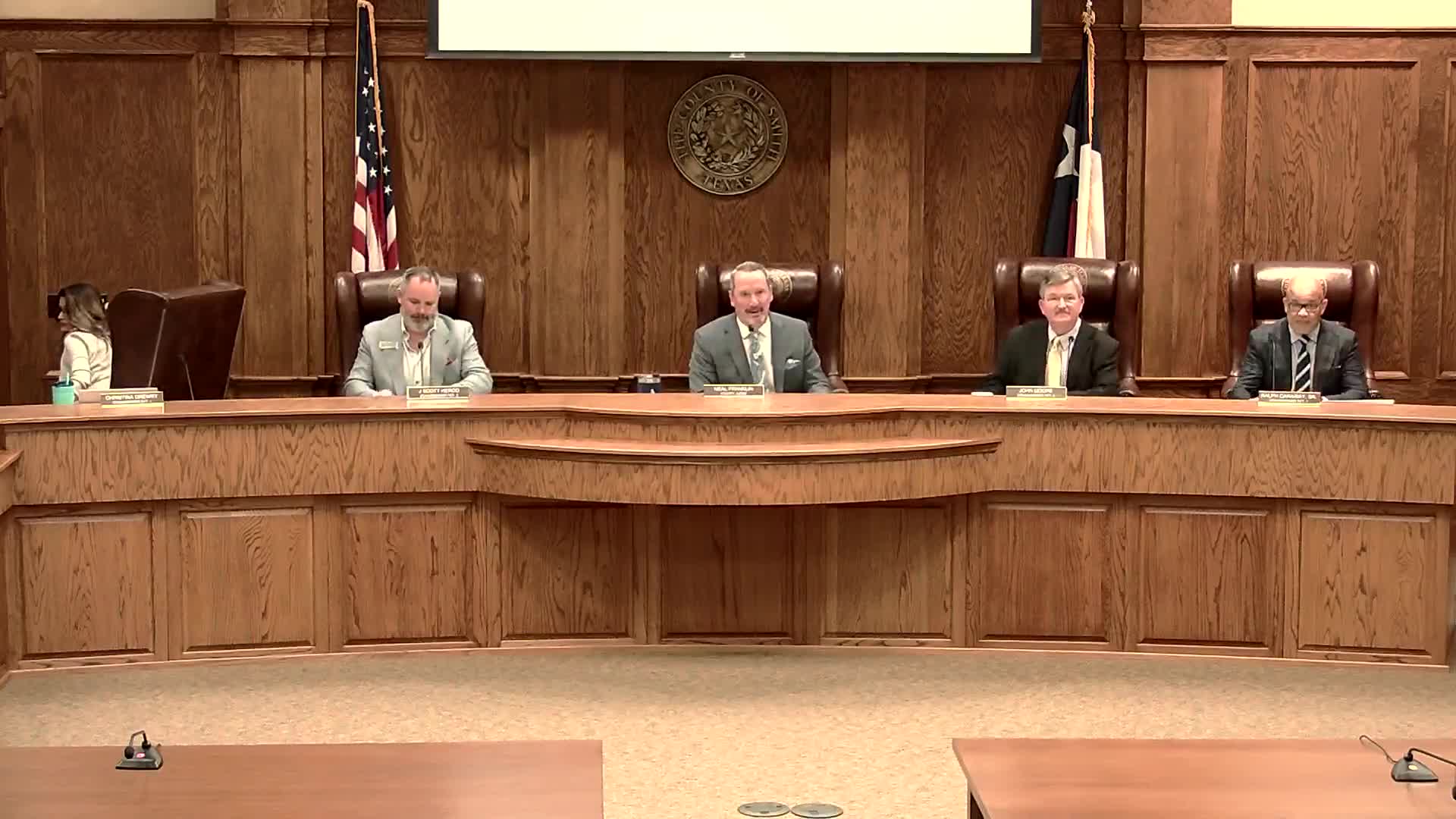
Keisha Morris, the Sequential Intercept Model coordinator for the Andrews Center, briefed the Smith County Commissioner’s Court on Feb. 25 about programs that aim to divert people with serious mental illness from the criminal justice system and to coordinate care across local partners.
“SIM supports community-based jail diversion services to individuals identified as having a mental illness or co-occurring psychiatric substance use disorder,” Morris said. She described six teams the program now oversees, including mobile crisis outreach, crisis respite, forensic competency restoration (in‑jail and outpatient), Takumi (reentry case management), outpatient substance use disorder services and OSAR (outreach, screening, assessment and referral) for Region 4.
Morris reported service and outcome figures for the previous year. Key numbers she presented to the court included: about 7,500 total crisis service contacts; roughly 519 acute bed placements at UT North, with a readmission rate around 15 percent; 82 outpatient competency restoration screenings with 9 resulting court orders; and 288 jail-based competency screenings with 16 orders since that program began in February. She said the county’s inpatient clearinghouse wait list decreased from 38 to 24 and the maximum-security wait list fell from 17 to 6.
Morris also described program expansions and new funding. The Andrews Center won a two-year mental-health grant to support jail-based competency restoration and said it received more funding than requested: she asked for about $84,000 and was awarded roughly $200,000 for two years. The center also was selected by the Texas Health and Human Services Commission (HHSC) for a jail continuity-of-care liaison pilot that funds two jail navigators — one assigned to Smith County — and carries $250,000 annually for a total of $500,000 over two years, Morris said.
She described a recently opened short-term crisis respite program (started Sept. 2024) that had served 17 people and provided more than 93 hours of programming, and an intensive outpatient substance-use-disorder program (IOP) with 28 current enrollees. Morris said Takumi served 237 enrolled participants with more than 2,000 service contacts and reported a recidivism rate of 11.9 percent for those enrolled 12 months or longer.
Morris invited the public and stakeholders to quarterly Mobile Crisis Outreach Team meetings and said the center follows up with callers the next day to coordinate placement or aftercare. She noted improvements in local relationships with law enforcement and that the center provides medication and in‑jail services; she said one annual figure related to jail medication was approximately $130,580.
Judge Neil Franklin and commissioners thanked Morris and asked for comparative state statistics (for readmission and recidivism rates) and for other cost figures; Morris said she could provide comparative data and that some operational cost figures would require follow-up with jail staff. During questions, Morris and other court members discussed that housing a person with mental illness in jail tends to cost the county more than the average inmate because of additional staffing and overtime requirements.
Ending
The court did not take immediate action on the Andrews Center presentation. Commissioners praised the programs and encouraged continued collaboration with law enforcement, the district attorney’s office and regional partners. Morris said she would provide comparative state metrics and other requested details to the court.