Get Full Government Meeting Transcripts, Videos, & Alerts Forever!
Get email alerts on the Hfcs And Refrigerants topic
No spam. Unsubscribe anytime.
HFC bill advances amid industry backing and agricultural concerns over refrigerant supply and retrofit costs
Summary
House Bill 1462 would restrict newly produced HFCs based on global warming potential on a delayed schedule, exempt reclaimed refrigerant and certain sectors, and create a task force to guide transition to lower-GWP alternatives.
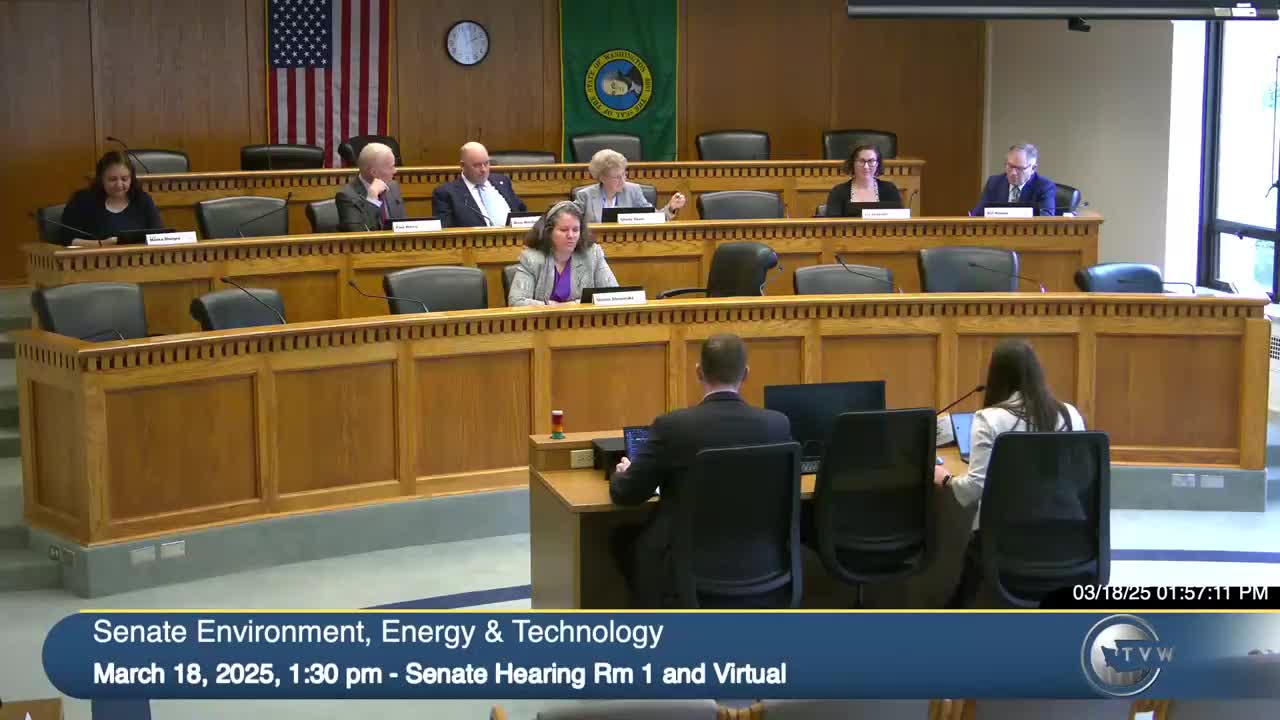
The committee heard second substitute House Bill 14 62, which addresses the state response to the federal HFC phase-down and seeks to reduce greenhouse-gas emissions associated with hydrofluorocarbons (HFCs) while maintaining refrigerant availability for existing systems.
Matt (staff) gave a technical briefing on the bill’s changes from earlier versions and compared the bill to a companion introduced in the Senate. The bill would prohibit newly produced bulk HFCs or blends with a global warming potential (GWP) exceeding 1,500 beginning in 2030 and those exceeding 750 beginning in 2033 (a later timetable than some prior proposals). It exempts reclaimed refrigerants and provides exemptions for specified sectors, including agriculture, HVAC, labor unions, tribal governments and users of large refrigeration systems; it also allows Ecology to invite additional participants to an advisory group and restricts state rulemaking to require very low-GWP alternatives in a sector until Jan. 1, 2028.
Sponsors and environmental groups framed the measure as aligning state policy with federal AIM Act phase-downs while protecting refrigerant supply for food-safety and industrial refrigeration systems. Beth Porter (Environmental Investigation Agency) and Ruth Ari Moore (Hudson Technologies) supported provisions to grow the reclaimed refrigerant market and to avoid premature equipment change-outs by enabling continued service of existing systems.
Industry and agricultural witnesses praised incentives for reclamation but voiced concern about supply and cost impacts: a potato and onion farmer testified that large cold-storage buildings can hold more than 1,200 pounds of refrigerant and that retrofitting a storage could cost “about $450,000” per unit, warning the bill could create an artificial shortage of usable gases and prematurely render otherwise serviceable systems obsolete. Contractors and grocery operators urged clear incentives for recovered and reclaimed refrigerant and warned against measures that would disincentivize bringing recovered refrigerant into the reclamation market.
Several witnesses asked for careful composition of the task force studying alternatives and for clarity that the bill would not impose immediate retrofit mandates; sponsors and many stakeholders emphasized the bill’s goal to support reclamation infrastructure and a managed transition to low-GWP alternatives while protecting food and cold-chain security.
The committee heard broad stakeholder engagement but did not record a vote at the hearing. A partial fiscal note was presented describing multi-year state-level costs in the legislative fiscal estimates.