Get Full Government Meeting Transcripts, Videos, & Alerts Forever!
Get email alerts on the Solid Waste Oversight topic
No spam. Unsubscribe anytime.
Bill to give Ecology greater oversight of landfills draws support and concerns over overlapping authority
Summary
House Bill 1154 would require Ecology to review and approve landfill permits issued by jurisdictional health districts, allow Ecology to suspend permits and impose civil penalties for noncompliance, and create new reporting requirements; local health, county and industry witnesses sought clearer triggers and sequencing for state intervention.
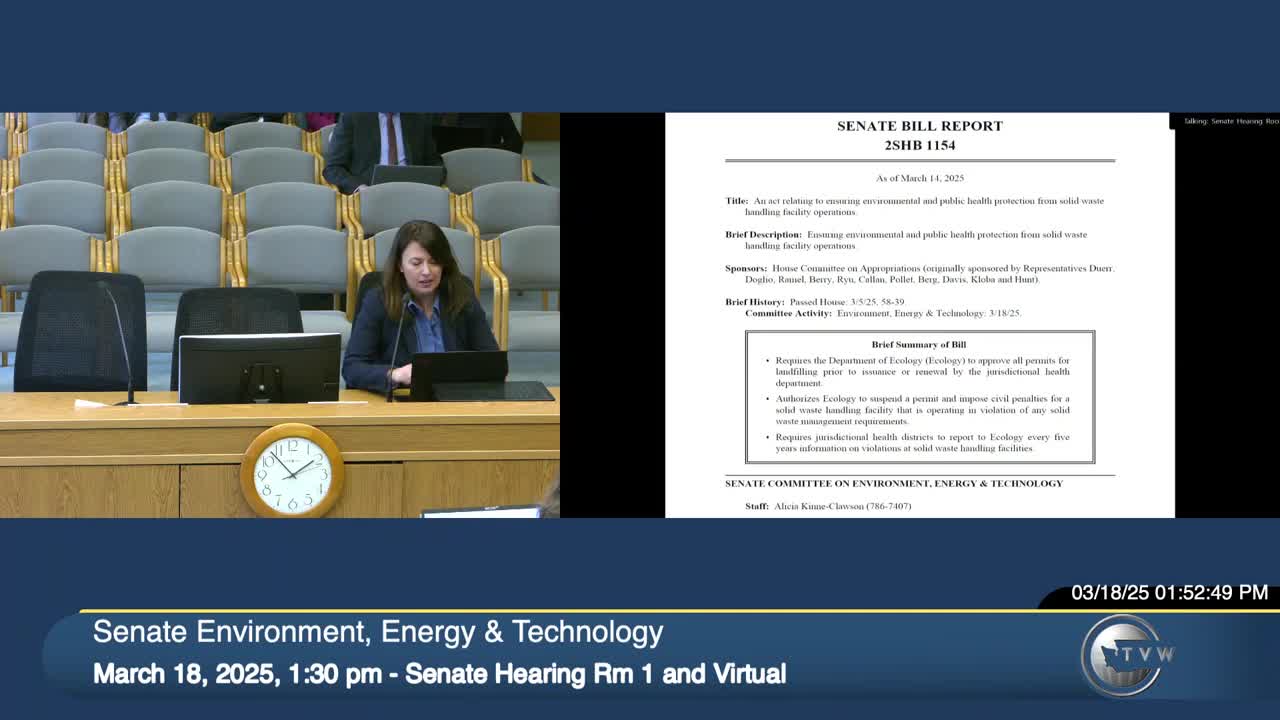
Committee staff and the bill sponsor briefed the Senate Environment, Energy & Technology Committee on second substitute House Bill 11 54, which would modify state oversight of solid waste handling facilities and landfills.
Alicia Kinney Claussen, committee staff, explained that under current law jurisdictional health departments issue permits for solid waste facilities (including landfills) and renew them every five years, with Ecology in an oversight role. The bill would require Ecology to review and approve all landfill permits before issuance and would allow Ecology and local health districts to suspend permits if a facility is out of conformance. The bill also authorizes civil penalties of up to $5,000 per day and up to $10,000 per day after 14 days for facilities operating in violation, and it requires five-year reporting from jurisdictional health districts on existing violations.
Representative Divina Doer, the sponsor, said the bill grew from recurring problems in Yakima County — citing underground fires and long-running noncompliance at specific landfills — and said the measure would create backstops to protect the public when local enforcement has not brought facilities into compliance.
Neighbors and community groups described long-standing impacts: Wendy Wickersham, a neighbor of the Keaton (Caden) landfill area in Yakima County, described underground and surface fires, tire dumping, waste buried outside facility boundaries and hundreds of complaints; Nancy Lust (Friends of Rocky Top) and Scott O'Keeffe testified about groundwater contamination, PFAS detection and difficulty obtaining timely compliance over multiple years.
Local public-health and county solid-waste officials supported stronger tools but objected to unclear triggers and potential regulatory uncertainty. Jamie Bodden (State Association of Local Public Health Officials) warned the bill, as written, could change the cooperative Ecology-local relationship into one where local authority is effectively secondary without clear standards for state takeover. Travis Dutton (Washington Association of County Solid Waste Managers) requested either narrower scope for Ecology intervention or clearer statutory triggers to provide investment certainty.
Operators and private-sector waste managers said they generally support enforcement tools for bad actors but raised concerns about the bill pulling all types of solid-waste handling permits (transfer stations, material recovery facilities, composting facilities, recyclers) into the Ecology intervention framework, which could impose additional compliance burdens where those facilities are not the source of the acute landfill failures described.
Peter Lyon of the Department of Ecology testified in technical support and said Ecology already provides substantial support to local jurisdictions; the bill would give Ecology explicit authority to act if local enforcement does not adequately address violations. Ecology offered draft language that would provide 30 days’ notice before stepping in and said it can implement the bill as written but that the bill has a fiscal impact not included in the governor’s budget.
The committee heard extended testimony and raised questions on how to define triggers, ensure clear sequencing, and protect local relationships while enabling state enforcement in extreme cases. No vote was recorded in the hearing.