Get Full Government Meeting Transcripts, Videos, & Alerts Forever!
Get email alerts on the Medication Dispensing Ed topic
No spam. Unsubscribe anytime.
Committee hears bill to allow hospitals to give larger prepackaged medication supplies at discharge
Summary
Substitute House Bill 1186 would change when hospitals and other licensed healthcare entities may dispense medications at discharge, allowing larger prepackaged supplies in circumstances where nearby pharmacy services are unavailable.
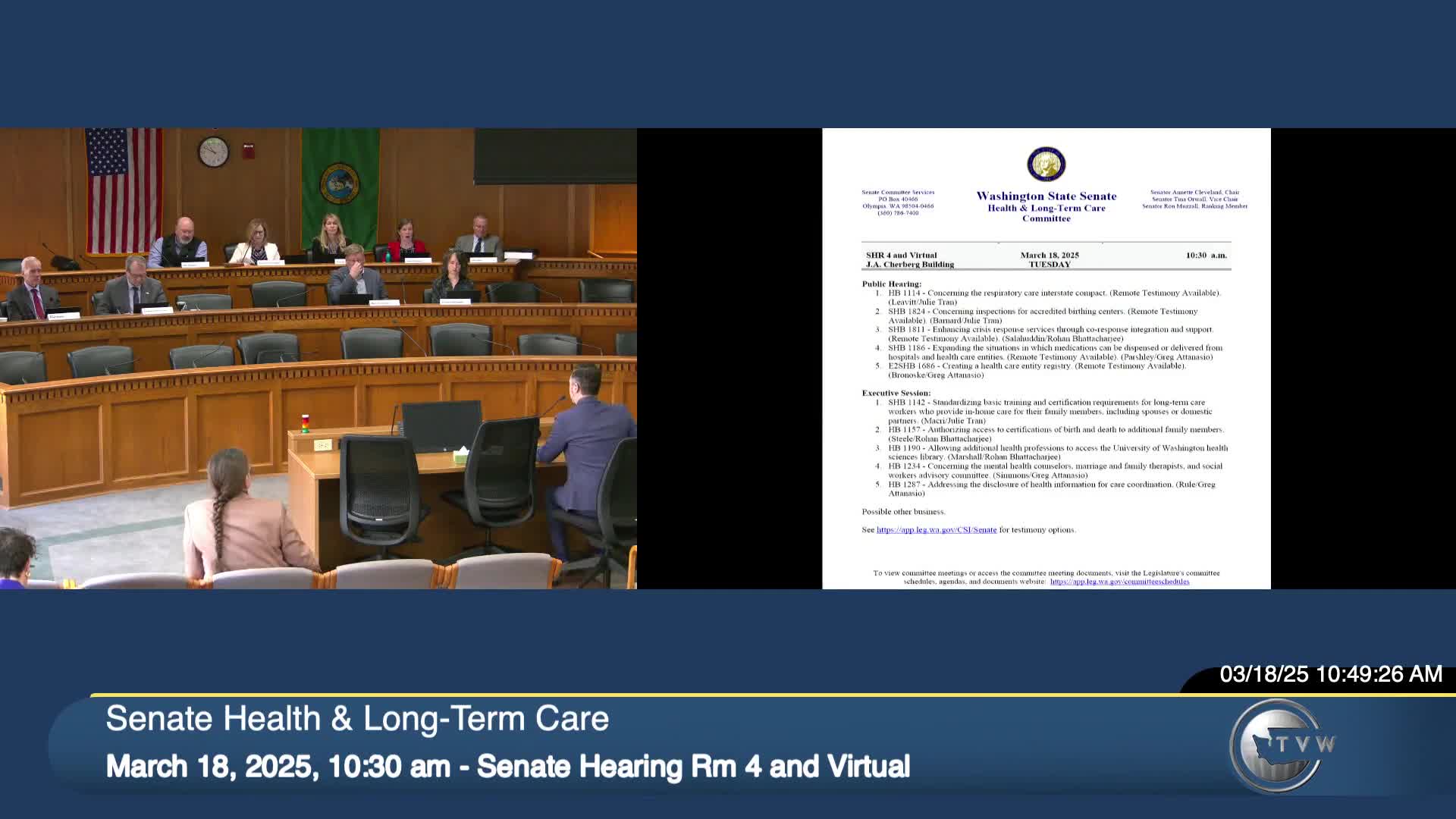
The Senate Health & Long Term Care Committee on March 18 heard testimony on Substitute House Bill 1186, which would modify limits on medication quantities that hospitals and other licensed health-care entities may dispense to patients at discharge when pharmacy services are not available.
Greg Attanasio, committee staff, summarized current law and changes proposed: hospitals may now dispense up to a 48-hour supply in limited circumstances (for example, when pharmacy services are not available within 15 road miles), and other health entities may dispense up to 72 hours. The bill would clarify the distance requirement and expand exceptions to supply limits to include anti-infective drugs and drugs packaged by the manufacturer in quantities larger than the statutory limit and that cannot be altered.
Representative Lisa Parsley, the bill’s sponsor, said the measure would prevent patients from being left without medicine after discharge — an issue in communities where local pharmacies have limited hours — and would reduce waste from opening prepackaged multi-dose products only to discard unused doses.
Rural pharmacists and hospital pharmacy directors described local access problems. Janet Shade, director of pharmacy at Forks Community Hospital, said her town has a single community pharmacy that closes evenings and weekends and that the nearest pharmacy is more than 60 miles away. “The ability to provide prepackaged take home medications over the last several years has been an invaluable resource for patients in Forks,” Shade said.
Katrina Schwartz, director of pharmacy at Cooley Medical Center in Grand Coulee, told the committee her region’s pharmacies have limited hours and that some local pharmacies do not accept Indian Health Service coverage; she said the bill would improve care for disadvantaged populations. Jenny Arnold, CEO of the Washington State Pharmacy Association, said the bill will ensure patients discharged from emergency departments can receive full courses of anti-infectives or prepackaged medicines that cannot be limited to 48 or 72 hours.
Committee staff noted the bill language modifies the distance and expands exceptions; supporters said it would reduce barriers to timely treatment and reduce wastage. The vice chair reported 284 pro, 0 con and 0 other signatories. The hearing record closed after testimony.