Get Full Government Meeting Transcripts, Videos, & Alerts Forever!
Get email alerts on the Prison Work Programs Voluntariness topic
No spam. Unsubscribe anytime.
Bill would make many prison work programs voluntary, bar punishment for refusing to work
Summary
The Senate Human Services Committee heard testimony on a bill that would make most prison work programs voluntary and bar disciplinary punishment for refusing to participate, while DOC officials warned of operational and fiscal impacts.
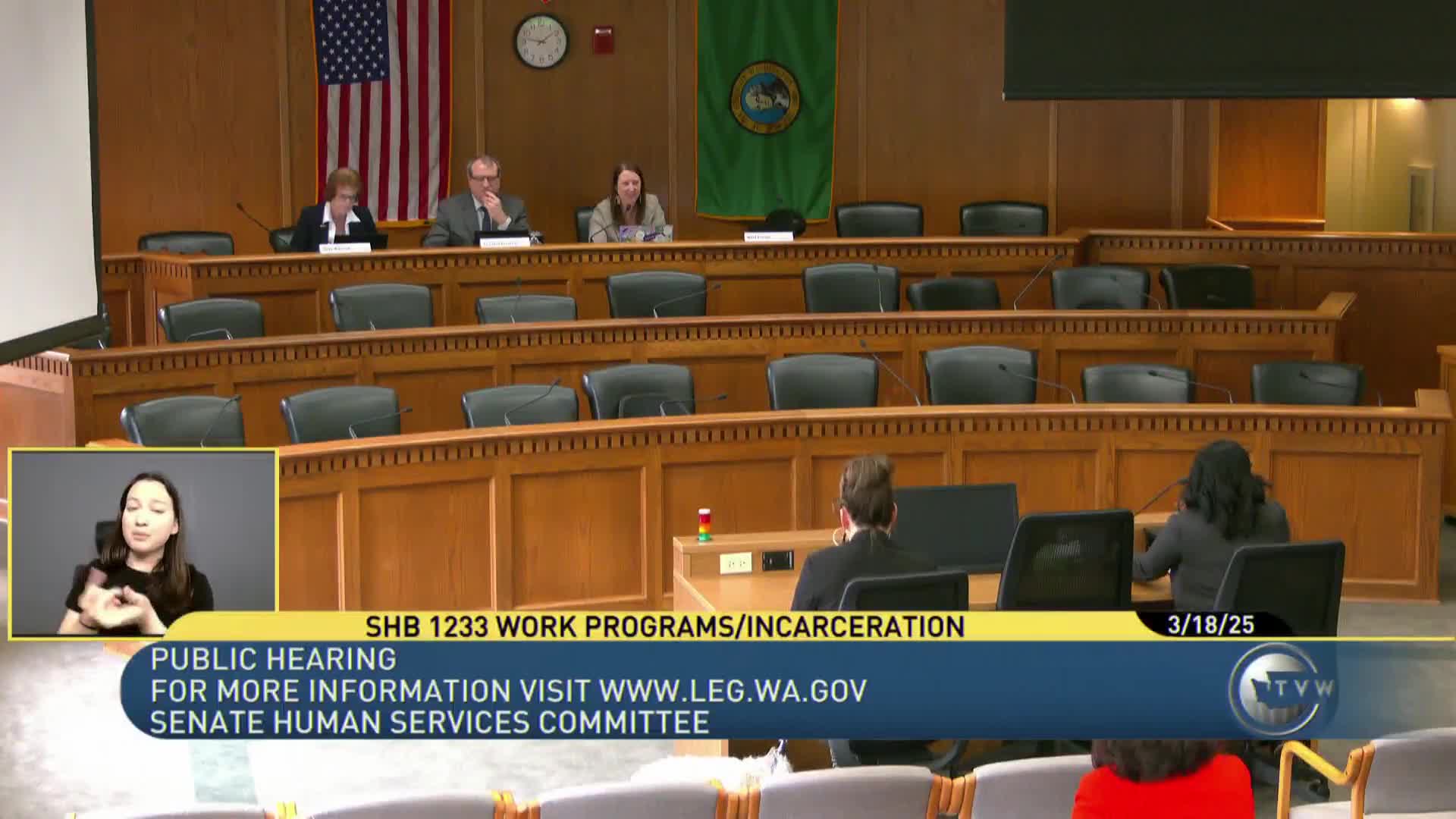
The Senate Human Services Committee heard testimony on Engrossed Substitute House Bill 1233, a bill that would make participation in most correctional work programs voluntary and bar disciplinary or punitive actions for incarcerated people who choose not to participate.
Committee staff Kelsey Ann Fung summarized the bill. She noted the Department of Corrections operates five classes of work programs and that current law links participation and program behavior to the receipt or denial of earned early release days and other privileges. Under the engrossed substitute, incarcerated people would not be required to work except when ordered by a court for community restitution (class 5). If a person voluntarily agrees to participate in a program, they would still be required to comply with established rules for attendance and disenrollment. The bill would prohibit reducing earned early release days and other privileges based solely on a person’s choice not to participate in work programs, and it would prohibit infractions or punitive disciplinary actions for refusal to participate. The substitute also specifies that participants in class 1 through 4 programs must be paid a wage or gratuity as provided in current law.
Representative Tara Simmons, the bill’s sponsor and a person with direct lived experience, described her time in incarceration and told the committee she was forced to work in a prison kitchen for 42¢ an hour and subjected to daily strip searches; she said voluntary participation is a moral and rehabilitative issue and cited trauma associated with forced labor. Simmons said many incarcerated people worked for low pay because of commissary needs and family circumstances, but others—such as people with disabilities or older adults—should not be forced into operations work.
Department of Corrections witnesses emphasized operational risks if class 3 work became voluntary. Kristen Morgan, a senior administrator in DOC’s reentry division, said work programs combat idleness and promote work readiness and reduce recidivism. Jason Bennett, senior director of correctional operations, told the committee that about 3,800 class 3 participants work across eight major facilities and three camps and that DOC produces roughly 39,000 meals per day. Bennett estimated that if many class 3 positions went unfilled the department would need roughly 750 additional staff to meet operational needs, at high cost. He also said medical exemptions exist and that health‑status reports (HSRs) can exempt individuals for medical reasons.
Several witnesses with lived experience testified they had volunteered for work that taught marketable skills; others argued forced work is dehumanizing. Tuan Quach of the Equity and Education Coalition and Jamey (Jermaine) Williams of the Black Rose Collective said the key distinction is consent: where work is voluntary, participants reported meaningful skill and personal development; where forced, work becomes punitive.
Committee members asked for more data on infractions for refusal to work and on victim restitution deductions. Staff clarified that for class 3 institutional support jobs, crime victims compensation deductions are 5 percent. Witnesses requested more study about which positions have waiting lists and which roles are hard to fill, and some recommended policy alternatives that preserve core operations while protecting incarcerated people from punitive discipline for refusing work.
No committee vote occurred at the hearing; the bill remains in committee for further consideration.