Get Full Government Meeting Transcripts, Videos, & Alerts Forever!
Get email alerts on the Clean Energy Transformation Act topic
No spam. Unsubscribe anytime.
Bill would clarify how Bonneville purchases count under Washington’s Clean Energy Transformation Act
Summary
House Bill 1329 would narrow and clarify treatment of unspecified wholesale power purchases under the Clean Energy Transformation Act (CETA), allowing limited-duration unspecified contracts for reliability and explicitly excepting long-term BPA purchases from the law’s no-coal standard except where BPA knows power is coal-generated.
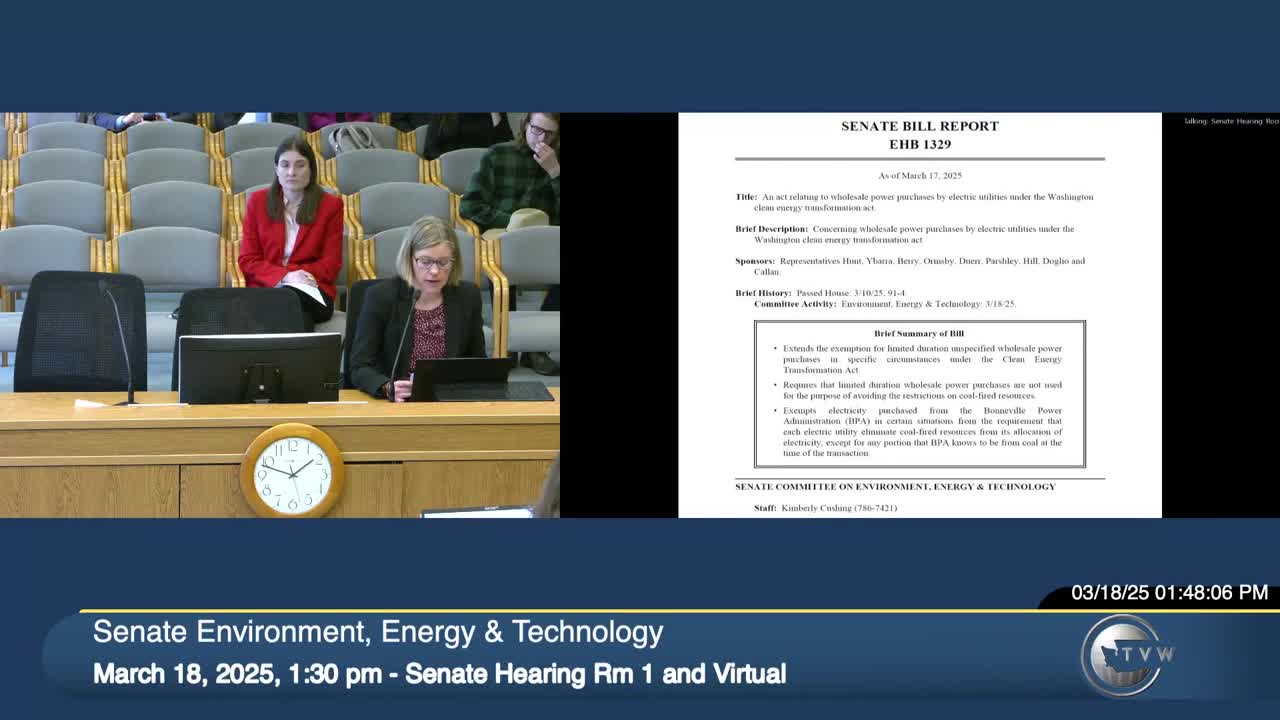
Committee staff and sponsors briefed members on engrossed House Bill 13 29, a technical bill intended to clarify how certain wholesale power purchases are treated under the Clean Energy Transformation Act (CETA).
Kim Cushing, committee staff, explained that CETA requires Washington utilities to eliminate coal-fired resources from their electricity allocation by Dec. 31, 2025, make retail sales greenhouse-gas neutral in subsequent milestones, and reach 100% nonemitting and renewable retail load by Jan. 1, 2045. Under current CETA guidance, a limited-duration wholesale power purchase of unspecified electricity (where the source is not known at procurement) is exempt from the definition of a coal-fired resource if the contract duration is less than one month.
The bill would extend that exemption, allowing unspecified purchases with a contract duration not to exceed three months, or up to six months if used to demonstrate compliance with regional resource adequacy under an approved program. The bill also clarifies that limited-duration wholesale purchases may not be used to evade the CETA no-coal standard. It directs that electricity purchased from the Bonneville Power Administration (BPA) under a long-term power purchase or exchange — including unspecified electricity — be treated as exempt from CETA’s no-coal standard except for any portion BPA knows to be generated by a coal-fired plant at the time of transaction.
Sponsors and public utility witnesses said the change removes legal uncertainty that could expose utilities and customers to penalties. Representative Victoria Hunt, the sponsor, said the measure supports affordability and reliability for public utilities as they meet CETA milestones. Multiple public utilities and PUD representatives testified in support: Cowlitz PUD, Seattle City Light, Tacoma Power, Grant County PUD and Snohomish County PUD described the bill as a narrow technical fix that protects customers from potential penalties and price volatility while allowing utilities to meet reliability obligations. Testimony cited a potential penalty of $150 per megawatt-hour if certain purchases were later interpreted as violating CETA.
Staff said Commerce anticipates minimal rulemaking and the fiscal impact is small; UTC rulemaking costs were estimated at approximately $41,000 in an earlier analysis. The bill was discussed but not voted on at the hearing.
What the bill does not change: sponsors emphasized the bill does not alter CETA’s no-coal policy or the broader decarbonization transition; it clarifies the treatment of specific short-term wholesale products and long-term BPA purchases to avoid unintended penalties and preserve reliability.