Get Full Government Meeting Transcripts, Videos, & Alerts Forever!
Get email alerts on the Core Response Crisis topic
No spam. Unsubscribe anytime.
Senate committee hears bill to expand co-responder protections and recognize core response teams
Summary
Substitute House Bill 1811 would define and recognize core response teams — multidisciplinary partnerships of first responders and behavioral-health professionals — expand privileged-communications protections to certain peer supporters and include corresponders in workers’ compensation presumptions.
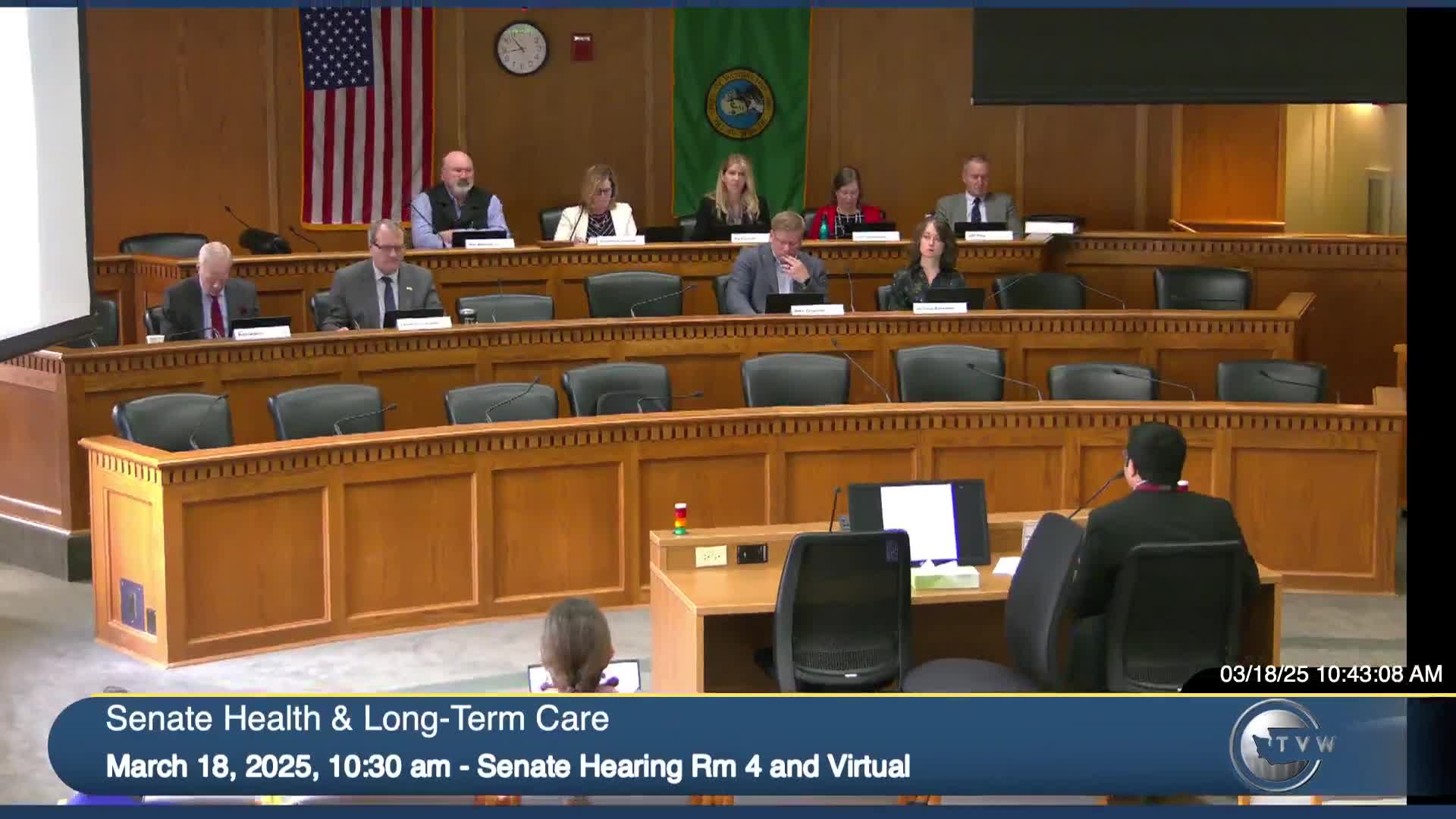
The Senate Health & Long Term Care Committee on March 18 heard testimony on Substitute House Bill 1811, which would enhance crisis response by integrating behavioral health professionals into first-responder systems and extending legal protections and employment presumptions to core response participants.
Rohan Bhattacharjee, committee staff, said the bill (which passed the House 92-3) defines “core response” as a multidisciplinary partnership of first responders and human services professionals responding to behavioral health crises, expands the definition of first responder for privileged communications purposes to include those engaged in core response services, and extends a prima facie workers’ compensation presumption for occupational disease during public health emergencies to corresponders engaged in first response teams.
Representative Osman Salahuddin, the bill’s prime sponsor, said co-response teams “are comprised of trained clinicians, social workers, nurses, and peer support specialists” and that the bill formally recognizes co-responders as frontline employees, giving them similar legal protections to police, fire and EMS. Salahuddin said the model is operating in multiple Washington jurisdictions and urged the Senate to adopt it.
City and program representatives, public-health and academic experts and crisis responders testified in support. Amy Barton, chief of Seattle’s Seattle Care Department, said about half of incoming 911 calls relate to mental health, homelessness or substance use and described Seattle’s community crisis responder unit. “Providing the best first response saves time, it saves money, and it saves lives,” Barton said.
Natasha Grossman of Bellevue Fire Department described trauma exposure for behavioral-health corresponders and said the bill would allow corresponders to participate in peer-support programs without fear their peer conversations could be compelled in court. Jennifer Stuber, director of BH Core at the University of Washington, described a 40-hour co-response training academy developed with CROA and asked the committee to consider funding amendments to support training and peer support networks.
Brad Banks, representing Behavioral Health Administrative Services Organizations, and Brooke Buettner, director of a regional crisis response agency, described measurable outcomes from co-responder programs — reductions in jail bookings, fewer crisis-service events and fewer emergency department admissions — and asked that funding for training and peer support be added.
Committee testimony was uniformly supportive: vice chair reported 39 pro, 0 con and 0 other testifiers. Supporters requested the bill also include resources for training and peer supports; staff and witnesses noted that funding language had been considered in prior budget provisos.