Get Full Government Meeting Transcripts, Videos, & Alerts Forever!
Get email alerts on the Service Of Process topic
No spam. Unsubscribe anytime.
Panel backs statutory cleanup to align service-of-process rules with business code
Summary
House Bill 1361, an agency-request bill from the Secretary of State, would align general service-of-process statutes with the Uniform Business Organization Code and clarify nonresident motorist service procedures. Secretary of State staff and the sponsor told the Law & Justice Committee the changes reduce confusion and help pro se litigants.
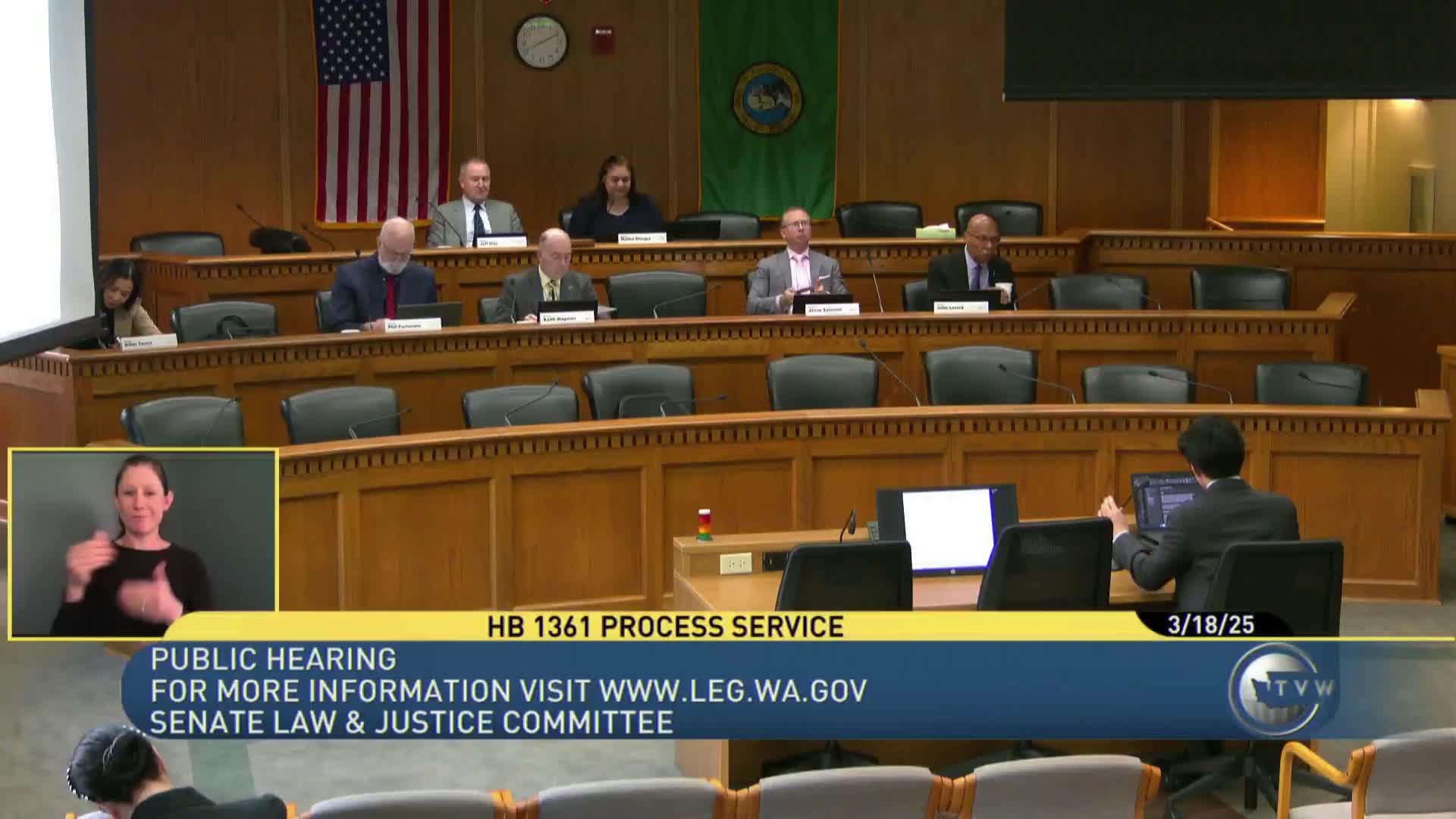
House Bill 1361, brought to the Senate Law & Justice Committee at the request of the Secretary of State, would revise Washington's service-of-process statutes to align general civil-procedure rules with the Uniform Business Organization Code and clarify procedures for serving nonresident motorists.
Ryan Giannini, staff counsel to the committee, summarized that the Uniform Business Organization Code adopted in 2015 created new standards for serving business entities, but existing civil procedure statutes were not amended then, leaving two conflicting methods. The bill would reconcile those provisions and restructure statutes for clarity. The bill would also clarify how a nonresident motorist involved in an accident may be served and makes the procedures applicable regardless of whether a party is represented by counsel.
Representative Laurie Jinkins Hill (sponsor in the transcript identified as Representative Hill) told the committee the measure is largely a statutory cleanup that will reduce attorney fees and confusion among pro se litigants. Scott Douglas, director of the Corporations and Charities Division at the Secretary of State, testified the bill aligns Title 4 civil procedure language with RCW 23.95 (Uniform Business Organization Code) and breaks dense current language into clearer sections, including nonattorney-friendly instructions for nonresident motorists.
Staff said the bill is nearly identical to a prior Senate bill that passed unanimously last year; a fiscal note was not requested. The committee closed the public hearing with no immediate action reported.