Get Full Government Meeting Transcripts, Videos, & Alerts Forever!
Get email alerts on the Clemency And Pardons Board topic
No spam. Unsubscribe anytime.
Bill would double Clemency and Pardons Board membership and add training and reporting requirements
Summary
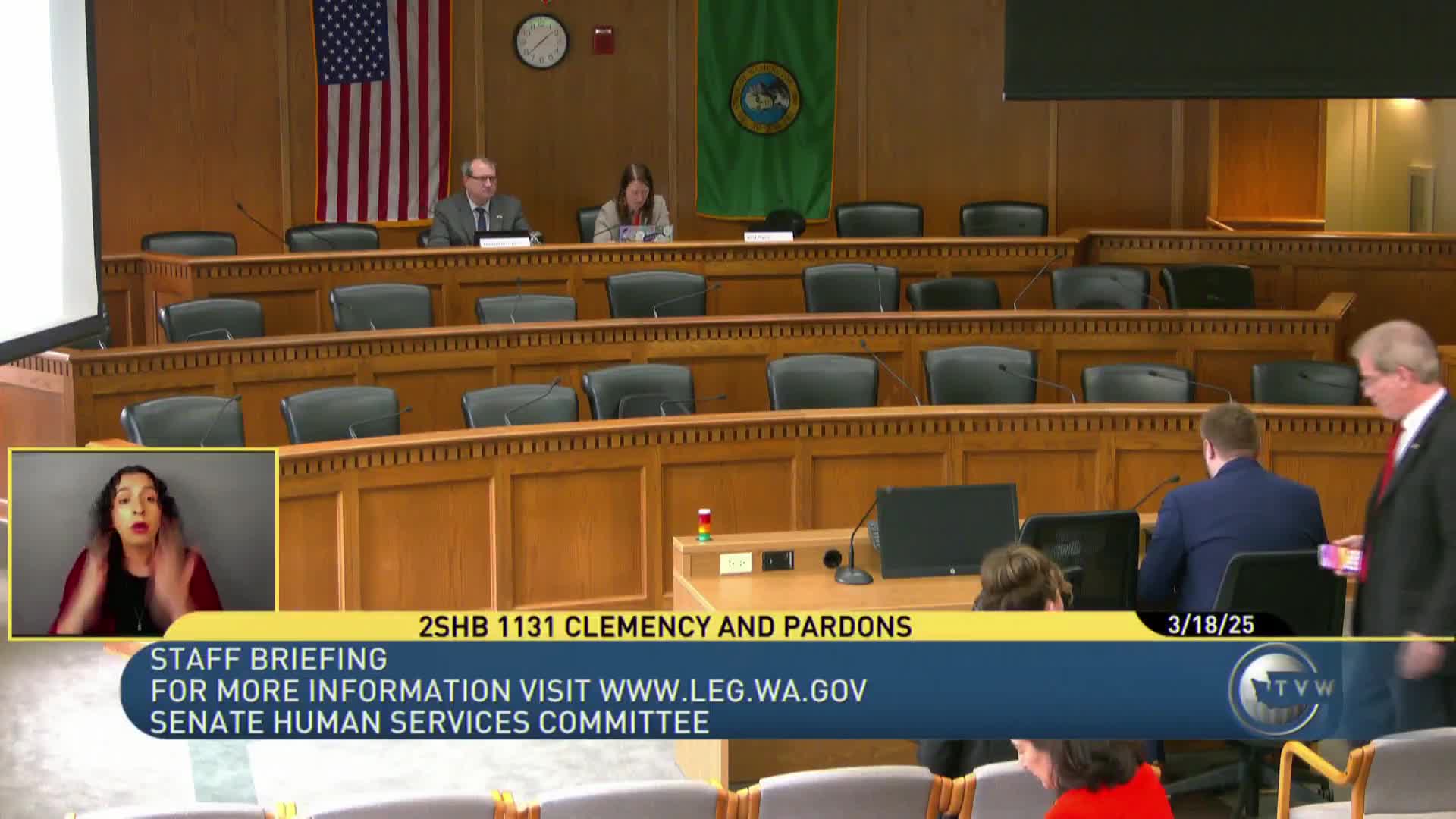
The Senate Human Services Committee took testimony on a bill to expand the Clemency and Pardons Board from five to ten members, require training and reporting, and clarify procedures for pardons and commutations.
The Senate Human Services Committee took testimony on Engrossed Second Substitute House Bill 1131, which would expand the Clemency and Pardons Board from five to ten members, extend term length, require training and annual reporting, and modify several procedural requirements for pardons and commutations.
Will Tronson, committee staff, summarized the bill. He said the governor currently has constitutional authority to pardon state convictions and that the Clemency and Pardons Board—established within the governor’s office—now consists of five governor‑appointed members who serve four‑year terms. House Bill 1131 would expand the board to ten members, change terms to five years with a two‑term limit, and allow per‑diem compensation up to $100 per day (which a member may waive). The bill would also require the governor to ensure diversity in appointments and require board members to attend training in racial equity, racism and restorative justice at least every two years. The staff briefing said the bill would increase notice to county prosecutors from 30 to 90 days and require the DOC to provide community custody supervision where a commutation includes conditional community custody. A staff fiscal note cited indeterminate costs, primarily related to supervising individuals on community custody, with potential costs below $50,000 per year; the governor’s office estimated roughly $16,000 for member compensation and travel.
Representative Roger Goodman, the bill’s prime sponsor, told the committee the principal intent is to expand board capacity so more petitions can be considered and to enumerate certain types of members, including people with lived experience and victims. Goodman said the bill clarifies the standard for commutation by adopting the phrase “in the interest of justice,” a standard he said is already used in other resentencing statutes.
Supporters from community organizations said expansion and codifying the standard would increase transparency and capacity. Waldo Waldron Ramsey of Washington CAN argued the community should have a formal voice on clemency decisions. Barbara Serrano, former senior policy advisor on public safety to Governor Inslee, said she reviewed petitions for the governor and supported expansion to reduce backlogs; she also noted petitions undergo rigorous review by the board and by the governor.
Several system stakeholders raised objections or concerns. James McMahon of the Association of Sheriffs and Police Chiefs and Russell Brown of the Washington Association of Prosecuting Attorneys said they were concerned the bill substitutes the existing, long‑standing “extraordinary cases” standard with “in the interest of justice,” which they interpreted as a potentially lower or different standard. They also objected to the bill’s mandatory enumeration of member constituencies, saying appointments should remain the governor’s discretion and not read as caucus representation.
Cindy Ahrens of the Washington Defender Association and the Washington Association of Criminal Defense Attorneys supported expansion but recommended the bill soften mandatory language about specific member types to preserve flexibility; she also recommended adding gender equity and sexism to the required training curriculum and supported per‑diem compensation to broaden the pool of possible members.
The committee heard multiple perspectives on risk, victim notice, member training and the constitutional role of the governor in clemency. No committee vote occurred during the hearing; the bill remains under committee consideration.