Get Full Government Meeting Transcripts, Videos, & Alerts Forever!
Get email alerts on the Organics Management topic
No spam. Unsubscribe anytime.
Committee hears bill to standardize bin colors, expand organics collection and require labeling
Summary
House Bill 1497 would set container coloring and labeling standards, require multifamily source-separated organics in areas already served, strengthen space requirements in the state building code for organics collection, and authorize civil penalties for noncompliant businesses.
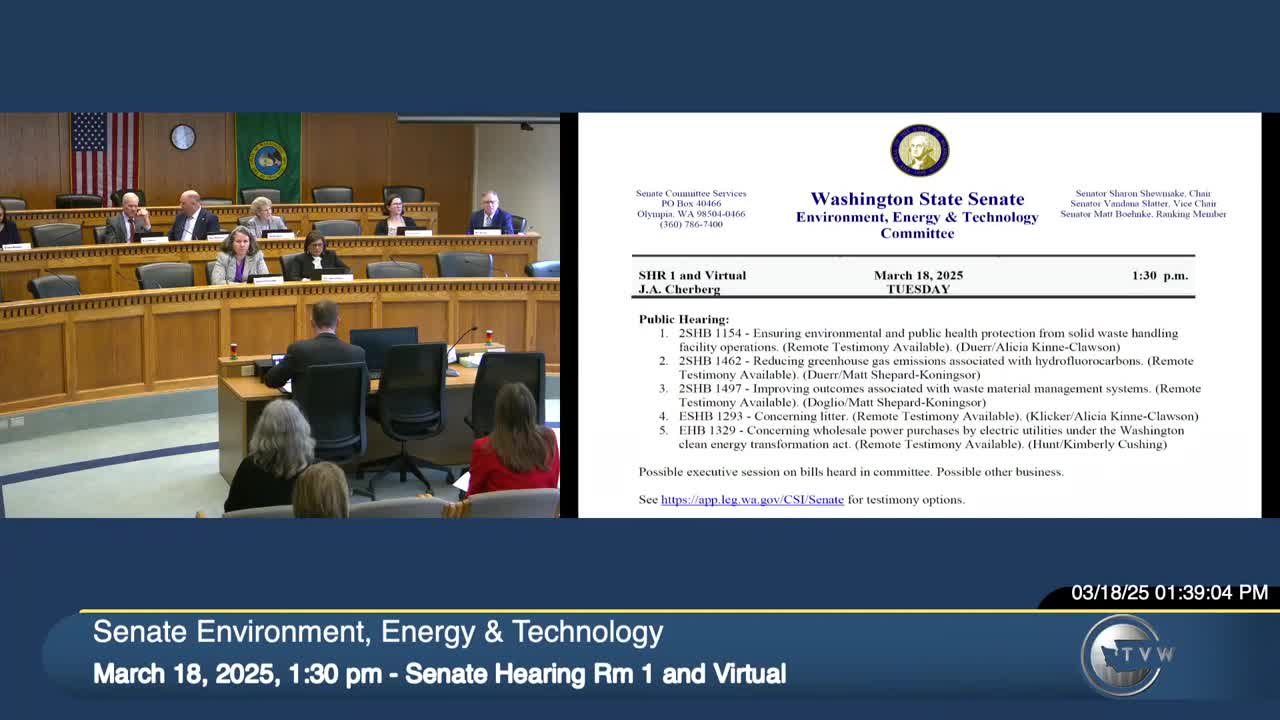
The Environment, Energy & Technology Committee heard staff and sponsor briefings and public testimony on second substitute House Bill 14 97, legislation aimed at strengthening the state’s organic materials management system.
Matt Sheppard Coningsworth, staff to the committee, described background requirements established by prior laws and summarized the bill’s key provisions: standardized coloring and labeling requirements for solid waste collection containers and lids; a phase-in to require source-separated organic collection for newly constructed or substantially remodeled multifamily housing in areas subject to existing requirements; modifications to the state building code to provide adequate space for co-located containers; and civil penalties beginning in 2026 for businesses that fail to comply after notice.
Representative Beth D'Oleo, the bill sponsor, framed the measure as an iterative step toward the state’s 50% food-waste reduction goal set in earlier legislation. She emphasized educational opportunities — including OSPI (Office of Superintendent of Public Instruction) developing school resources — and said the bill is designed to balance emission reductions with attention to small-business impacts and phased implementation.
Local governments, waste-collection companies and nonprofits provided varied testimony. Counties and waste managers supported the clarity and stronger enforcement tools but asked for predictable triggers and sequencing for state intervention. Jamie Bodden of the State Association of Local Public Health Officials and Travis Dutton of the Washington Association of County Solid Waste Managers supported Ecology’s enhanced role but warned that the bill should clarify the circumstances that would allow the Department of Ecology to overrule or step in on local enforcement. City and utility officials asked for flexibility on cart color conversions and phased funding support: the City of Kirkland estimated changing residential bin colors for 44,000 carts would cost over $4 million and said it could create short-term inconsistencies and contamination risks if not phased and funded thoughtfully.
Operators and processors stressed practical matters: Seattle Public Utilities’ organics lead said standardized colors reduce contamination; material recovery and compost operators urged investments in depackaging and contamination controls; and private-sector collectors signaled support for standardized labels and source separation while urging careful sequencing and funding changes because organics diversion can reduce landfill tip-fee revenue counties use to fund operations.
Stakeholders noted fiscal impacts in the bill’s partial fiscal note and urged further work on funding mechanisms for long-term organics programs. The committee received extensive stakeholder feedback but did not adopt amendments or vote at the hearing.
The bill remains at the hearing stage with further work expected on sequencing, funding, and technical rulemaking.