Get Full Government Meeting Transcripts, Videos, & Alerts Forever!
Get email alerts on the Birthing Center Inspections topic
No spam. Unsubscribe anytime.
Bill would let accredited birthing centers skip duplicate state surveys; owners and midwives testify
Summary
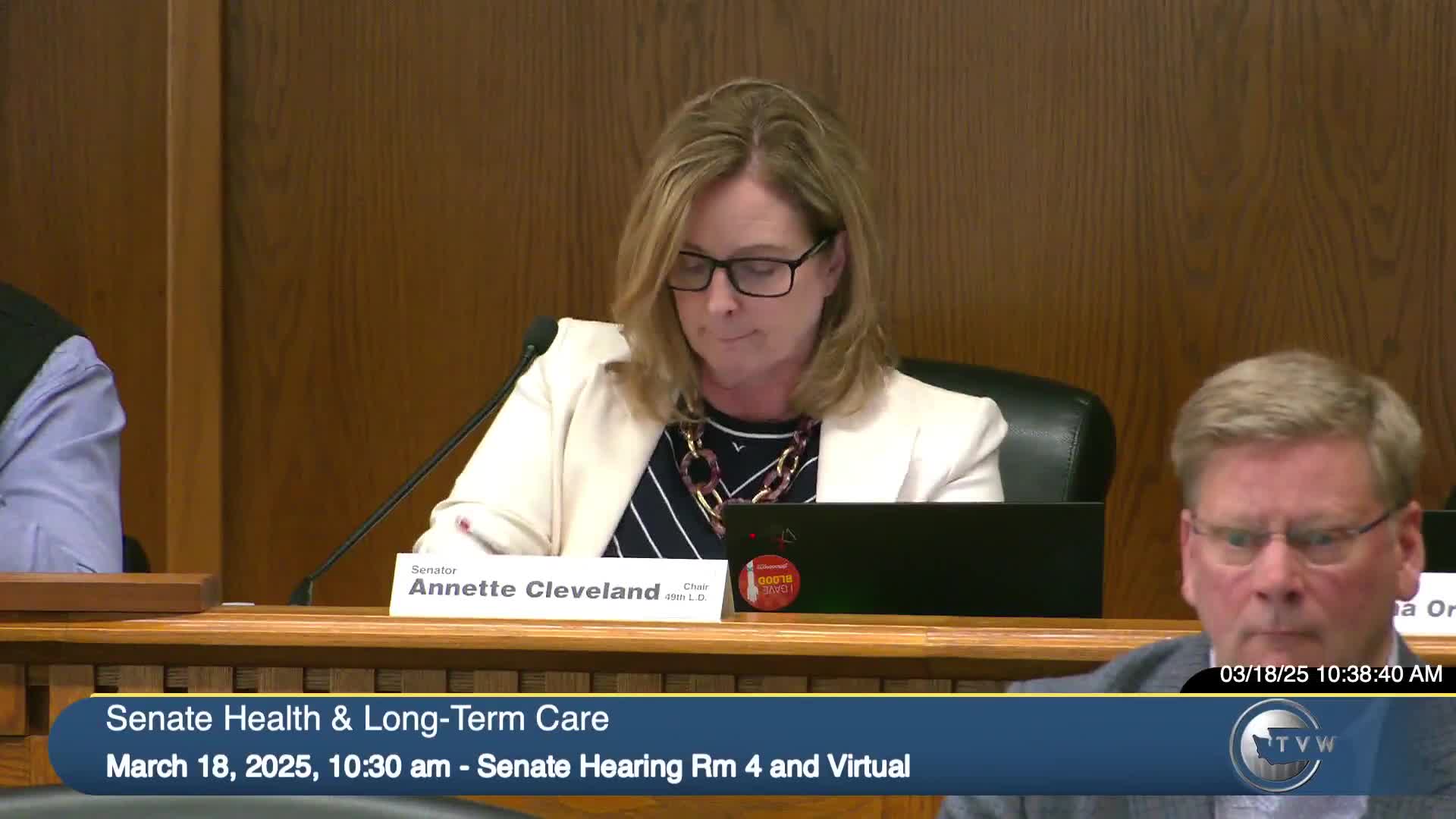
The Senate Health & Long Term Care Committee on March 18 considered substitute House Bill 1824, which would let nationally accredited birthing centers avoid duplicative Department of Health licensure surveys when the accreditor’s standards are substantially equivalent to state law and rules.
The Senate Health & Long Term Care Committee on March 18 considered substitute House Bill 1824, which would allow birthing centers accredited by a recognized accrediting body to be exempt from periodic state licensure surveys when the department determines the accreditor’s standards are substantially equivalent to state statutes and rules.
Julie Tran, committee staff, told members the bill sets conditions for the exemption, including demonstration that the accrediting body’s survey standards align with applicable statutes and rules, and noted birthing centers are licensed and inspected by the Department of Health. Representative Stephanie Barnard, the bill’s House sponsor, described the measure as a “good little bill” aimed at reducing duplicative inspections and saving money for birth centers and the Department of Health.
Carolee Hall, a licensed midwife and owner of The Birth House in Olympia, testified the Commission for the Accreditation of Birth Centers (CABC) “exceeds Department of Health requirements” and that national accreditation reviews evidence and updates indicators more frequently than the department can. Hall said she has had multiple Department of Health inspections and that those inspections sometimes occurred soon after CABC accreditation surveys, producing duplicative work.
Dr. Cynthia Flynn, a certified nurse midwife and co-owner of Columbia Birth Center in Eastern Washington, said national accreditation is independent and provides a rigorous, evidence-based review that already ensures compliance with state statutes and rules. Flynn told the committee the bill would cost the state nothing and could save resources by avoiding redundant inspections.
Witnesses pointed to published studies and accreditation outcomes, saying accredited centers show positive maternal and infant outcomes. No opponents testified; the vice chair reported 25 pro, 0 con and 0 other testifiers.
Supporters asked the committee to confirm that state statutes and rules remain binding and that exempted centers must still follow state law. The bill includes language requiring the Department of Health to determine substantial equivalency before granting the exemption for accredited centers. The committee closed public testimony and temporarily set the bill aside for further consideration.