Get Full Government Meeting Transcripts, Videos, & Alerts Forever!
Get email alerts on the Court Interpreters topic
No spam. Unsubscribe anytime.
Committee hears bill to update court interpreter rules, AOC and court officials urge passage
Summary
Engrossed Second Substitute House Bill 1174 would modernize Washington's court-interpreter statutes to clarify appointment, payment, terminology and AOC responsibilities.
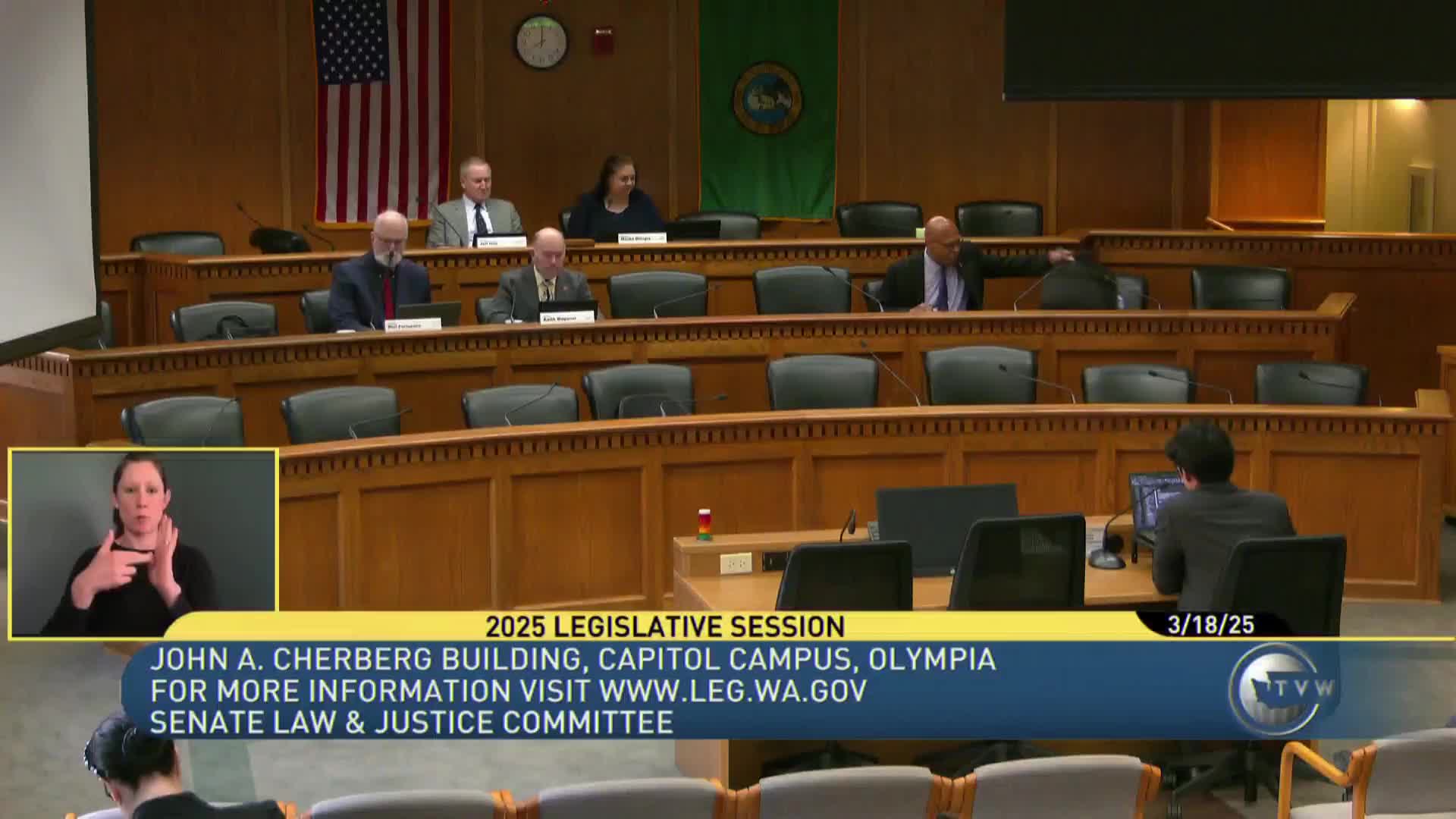
Engrossed Second Substitute House Bill 1174, which revises state law governing court interpreters, was the subject of a public hearing before the Washington Senate Law & Justice Committee. Staff counsel Ryan Giannini summarized the bill as an Administrative Office of the Courts (AOC) request that modernizes terminology, clarifies appointment processes and payment responsibilities, updates reimbursement rates and requires language access plans from trial courts prior to AOC reimbursement.
Ryan Giannini, staff counsel to the committee, told members the bill “updates statutory provisions related to court interpreters” and aligns state law with current court practice and federal and state case law. Representative Strom Peterson, prime sponsor, described the measure as an access-to-justice step that adds flexibility and modernization to existing statute.
Court and AOC witnesses urged support. Michael Diaz, judge on the Court of Appeals Division I and chair of the interpreter commission, said the statute dates to 1989 and that the bill would harmonize state law with federal and state developments and current operations.
James Wells, language access supervisor at the Administrative Office of the Courts, said the proposed changes will “help ensure that Washington can continue being a leader in serving our community,” noting the state was an early adopter of court language-access policies and that the law has fallen behind current practice. Luisa Garcia, manager of Seattle Municipal Court Interpret Services, said the changes will improve how courts secure interpreters and manage teams and credentials, and will help courts steward taxpayer funds more efficiently.
Haley Perkins, court program supervisor in AOC’s Office of Judicial and Legislative Relations, said the bill codifies practices already in use, clarifies judges’ role in identifying suitable interpreters and will let courts make better use of the reimbursement program the Legislature funded in 2019.
Committee Chair Dhingra closed the public hearing after staff noted 38 people signed in pro and 67 signed in con. No committee action was recorded during the hearing.
Supporters asked the committee to advance the bill to maintain court access for people with limited English proficiency and to align statute with current funding and operational practices; Giannini and witnesses said a fiscal note is available.