Get Full Government Meeting Transcripts, Videos, & Alerts Forever!
Get email alerts on the Litter And Plastic Bags topic
No spam. Unsubscribe anytime.
Senate committee hears bill to raise litter penalties, delay thicker plastic bag requirement
Summary
A public hearing on House Bill 1293 considered raising the civil infraction for littering from class 3 to class 2 and delaying an increase in the minimum thickness for reusable plastic bags; supporters emphasized deterrence, opponents and industry groups urged caution about the bag change.
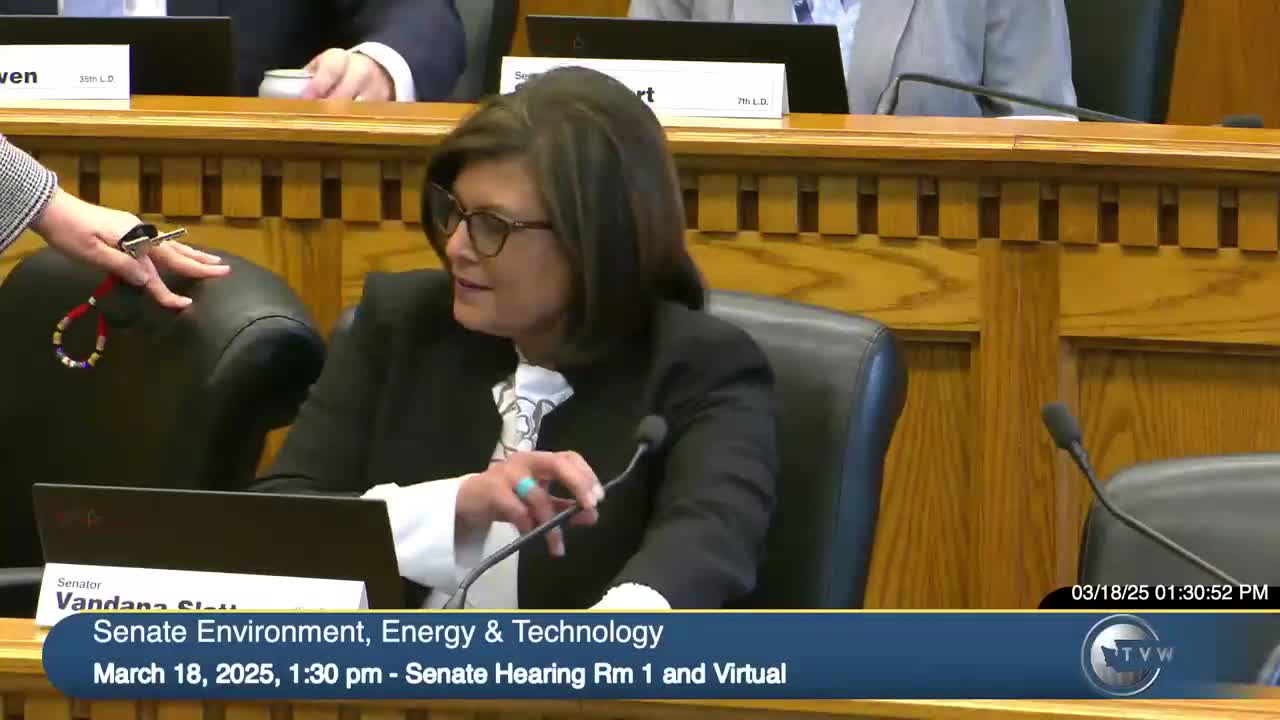
Vice Chair Slatter convened a public hearing on House Bill 1293 on litter enforcement and plastic bag rules, with staff and the bill’s prime sponsor briefing the Senate Environment, Energy & Technology Committee.
Alicia Kinney Claussen, staff to the committee, summarized the engrossed substitute: “This bill raises the penalty for littering and delays the increase in the minimum allowable thickness of plastic bags.” She described current law classifying small litter (one cubic foot or less) as a class 3 civil infraction and noted separate traffic infractions for throwing material onto state highways. Kinney Claussen also summarized that retailers currently collect an 8¢ pass-through charge per reusable plastic bag through Dec. 30, 2025, increasing to 12¢ on Jan. 1, 2026; the bill leaves that charge schedule unchanged while delaying the 4 mil thickness requirement until Jan. 1, 2028.
Representative Mark Clicker, the bill’s sponsor, said the bill is meant to be “a start” toward addressing what he described as “a real litter problem in the state of Washington,” and noted higher fines across the border in Oregon as an example he sees working locally. He urged the committee to move the bill forward to deter littering on highways and other public spaces.
Stakeholders and agency staff who later testified during the resumed public hearing emphasized different aspects. Peter Lyon of the Department of Ecology said the bill “may help deter littering” by increasing the infraction level and described the delayed bag-thickness change as allowing more time to support businesses and to consider an upcoming Department of Commerce report on the issue. Nonprofit and business witnesses split: Heather Trim of 0 Waste Washington supported the change as part of broader litter and waste-reduction work; Amber Carter of the American Recyclable Plastic Bag Alliance said the stakeholder process favored keeping the current 2.25 mil (or 2.5 mil reported by recyclers) threshold rather than moving to 4 mils, arguing that a 4 mil standard would increase plastic production without addressing litter.
Volunteers who pick up litter urged stronger enforcement. Susan Vossler, an adopt-a-highway volunteer, described collecting 143 bags of litter along a one-mile stretch in recent weekends and said stricter penalties could change behavior.
The committee did not take action in the hearing; testimony and staff briefings were the only recorded actions. No vote or amendment was recorded in the transcript.
The bill also includes a partial fiscal note and, at staff briefing, was described as having “no estimated fiscal impact” for the changes discussed in the staff summary.
What’s next: the committee suspended and resumed the public hearing; the transcript records the briefing and public testimony but does not show final committee action on HB 1293.