Get Full Government Meeting Transcripts, Videos, & Alerts Forever!
Get email alerts on the Real Estate Excise Tax topic
No spam. Unsubscribe anytime.
Committee hears bill to harmonize local real estate excise tax uses, create REET exemption for community-serving affordable housing
Summary
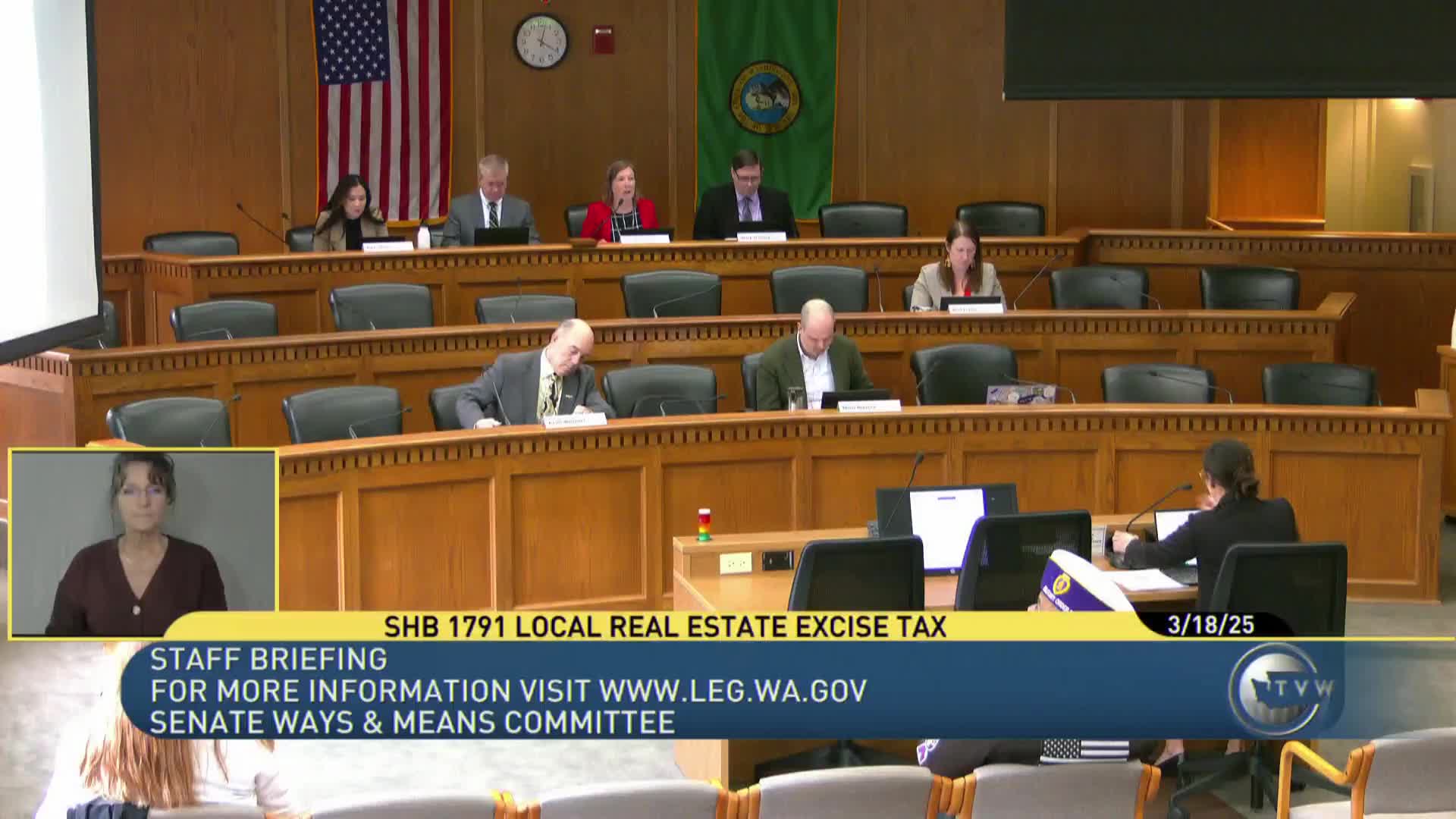
The Ways & Means Committee heard testimony March 18 on substitute House Bill 1791, which would broaden how cities and counties may spend local real estate excise tax (REET) revenues and create a permanent REET exemption for portions of affordable housing developments used for community purposes.
The Ways & Means Committee heard testimony March 18 on substitute House Bill 1791, which would broaden how cities and counties may spend local real estate excise tax (REET) revenues and create a permanent REET exemption for portions of affordable housing developments used for community purposes.
Alia Kennedy, staff to the committee, told members that the bill "removes" restrictions based on population and Growth Management Act planning and allows REET 1 revenues to be used for REET 2-eligible capital projects and vice versa. She said the bill also eliminates certain sunset dates and the $1 million cap on capital projects, and makes permanent a January 1, 2026, exemption for sales of affordable housing space used as community facilities such as health clinics, senior daycare, food banks or early learning centers.
Supporters from local government organizations and housing partners told the committee the bill would give jurisdictions more flexibility to fund and maintain facilities they already build. Paul Jewell of the Washington State Association of Counties said the proposal "creates a lot of flexibility" and praised restoring the ability to use a portion of REET for maintenance. Carl Schroeder of the Association of Washington Cities said the change "unties the hands of cities with revenues we're already collecting," noting that REET is not a tax increase but a change to spending authority. Brandi Clark of Washington Realtors said the bill keeps REET focused on capital uses and "doesn't become an operating budget source." Jennifer Gregersen, Government Affairs Director for the City of Everett, and other city officials said the flexibility would let communities prioritize urgent capital needs such as trails, public safety facilities, and affordable housing.
Kennedy summarized estimated impacts in the fiscal note, saying the REET exemption would reduce real estate excise tax revenue by about $30,000 in the upcoming biennium and $61,000 over four years; she also cited a one-time Department of Revenue administrative cost of $151,000 in 2025-27.
Committee members posed no substantive questions during the public testimony. Testifiers urged passage to allow cities and counties to share REET resources with regional housing consortia and to preserve funding for maintenance and operations of projects previously funded with REET.
If enacted, the bill would: allow any jurisdiction to use REET 1 for REET 2 capital projects (and vice versa); remove the 01/01/2026 sunset for REET 2 uses; permit local governments to use the greater of 35% or $100,000 of REET revenues for operation and maintenance; remove the $1,000,000 cap on capital projects; and establish a permanent REET exemption for portions of affordable housing developments used for community purposes.
Supporters stressed the measure does not raise REET rates but reallocates how existing local REET revenues may be spent. Opposition was not recorded during the public testimony portion.
The committee moved on after public testimony; no vote on HB 1791 was recorded in this hearing.