Get Full Government Meeting Transcripts, Videos, & Alerts Forever!
Get email alerts on the State Government Open Access topic
No spam. Unsubscribe anytime.
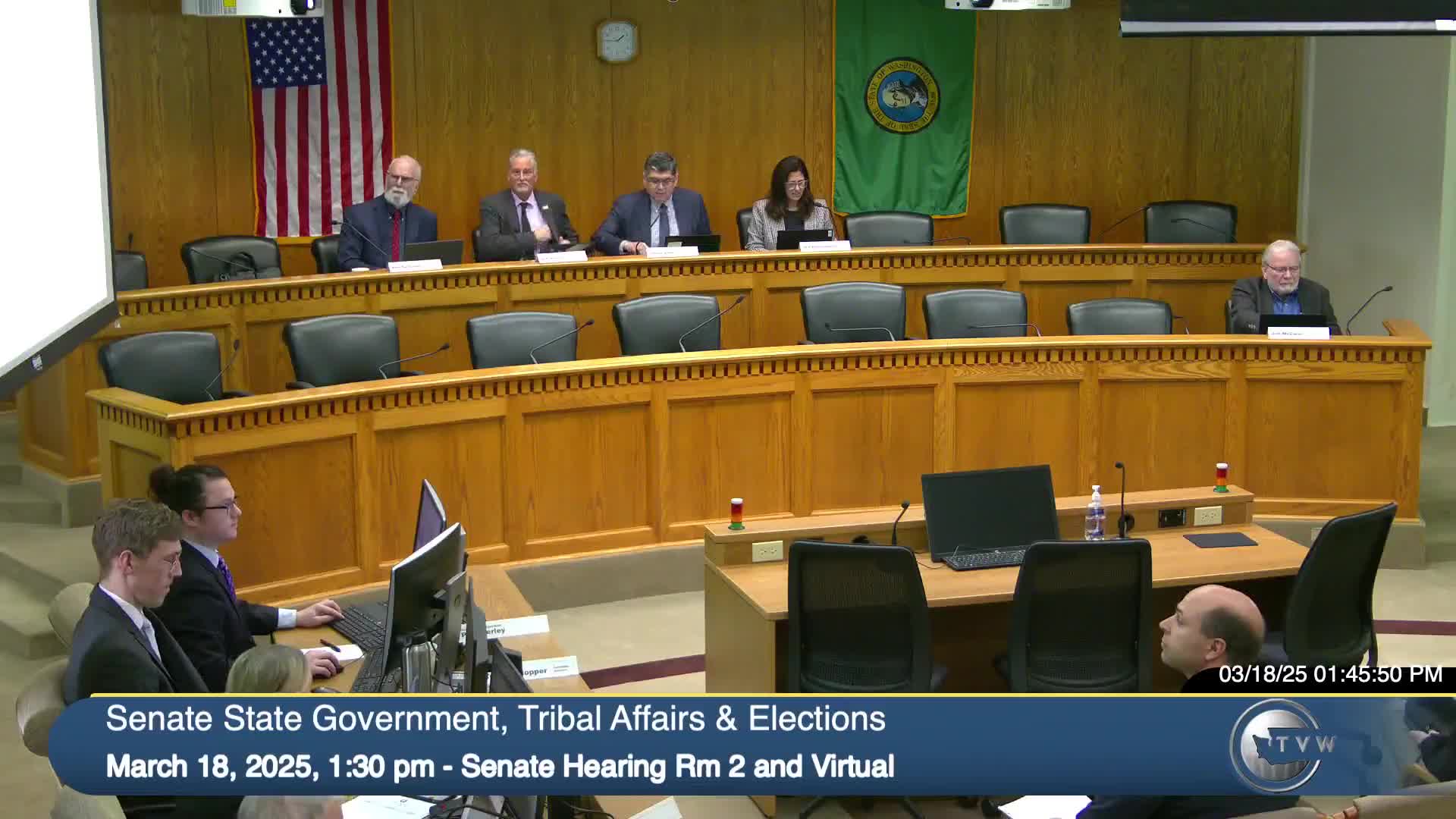
Committee hears bill directing WSIPP study on giving state employees electronic access to peer‑reviewed journals
Summary
The Senate committee heard substitute House Bill 1606 on March 18, directing the Washington State Institute for Public Policy to study ways to provide state employees electronic access to peer‑reviewed journals.
The Senate State Government, Tribal Affairs & Elections Committee heard substitute House Bill 1606 on March 18, a bill sponsored by Representative Andrew Engel requiring the Washington State Institute for Public Policy (WSIPP) to study mechanisms to provide state employees electronic access to peer‑reviewed journals.
Committee staff said the substitute differs from its Senate companion only in the study due date and the lack of an appropriation: under the House substitute the study must be completed by June 30, 2026, rather than Dec. 1, 2026, and there is no appropriation section in this version.
Representative Andrew Engel said the bill would explore cost-saving consortium models and other organizational arrangements that other states have used to gain access and reduce costs. "A number of other states have been able to find that getting various ways such as consortiums to get access to journals has saved money as well as making government more efficient," Engel said.
Researchers and agency staff urged the committee to approve a study. "Access to such journals and articles is imperative so commission members can learn what current research says and what other states are doing," said Carrie Anne Yetzer, coordinator for the Washington State Sentencing Guidelines Commission, explaining why the commission used appropriated funds in 2018 to obtain limited journal access for a previous review.
Testimony also came from natural-resource managers, Ag Forestry Leadership Program members and other state employees, who described practical barriers: many state staff must buy individual articles, rely on partner organizations to conduct literature searches, or travel to university libraries, costing hours of staff time. "Locating a single paper can consume hours of staff time, making it an inefficient and costly drain on state resources," Stacy Rasmussen said.
Supporters said a targeted study would identify a cost‑effective mechanism to broaden access while reducing duplicated purchases across agencies. The committee recorded 76 proponents and 0 opponents on the sign‑in sheet and closed the hearing on the substitute bill.