Get Full Government Meeting Transcripts, Videos, & Alerts Forever!
Get email alerts on the Weapons Restrictions Public Places topic
No spam. Unsubscribe anytime.
Committee hears broad bill to restrict weapons at parks, public buildings and county fairs; advocates split
Summary
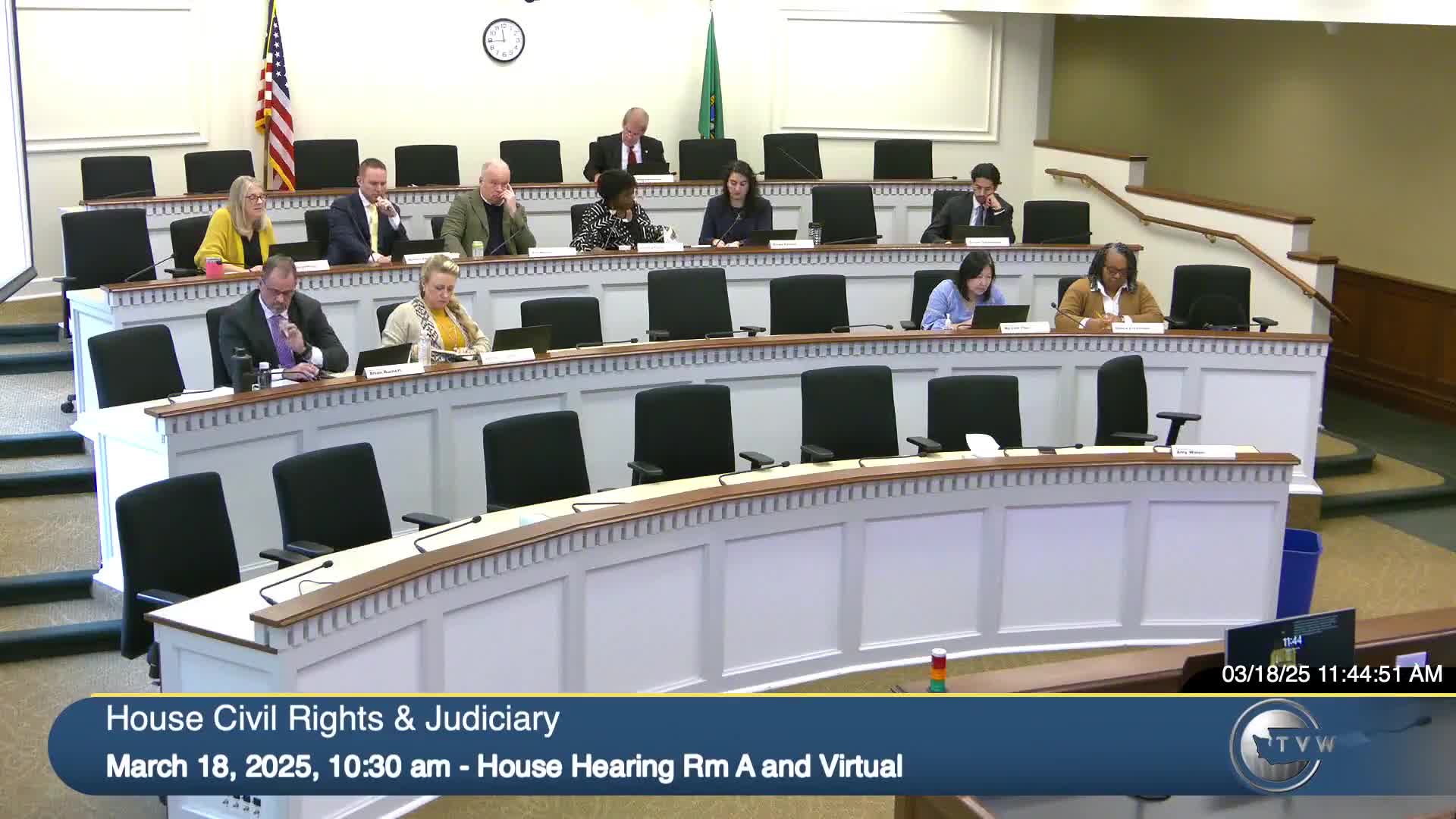
The Civil Rights & Judiciary Committee considered a bill to prohibit weapons in park facilities likely to be used by children, state and local public buildings, and county fairgrounds when open to the public.
The Civil Rights & Judiciary Committee considered engrossed second substitute Senate Bill 5,098, a proposal to prohibit entry with weapons into specified public places — including park facilities likely to be used by children, state and local public buildings, and county fairgrounds when open to the public.
John Brzezinski, staff to the committee, said park facilities covered by the prohibition would include playgrounds, sports fields, swim beaches and teen or community centers; local governments would be required to designate and post the perimeter of restricted areas. The bill would not apply to Washington State Department of Transportation properties used primarily by the traveling public, but would require firearms in such areas to remain locked in cases or in locked portions of vehicles. Brzezinski said the bill exempts qualifying law enforcement, military personnel, concealed‑carry licensees and other enumerated categories and would not apply to gun shows on county fairgrounds.
Sen. Javier Valdez, sponsor, described the proposal as an expansion of last year’s restrictions and cited a shooting at a county fair as impetus to extend prohibitions to fairgrounds and additional public buildings. “Wherever children are likely to be,” Valdez said, “is a North Star” for the policy.
Testimony split along predictable lines. Parents, educators, pediatricians, survivors and student speakers urged passage. Margaret Heldring of Grandmothers Against Gun Violence, a Portland mother and a pediatrician from Seattle Children’s cited increased risks and long‑term harm from firearm exposure. A number of students gave emotional testimony about feeling unsafe at school and in parks.
Local elected officials and school‑district representatives supported the bill’s public‑safety aims but asked for clarity and funding to implement posting requirements. Brian Buck of the Lake Washington School District said the 10‑year school‑planning timelines and multiple failed bond measures in his district illustrated the need for operational exceptions if property‑use timelines interact with the restricted‑area obligations.
Opponents included gun‑rights organizations, self‑defense instructors and some private citizens. Aveen Klein of the NRA urged the committee to oppose the bill, arguing empirical claims about gun‑free zones are flawed and that prohibitions would disarm law‑abiding citizens. The Washington State Association of Counties cautioned about implementation costs for signage and ordinance drafting and asked for state reimbursement or an appropriation. Public testimony included sharply divergent accounts from survivors of gun violence who said the bill would protect families and from individuals who said disarming lawful citizens would increase vulnerability.
Committee members asked detailed technical questions about weapon definitions and how specific knives would be treated under the unified definition proposed in the bill. Staff said the bill consolidates two current statutory definitions into a single definition that could cover items not listed explicitly if they fit the text.
Why it matters: The bill would expand areas where weapons are prohibited in public spaces across Washington and raises questions about implementation costs, signage, local‑ordinance work and constitutional challenges flagged by opponents.
What’s next: The hearing recorded extensive public comment both for and against the bill; staff and the sponsor will consider technical clarifications and follow‑up questions; no committee vote was taken at the hearing.