Get Full Government Meeting Transcripts, Videos, & Alerts Forever!
Get email alerts on the Habitat Restoration Wood And Materials topic
No spam. Unsubscribe anytime.
Committee hears bill to let DNR sell larger quantities of timber for habitat restoration
Summary
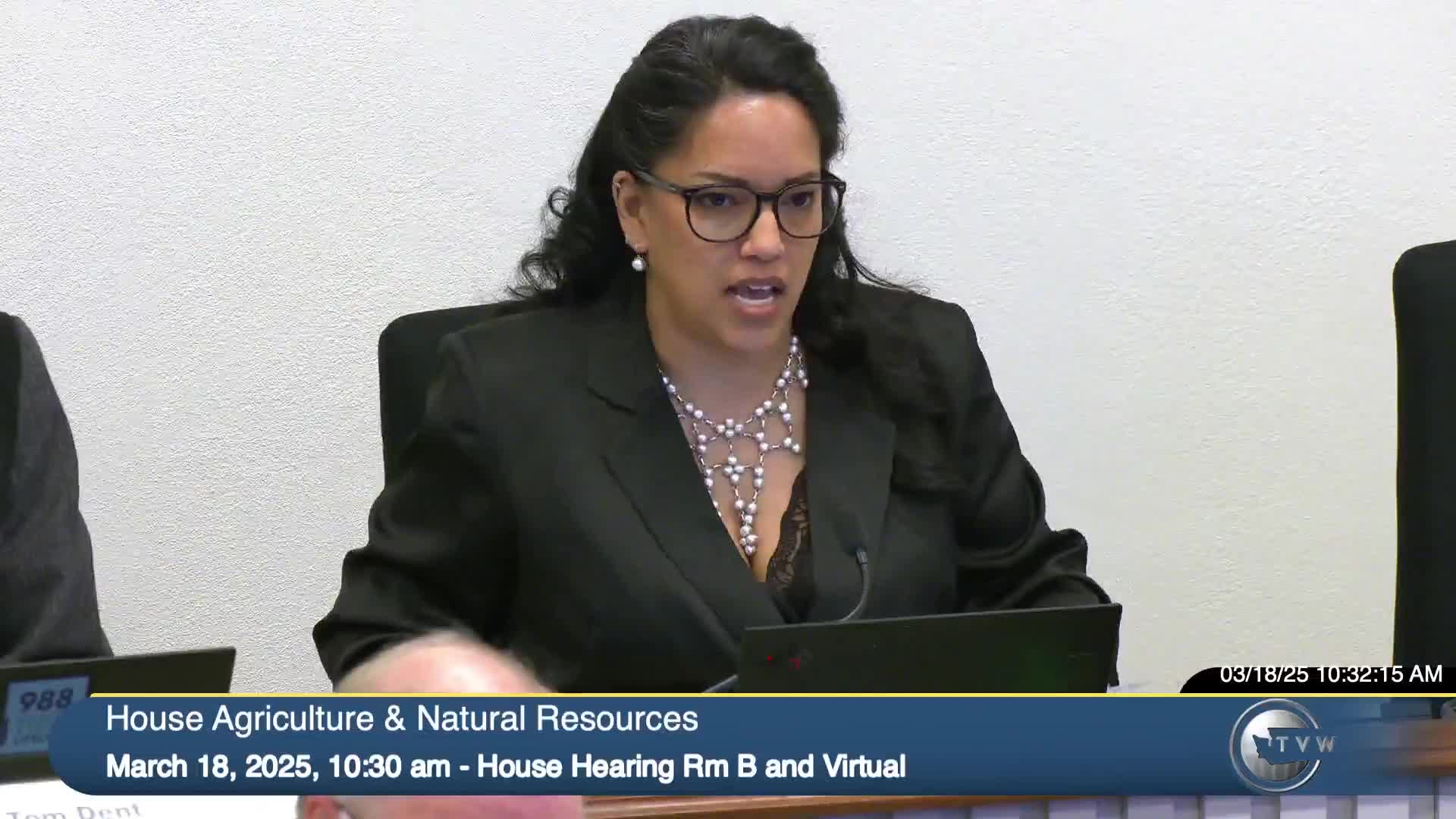
On Tuesday, March 18, the House Agriculture and Natural Resources Committee opened public testimony on Substitute Senate Bill 5157, which would let the Department of Natural Resources use direct sales for valuable materials from state lands up to $250,000 when the wood or other material is designated for habitat restoration projects.
On Tuesday, March 18, the House Agriculture and Natural Resources Committee opened public testimony on Substitute Senate Bill 5157, which would let the Department of Natural Resources use direct sales for valuable materials from state lands up to $250,000 when the wood or other material is designated for habitat restoration projects.
The measure’s supporters say raising the direct-sale threshold would let salmon-recovery projects obtain large trees and intact root wads on timelines that match grant-funded work; opponents and agency witnesses urged safeguards to protect trust beneficiaries and ensure accurate appraisals.
Sen. John Solomon, the bill’s sponsor, told the committee he saw restoration work in Southwest Washington where large trees with intact root wads had measurably improved salmon habitat. “A lot of our projects don't reach the potential that they could in terms of the impact of the investment because we can't source this large woody debris…a bid is the highest sellable amount. And so they don't sync up,” Solomon said, explaining the bill raises the existing $25,000 direct-sale limit to $250,000 for this purpose.
Lily Smith, committee staff, explained the current statutory framework: in addition to timber, DNR may sell other valuable resources from state lands, and for materials valued under $25,000 DNR may use a direct sale. The bill would allow direct sales up to $250,000 when the materials are to be used for habitat restoration and the department determines the sale is in the best interest of the state or the affected trust; the bill also includes conditions such as a prohibition on resale for other uses.
Duane Emmons, assistant deputy supervisor for State Uplands at DNR, said the department helped draft the bill and described how DNR would value whole trees with root wads. “We do look at it like any other timber sale. We’re going to look at the value of each of those logs…we're going to appraise the entire tree, the entire value,” Emmons said, noting appraisals consider residual value and costs to deliver material to a mill. Emmons also said much of the material used for restoration often comes from blowdown or road-construction work rather than from deliberate harvest of structurally complex stands.
Conservation and restoration groups told the committee they face practical barriers when projects must wait for competitive timber-sale processes. Scott Richards of The Nature Conservancy said his organization’s restoration plans on the Olympic Peninsula need larger-diameter wood that is “difficult to acquire” through auctions and that a higher direct-sale threshold would better match project timelines. Don Gourley of the Puget Sound Partnership and Lehi Kalmikita of Trout Unlimited described how large woody debris reduces downstream flooding, recharges groundwater, and creates salmon habitat; Gourley gave examples of projects that avoided helicoptering logs or highway transport costs by sourcing nearby material.
Industry witnesses supported the bill with conditions. Heath Heikle of the American Forest Resource Council said his members supply many high-value wood products and that it is important to value materials accurately for the trust beneficiaries; he noted ongoing litigation and a department pause on some timber sales and asked that safeguards prevent stockpiling or diversion of material from trust revenue streams.
Committee members pressed DNR on valuation method and potential scope. Representative Orcutt asked whether DNR’s appraisal treats a whole tree as the sum of millable logs and residuals; Emmons confirmed appraisals account for higher- and lower-quality logs and for costs to move material to market. Emmons said the total need for restoration wood likely exceeds what DNR can supply, and that when material is not needed for restoration it is traditionally sold to mills.
The committee recorded 37 pro and 1 con sign-ins for testimony on SB 5157. No final action or vote occurred; the committee suspended and later resumed hearings on the bill during the same session.
The bill’s sponsors, DNR staff, and conservation groups said they had negotiated language and that DNR supported the concept with clarifying provisions. DNR indicated it would refine appraisal and contract language and suggested adding a provision to prevent a private right of action in some related contexts.
If passed as drafted, the bill would not change the statute’s other limits and would restrict the $250,000 direct-sale allowance to materials used for habitat restoration projects and subject to appraisal and use conditions.
Committee staff said they would circulate amendments and that the committee would consider further adjustments before any markup.