Get Full Government Meeting Transcripts, Videos, & Alerts Forever!
Get email alerts on the Ado Funding Reporting topic
No spam. Unsubscribe anytime.
Committee hears ADO funding and reporting changes as rural leaders warn cuts would 'decimate' programs
Summary
Senate Bill 5677 would alter reporting requirements and change base and matched allocations for associate development organizations (ADOs); rural ADO leaders told the committee that proposed cuts to state ADO funding would sharply reduce local economic development capacity.
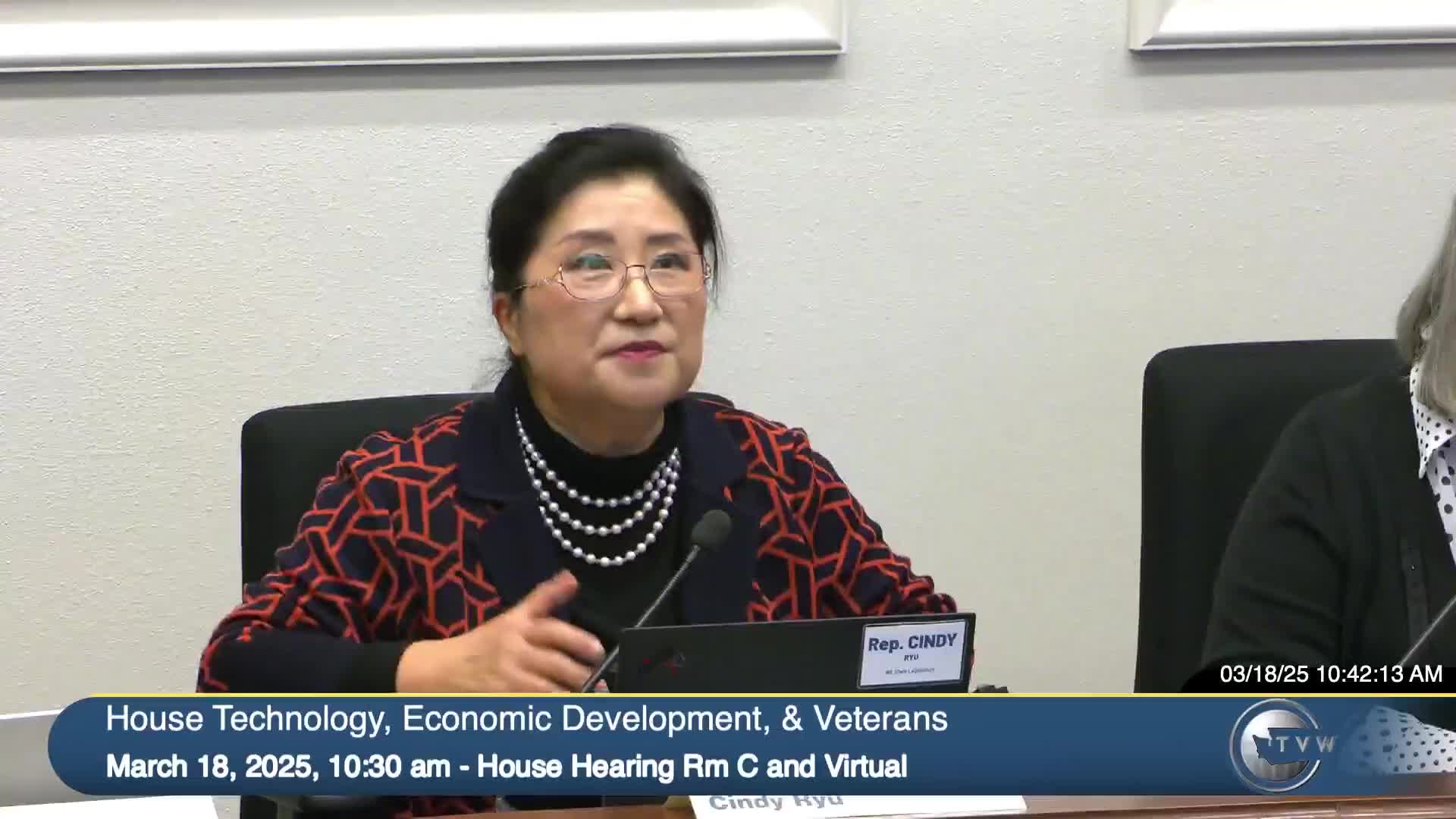
Senate staff told the Technology, Economic Development and Veterans Committee on March 18 that engrossed substitute Senate Bill 5677 would change reporting requirements for associate development organizations (ADOs) contracted by the Department of Commerce and adjust base and matched funding allocations.
Martha Whaling, committee staff, said the bill removes King County’s unique small-business reporting requirement, adds a requirement that all ADO annual reports include demographic information meeting federal race and ethnicity standards, and changes how Commerce awards base and matched allocations to ADOs. "An associate development association in a rural county receives a minimum of $85,000 and a maximum of $150,000 base allocation and a match and a matched allocation," Whaling said, noting the bill removes the previous 90¢ per capita formula for matched allocations.
For urban counties Whaling said the bill keeps a $500,000 base allocation and increases the maximum by $200,000; it also changes the matched allocation so the match is in addition to the base. The engrossed substitute allows matched allocation to be provided in cash or in kind (or a combination), but limits in-kind match to 25% of the local match.
ADO leaders testified at length about the impact of funding reductions and the scale of their work. Suzanne Dale Estee, Executive Director of the Washington Economic Development Association, told the committee the ADO network currently receives $5 million a year in operating funds and asked that funding be protected. She said the network needs additional resources to meet growing statutory expectations. Michael Cade, executive director of the Thurston Economic Development Council, said his ADO generates $22.50 in local economic activity for every $1 invested and warned that proposed cuts could remove roughly $2 million from Thurston County’s local economy.
Ronnie Holder Diefenbach, executive director of the Economic Alliance of Okanogan County, described Okanogan as a long-designated economically distressed and Frontier 1 county that relies on ADOs to help micro-enterprises and municipalities with business planning and infrastructure projects. He said the Department of Commerce now requires rigorous quarterly performance reporting and an online platform; ADOs have seen increased accountability without additional resources.
Lynette Buffington, chief of staff at the Seattle Metro Chamber (King County’s ADO), described statewide leverage ratios for the state dollars and asked that the committee adopt the staff draft amendment removing the additional King County reporting requirement. Whaling and sponsors discussed a staff-drafted amendment that would set floors for urban ADOs (a $300,000 floor per organization) and for rural counties (a $40,000 floor per county) but include a null-and-void clause so those funding floors only take effect if funded in the budget.
Committee members asked about the governor’s proposed cuts to economic development funding and whether conversations were underway to restore funding. ADO witnesses warned proposed cuts would roll the network back years and emphasized the leverage and return-on-investment ADOs deliver. The hearing closed without a committee vote; staff and sponsors said they would circulate amendment language and continue budget discussions.