Get Full Government Meeting Transcripts, Videos, & Alerts Forever!
Get email alerts on the Mobility Right To Repair topic
No spam. Unsubscribe anytime.
Committee Hears ‘Right to Repair’ Bill for Wheelchairs as Users, Providers Describe Long Delays
Summary
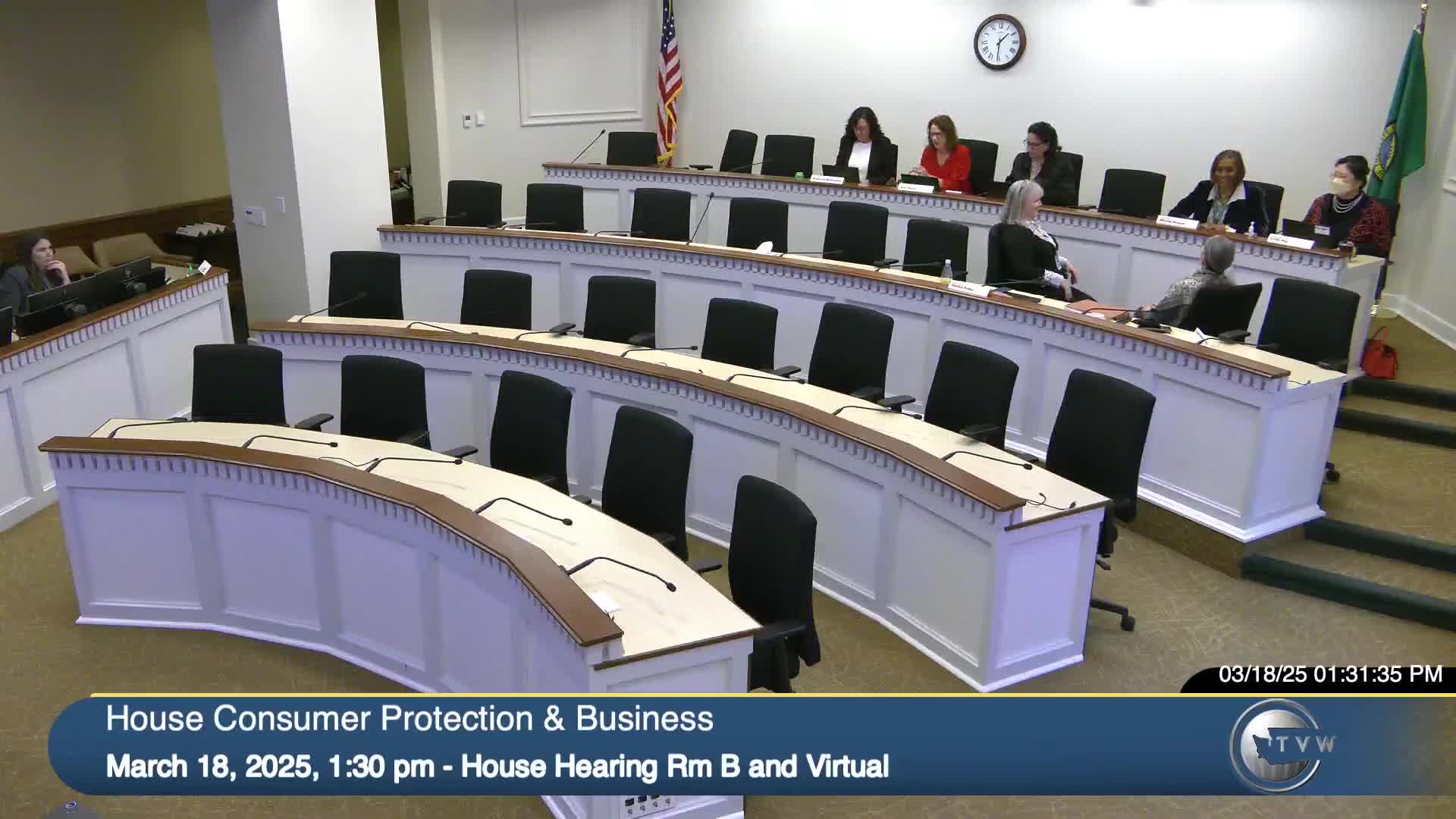
The Consumer Protection & Business Committee heard public testimony March 18 on Senate Bill 5680, which would require manufacturers to make parts, software and documentation available to independent repair providers and owners of mobility devices.
The Consumer Protection & Business Committee heard public testimony March 18 on Senate Bill 5680, a proposal that would require original equipment manufacturers to make parts, diagnostic tools, embedded software and documentation available on “fair and reasonable terms” to independent repair providers and owners of mobility devices, including power wheelchairs, manual wheelchairs, mobility scooters and power-assist devices.
Megan Mulvihill, staff to the committee, summarized the bill in the staff report and said it is the companion to House Bill 1826 and that the two bills contain no differences. “Senate Bill 5,680 requires an original equipment manufacturer to make available on fair and reasonable terms to any independent repair provider or owner of a mobility device any documentation, parts, embedded software, firmware, or tools that are intended for use with the mobility device or any part, including updates,” Mulvihill said.
The bill would also make it a per se violation of the Consumer Protection Act for covered parties to deny required access, with enforcement provided by the state Attorney General, Mulvihill said. The staff report listed several exceptions: manufacturers would not be required to sell parts no longer available, would not have to disclose trade secrets, and the bill would not alter agreements between manufacturers and authorized repair providers.
Why it matters: disability advocates, users and nonprofit providers told the committee that long repair waits can leave people unable to leave their homes, cause pressure sores and other health problems, and reduce employment and community access. Multiple witnesses described waits measured in weeks to months and urged the committee to expand repair options for people who rely on mobility equipment as an essential daily device.
Marsha Cutting, who testified in person, described being stranded when her wheelchair failed and said loaner equipment can be unsuitable. “When our chairs break down, we have none of those options,” Cutting said. “Unless we have a functioning backup chair, which is almost never covered by insurance, we are just stuck at home or in some cases, stuck in our beds.”
Matthew Clark, a wheelchair user who testified remotely, said he developed a pressure sore after waiting weeks for recommended positioning hardware. “I developed a pressure sore while I was waiting that I ended up having to be hospitalized,” Clark said. “That pressure sore is why I'm not able to testify in person today.”
Nonprofit providers and repair groups told the committee they already perform many repairs but lack manufacturer parts, diagnostic information and test tools that would allow safer, faster fixes. Jerry Rhodes, founder and CEO of a nonprofit that provides durable medical equipment, said his organization has repaired more than 2,500 electric wheelchairs over 28 years and that in the last year their branches repaired and issued more than 12,000 items of equipment; 210 of those were electric wheelchairs and scooters. “Obtaining detailed repair information will allow us to more closely assure our repairs meet OEM standard,” Rhodes said.
Advocacy groups and state panels also supported the bill. Elizabeth Gordon of the Governor’s Committee on Disability Issues and Employment noted that power chairs can cost more than $30,000 and are typically individually fitted. “When a wheelchair is broken, people cannot leave their homes or often even get out of bed independently,” Gordon said.
Several witnesses cited survey data describing widespread repair delays. Cecilia Black of Disability Rights Washington cited a 2022 U.S. Public Interest Research Group survey that found 62 percent of wheelchair users waited four or more weeks for repairs and 40 percent waited seven weeks or longer. Laura McCready, representing a state-based public-interest group, said a national survey of 141 wheelchair users found 93 percent needed servicing in the previous year and 68 percent waited four or more weeks, with some waiting more than six months.
Concerns from clinicians: clinicians and clinician groups who testified urged a narrow exception for the most complex chairs, which are individually prescribed and fitted by occupational and physical therapists together with assistive-technology professionals. Wayne Grau of the National Coalition for Assistive and Rehab Technologies said a “quarter of an inch adjustment can make a world of difference” for patients with traumatic brain injury, ALS, spinal-cord injury or similar conditions, and asked the committee to consider narrowly tailored exemptions or pre-repair clinical checks for specific seating components.
Supporters and several wheelchair users countered that most repairs are to propulsion and control components — motors, batteries, casters and joysticks — and that most users and experienced independent shops could safely perform or contract for those repairs if given access to parts and documentation. “There’s a shortage of available repair providers,” Laura McCready said. “It ought to be your choice what to do with your own chair.”
Committee response and status: committee members asked about exceptions for users with loss of sensation and about whether clinical involvement would create additional co-pays or delay repairs. Witnesses said the policy work is ongoing; advocates said they are drafting language to preserve necessary clinical safeguards while widening repair access.
The committee suspended the public hearing after testimony; no committee vote on the bill was taken during this meeting.
Ending: supporters said they will continue negotiations to refine clinical exceptions and liability language; committee staff and witnesses asked interested parties to submit written testimony and proposed amendment language for the record.