Get Full Government Meeting Transcripts, Videos, & Alerts Forever!
Get email alerts on the Animal Welfare Traveling Acts topic
No spam. Unsubscribe anytime.
Committee hears bill to ban traveling performances by elephants, big cats, primates and bears
Summary
Senate Bill 5065 would prohibit the use of elephants, nonhuman primates, non-domestic felines and bears in traveling animal acts and make violations a gross misdemeanor; proponents cited animal welfare and public-safety risks, opponents raised concerns about impacts on small educational outreach programs and local preemption.
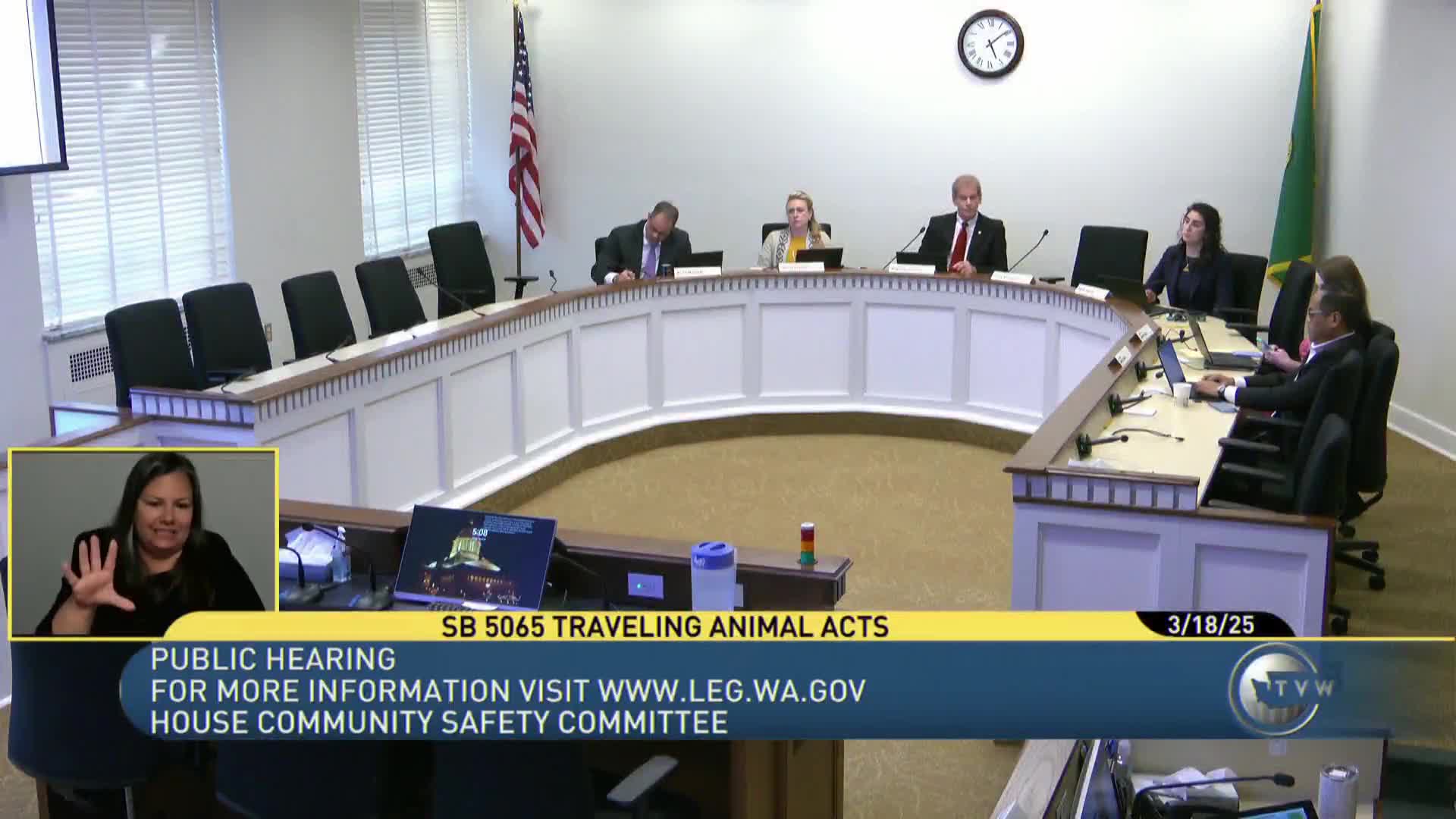
The House Community Safety Committee took public testimony on Engrossed Senate Bill 5065 on March 18, a bill that would prohibit certain animals from participating in traveling animal acts in Washington. The bill defines a traveling animal act as a performance in which animals are transported to, from or between locations for exhibition and identifies four categories of animals covered by the ban: elephants, nonhuman primates, felines excluding domestic cats (commonly "big cats"), and bears. Violations would constitute a gross misdemeanor under the bill as drafted.
Committee staff explained the bill in the context of existing federal and state law, including the Federal Animal Welfare Act (USDA/APHIS) and the 2007 Washington statute that already restricts possession or breeding of potentially dangerous wild animals and permits local jurisdictions to adopt more restrictive ordinances. Staff clarified that birds and reptiles are not included in this bill and said the bill would not apply to non-mobile licensed, fixed institutions (for example, a permanent zoo facility licensed by USDA).
Proponents described travel-based exhibitions as inherently harmful to wild animals and said the animals’ confinement, transport and forced performances cause psychological and physical harm and risk public safety. Cat Kelly of the Animal Legal Defense Fund said traveling circuses subject wild animals to long confinement, painful training, and temperature extremes in transport. “SB 50 65 will protect animals from abuse and neglect,” Kelly said. Wendy Linton described a series of domestic and international incidents in which animals escaped or attacked handlers and urged the committee to prioritize public safety. Multiple witnesses cited Viola, an elephant that has escaped handlers multiple times and was involved in high-profile incidents, as an example of behavioral stress and public-safety risk.
Supporters included local grassroots groups and municipal officials who said several Washington cities have already restricted traveling wild-animal acts; some proponents said there is growing national and international momentum away from live-animal circuses. Animal Defenders International and local nonprofit advocates testified that traveling shows cannot provide adequate space, social enrichment or proper transport for large wild animals and documented USDA violations by some traveling exhibitors.
Opponents included small animal-education and outreach providers who said the bill’s name and section 5 language could lead some local governments to adopt broader restrictions that would affect small, licensed educational programs that bring domestic or small exotic animals to libraries and schools. Kim Connolly and Debbie Goodrich, who run licensed outreach programs and parrot rescue/education organizations, said their programs use small, non-covered species to provide educational services in schools and libraries and raised concerns about inconsistent local ordinances creating a compliance burden.
Committee staff noted that the 2007 statute (RCW 16.30.050) already allows local jurisdictions to adopt ordinances that are more restrictive. Several committee members asked technical questions about which species are covered and what happens to animals if the ban passes; witnesses suggested sanctuaries or licensed permanent facilities would be appropriate placements. The committee scheduled that bill for further consideration in an executive session the following week.
No committee vote was recorded at the March 18 hearing.