Get Full Government Meeting Transcripts, Videos, & Alerts Forever!
Get email alerts on the Traffic Safety topic
No spam. Unsubscribe anytime.
Hearing on bill to expand reckless driving to include 30 mph over posted speed limit
Summary
Senate Bill 5238 would expand reckless driving to include intentionally driving more than 30 mph above the posted limit. Committee members and prosecutors debated whether to require an intent element and whether 30 mph is the correct threshold.
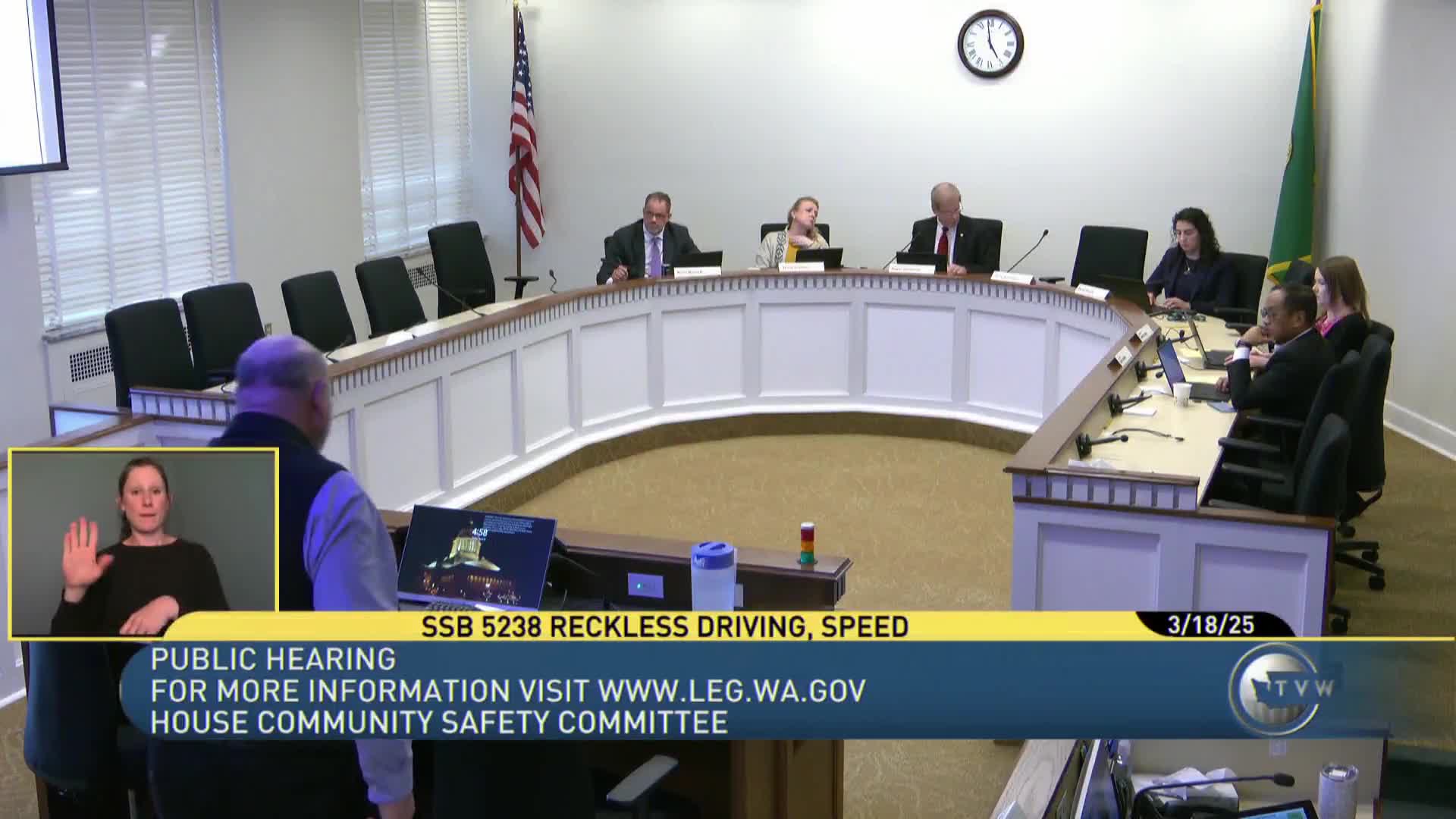
The committee heard Substitute Senate Bill 5238 on March 18, which would expand the criminal offense of reckless driving to cover instances where a person “intentionally” drives more than 30 miles per hour over the posted speed limit. Staff explained the current reckless driving statute is a gross misdemeanor punishable by up to 364 days in jail, a fine up to $5,000, and a minimum 30-day driver's license suspension by the Department of Licensing for a conviction.
Sponsor Sen. Ron Mazzall (as identified in committee remarks) told the committee the bill aims to make a clear statutory standard for particularly dangerous speeding, saying the 30-mph threshold was chosen because it represents a level that risks the safety of others on highways and local roads. The sponsor described repeated speeding incidents on state highways and said the change would allow law enforcement to charge reckless driving rather than only a speeding ticket in high-risk cases.
Amy Friedheim, senior deputy prosecuting attorney and chair of King County’s felony traffic unit, urged removing the word “intentionally” from the draft. “You need to remove the word intentional because ... no prosecutor is ever going to charge under that prong,” she said, arguing that the mental-state term would make prosecutions harder to prove and that a strict-liability approach (no intent element) would be more enforceable. Friedheim also recommended lowering the threshold to 20 mph over the limit and said any change would be more effective if paired with technology (speed-limiter devices) discussed in related legislation.
Committee members and the sponsor discussed whether “intentionally” is the appropriate mental-state element and whether 30 mph is the correct policy line. No committee vote occurred; the hearing gathered staff presentation, sponsor remarks, and testimony from a prosecutor and supporters of stricter speeding enforcement.
No action or amendments were recorded at the March 18 hearing.