Get Full Government Meeting Transcripts, Videos, & Alerts Forever!
Get email alerts on the Corrections Reentry topic
No spam. Unsubscribe anytime.
Committee weighs changes to partial confinement: more time, expanded parenting eligibility, and SUD screening
Summary
Senate Bill 5219 would align partial confinement programs (work release, graduated reentry, community parenting alternative), extend maximum participation to 18 months in many pathways, expand parenting eligibility, and require clinically appropriate substance use disorder evaluations before transfers to partial confinement.
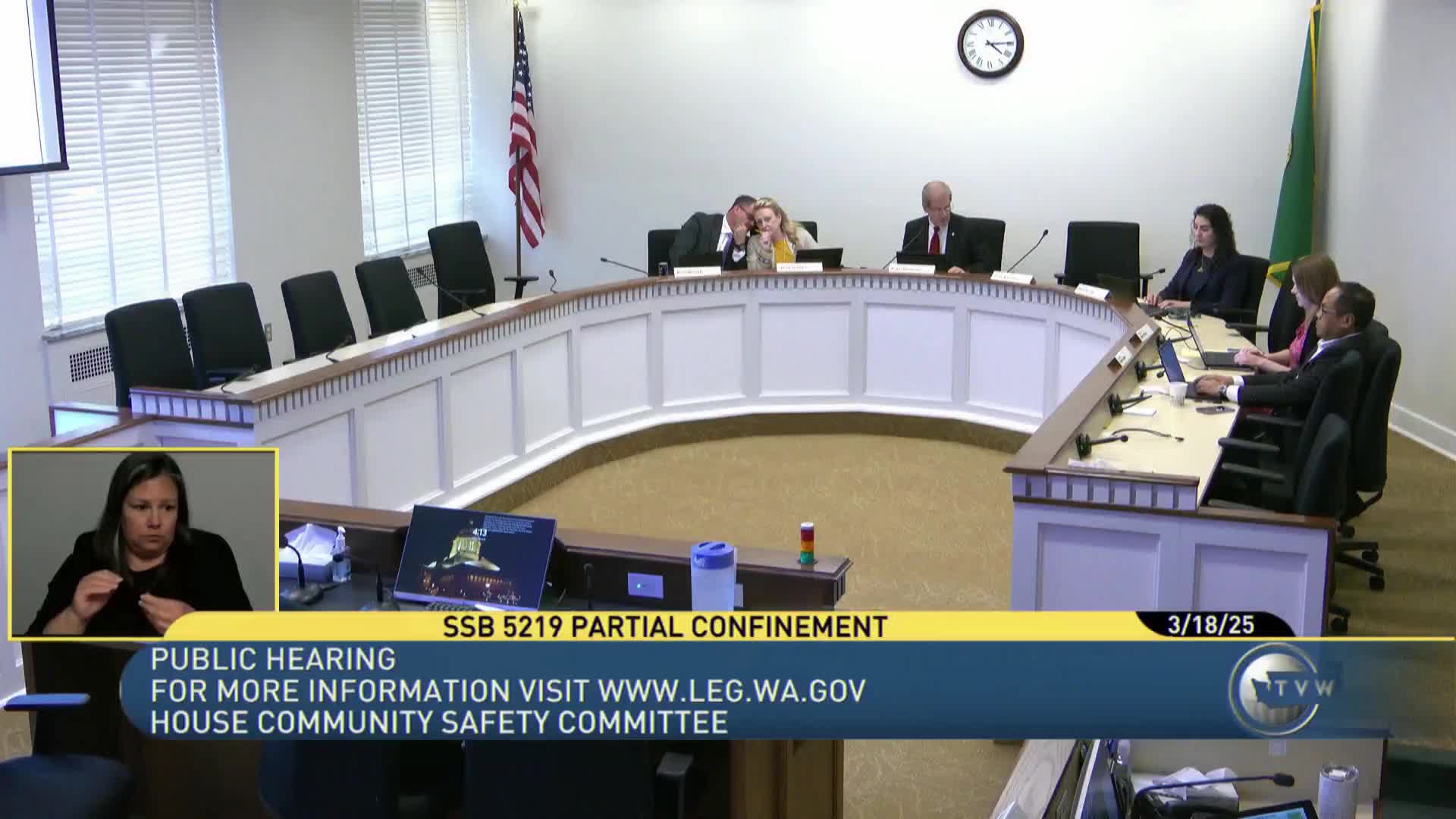
The House Community Safety Committee heard Engrossed Substitute Senate Bill 5219 on March 18. The bill, an agency-request measure, proposes several changes to Department of Corrections (DOC) partial confinement programs — work release, graduated reentry (GRE), and the Community Parenting Alternative (CPA) — including aligning participation windows to allow eligible people to participate up to the final 18 months of their term of confinement and adding clinically appropriate substance use disorder (SUD) evaluation requirements before transfer.
Committee staff Lena Langer provided a detailed overview of the partial confinement programs and the bill’s four main changes: extending maximum participation from 12 to 18 months for work release and CPA in some cases; expanding CPA eligibility to include caregivers expected to assume day-to-day care of a minor child; permitting DOC to rely on “clinically appropriate evaluations” for SUD (rather than a comprehensive SUD assessment) and ensuring access to medication-assisted treatment and counseling when clinically indicated; and modifying GRE eligibility minimum confinement periods (track 1 maximum GRE participation increases from 5 to 9 months; track 2 minimum total confinement reduced from 4 to 3 months for eligibility to serve up to 18 months).
Sponsor Sen. Claire Wilson framed the bill as aligning timelines so incarcerated people can select the partial confinement pathway that best meets their needs rather than a pathway that simply gives the shortest route to release. “When I was talking to the individuals at WCCW, what I was finding is people were choosing not the path that was necessarily best for them or met their needs, but perhaps the one that gave them the shortest route out,” Wilson said.
The Department of Corrections testified in support. Carrie Stanley, reentry center administrator, said aligning programs would “allow individuals to be empowered to pursue the pathway that best aligns with their personal needs and reentry goals.” Megan Prairie, DOC director of person-centered services and a person with lived experience, endorsed the bill and described the programs as “safe, structured, and supported transitions” that reduce recidivism when used in sequence (total confinement → reentry center → graduated reentry).
Several law-enforcement and prosecution organizations testified with concerns or opposition. James McMahon, policy director for the Association of Sheriffs and Police Chiefs, opposed the bill, arguing the measure effectively extends the time some people spend in the community before sentence expiration and noted a lack of statutory incentives or required achievements tied to transfer eligibility. Russell Brown, executive director of the Washington Association of Prosecuting Attorneys, also expressed concern about earlier release timelines and raised particular worry about expanding CPA eligibility to people who were not connected to a child at the time of the offense but are expected to become caregivers.
DOC representatives described screening and risk assessment processes that apply before transfers. Megan Prairie and Carrie Stanley explained DOC uses custody classification and evidence-based risk/needs assessment (referred to in testimony as the Washington 1 instrument) to determine minimum security status and risk level; DOC may return individuals to total confinement through established hearing procedures if suitability or eligibility changes.
Public testimony included people with lived experience and recovery advocates who supported the bill, saying more time in structured partial confinement with access to treatment supports can improve reentry outcomes. Opponents, including narcotics investigators, expressed concern about DOC capacity for real-time monitoring and potential public safety implications if monitoring resources are insufficient.
No formal committee vote was recorded at the March 18 hearing; the measure was discussed and received public testimony.