Get Full Government Meeting Transcripts, Videos, & Alerts Forever!
Get email alerts on the Public Safety Police Funding topic
No spam. Unsubscribe anytime.
Committee hears bill to codify police partnership funding for state psychiatric hospitals
Summary
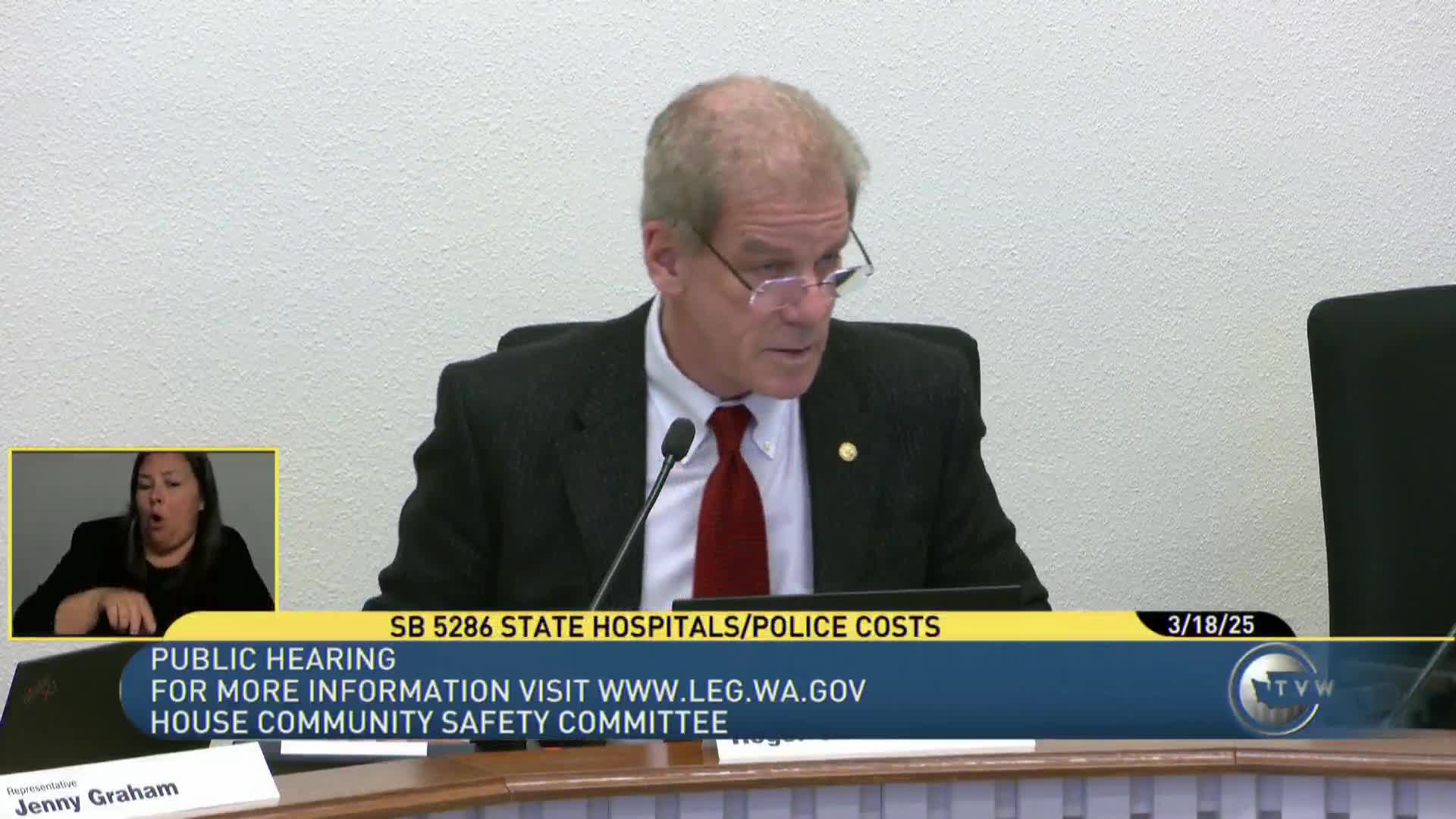
The House Community Safety Committee held a hearing on Senate Bill 5286, which would statutorily recognize and fund community policing partnerships between DSHS and the cities that host Western State and Eastern State hospitals and require annual reporting on use of funds and calls for service.
The House Community Safety Committee on March 18 heard testimony on Senate Bill 5286, a bill that would formalize state support for community policing partnerships at and near the two state psychiatric hospitals operated by the Department of Social and Health Services (DSHS). The measure would require DSHS to provide annual funding to the cities that host Western State Hospital (Lakewood) and Eastern State Hospital (Medical Lake) in amounts determined in the biennial budget and to collect and report data on funds used and calls for service.
Corey Patton, committee staff, summarized the bill and the background budget appropriations, noting the 2023–25 operating budget included line items for policing support tied to the hospitals. Patton said the 2023–25 budget included $311,000 per fiscal year for the community partnership program at Western State plus an additional $45,000 per fiscal year for related police services, and $311,000 per fiscal year plus $25,000 for Eastern State and Medical Lake policing services.
Sen. Jeff Hawley, sponsor, described the bill as a way to move the current biennial provisos into statute so the cities “don’t have to chase the money” and to formalize metrics that align funding with service levels. He described the measure as creating a stable funding model and putting metrics in place to avoid under- or over-funding.
Lakewood Police Captain Chris Westby testified in support and described the city’s long-standing community policing program at Western State Hospital. “We established a community policing program, which has led to a 40% reduction in calls for service at Western State Hospital,” Westby said. He said the dedicated officers provide response, reports and investigative services beyond basic patrol and help hospital staff by offering a direct point of contact rather than routing requests through 911.
Terry Cooper, mayor of Medical Lake, and Sunny Weathers, Medical Lake city administrator, also testified in support. Cooper told the committee Medical Lake is a small city of about 5,000 and that roughly 25% of the city’s calls are to Eastern State Hospital; he said the past proviso funding “has really helped us a lot” and that statutory assurance would let the city plan its community policing model with more certainty.
Committee staff and proponents emphasized the bill does not itself appropriate the dollar amounts but requires DSHS to provide funding in amounts set in subsequent budgets and to report annually by Dec. 1 on use of funds and calls for service. The bill also directs that aggregate amounts should fairly reflect relative hospital size and community needs and be in addition to appropriations for police services.
No formal action or vote occurred at the March 18 hearing; the item was presented for committee consideration and public testimony only.
Outlook: If advanced, the bill would direct future budget writers to include line items supporting community partnership policing at the two state hospitals and would require DSHS reporting intended to improve transparency about what the funds pay for and how frequently police respond to hospital-related calls.