Get Full Government Meeting Transcripts, Videos, & Alerts Forever!
Get email alerts on the Foreclosure Mediation topic
No spam. Unsubscribe anytime.
Committee hears bill to expand foreclosure mediation to condo/HOA liens and create $80 mortgage fee
Summary
The House Housing Committee heard Senate Bill 5,686 on March 18, 2025, which would expand Washington’s foreclosure mediation program to include association lien foreclosures for common‑interest communities and create an $80 foreclosure prevention fee on most mortgage originations to fund the program.
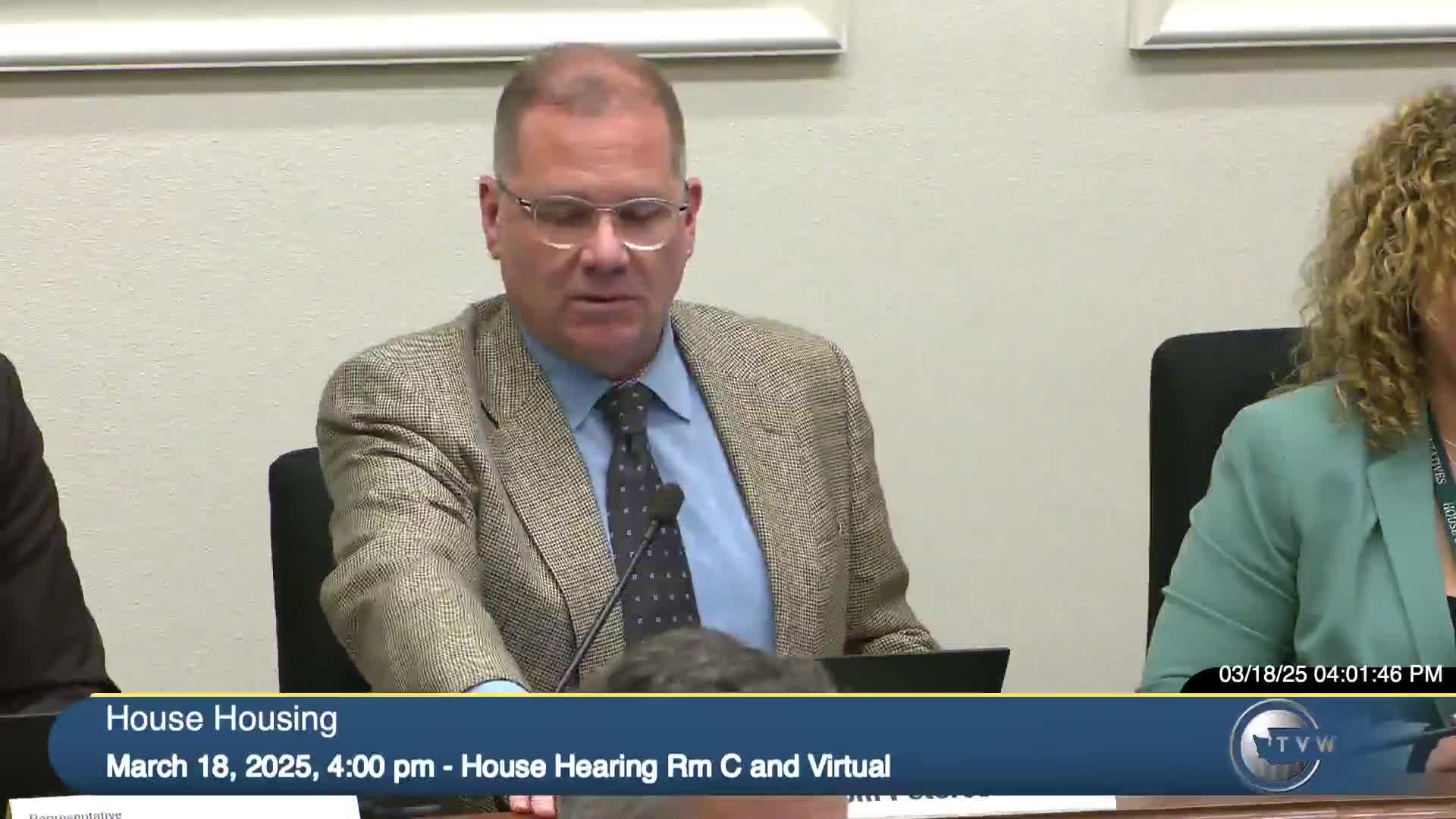
The Washington House Housing Committee on March 18 heard testimony on Senate Bill 5,686, which would expand the state’s foreclosure mediation program to include unit owners in common‑interest communities facing foreclosure on association liens and create a new $80 foreclosure prevention fee on most residential mortgage originations to fund the program. Audrey Vaisik, staff to the committee, described the bill and its funding mechanism during the hearing.
The bill would add unit owners of condominiums and other common‑interest communities to the mediation framework established under the deeds of trust statute and the state’s Foreclosure Fairness Act. The expansion would take effect Jan. 1, 2026, according to committee staff. The proposed $80 fee would be remitted at closing by the escrow or settlement agent; reverse mortgages for borrowers over age 61 would be exempt. The Department of Commerce would report annually on fee remittances, and the bill would require an online common‑interest community resource center.
Supporters told the committee the program provides critical legal and counseling services that help people avoid losing homes and that sustainable funding is needed as federal and other temporary sources wind down. Denise Rodriguez, executive director of the Washington Homeownership Resource Center, said her agency’s statewide foreclosure prevention hotline served 12,000 homeowners in 2024 and warned that without funding from SB 5,686 “we risk losing this critical safety net and stranding about 9,000 homeowners” who would otherwise reach the hotline. Mark Cote, executive director of Parkview Services, said 82% of distressed homeowners who receive housing counseling remain in their homes or sell and realize equity an average of five years later.
Several legal‑aid and consumer‑protection organizations urged passage. Tom McKay, managing attorney of the Northwest Justice Project’s foreclosure prevention unit, said Northwest Justice Project has opened more than 9,300 foreclosure‑related cases since 2010 and estimated the organization has preserved about $138,000,000 in homeowner equity; he said NJP would need the bill’s funding to continue foreclosure prevention work beyond July. Steve Horvath of Homeowners of America United submitted data from the Department of Commerce showing 822 HAF grants to condo and HOA owners over the past three years totaling more than $5,000,000, and said attorney fees and assessments are often a large share of the amounts owed.
Stakeholders also flagged issues still under discussion. Bennett Taylor of the Washington State Chapter of the Community Association Institute (WSCAI) said WSCAI opposes provisions in the most recent draft that would limit associations’ ability to charge delinquent owners for legal fees tied to meet‑and‑confer and mediation; he argued shifting those costs to other owners would be unfair. Raylene Schifano, a volunteer with HOA United who used the program to avoid a sheriff’s sale, recommended defining “reasonable” attorney fees and asked for better reporting to understand causes of HOA sales. Representative Dufeau raised a question about how the fee allocation would affect housing counseling: she noted the draft had reduced the share for housing counseling from 69% to 50% and asked whether that could be increased; Senator Orwell said she had “bumped it up” from an earlier proposal but left it below the original level to fund other needs tied to HOA mediation.
Committee members also discussed where the fee would be collected and who would pay it. Representative Connors asked for clarification that the $80 fee would be charged at origination, so a buyer at closing would pay it; the sponsor and staff confirmed that the new fee is remitted at closing to create funding that is available earlier in the homeowner’s lifecycle. Representative Jacobson asked whether refinance transactions would trigger the fee; staff confirmed the bill includes an exception for reverse mortgages but not a blanket exclusion for refinancings. Representative Kamala suggested an amendment to require clear notice to homebuyers at closing about the program; the sponsor expressed support for an amendment addressing homeowner notice and education.
No committee vote was taken at the March 18 hearing; the bill remained under consideration and multiple stakeholders asked for further refinements on attorney‑fee language, reporting, and outreach plans.
Ending: The hearing record includes a range of stakeholders—including housing counselors, legal‑aid attorneys, consumer‑protection officials, community association representatives, and homeowner advocates—who generally supported the bill’s intent to preserve homes while asking for clarifications on cost allocation and procedural safeguards. The committee suspended the hearing with staff and the sponsor indicating follow‑up work on draft language and possible amendments.